
Blog
Set and Setting: A Harm-Reduction Guide to Safer Trips


Set and setting means your mindset (set) and your physical, social, and cultural environment (setting) together determine whether a psychedelic experience is beneficial or harmful. Get either one wrong and even a moderate dose can turn frightening. Get both right and you dramatically improve your odds of a safe, meaningful session.
Before any session, three things matter more than the substance itself: screen yourself or the person you’re sitting for, secure a calm and private environment, and have a sober, capable person present who knows what to do if things go sideways. A systematic review of clinical trials confirms that participant screening, environmental management, and monitor presence are the components researchers consistently flag as essential, even though they’re not always reported consistently.
- Screen for psychiatric history, medications, and mental state before dosing.
- Prepare a private, comfortable, hazard-free physical space.
- Arrange a sober sitter or guide who is briefed on your intentions and limits.
Pro Tip: Agree on a “trip killer” protocol before you start, not during. Decide in advance what substance or intervention you’ll use if distress becomes unmanageable, who administers it, and at what threshold. Deciding this mid-session, when judgment is already altered, is how simple problems become emergencies.
Key Takeaways
Set and setting together determine psychedelic outcomes more reliably than dose alone, and deliberate preparation of both is the strongest safety intervention available to you.
| Point | Details |
|---|---|
| Definitions matter | “Set” is your internal mindset; “setting” is your physical, social, and cultural environment. |
| Screening comes first | Assess medications, psychiatric history, and current mood before any session, not during. |
| Consensus is forming | The 2025 ReSPCT Delphi identified 30 setting variables experts agree deserve standard reporting. |
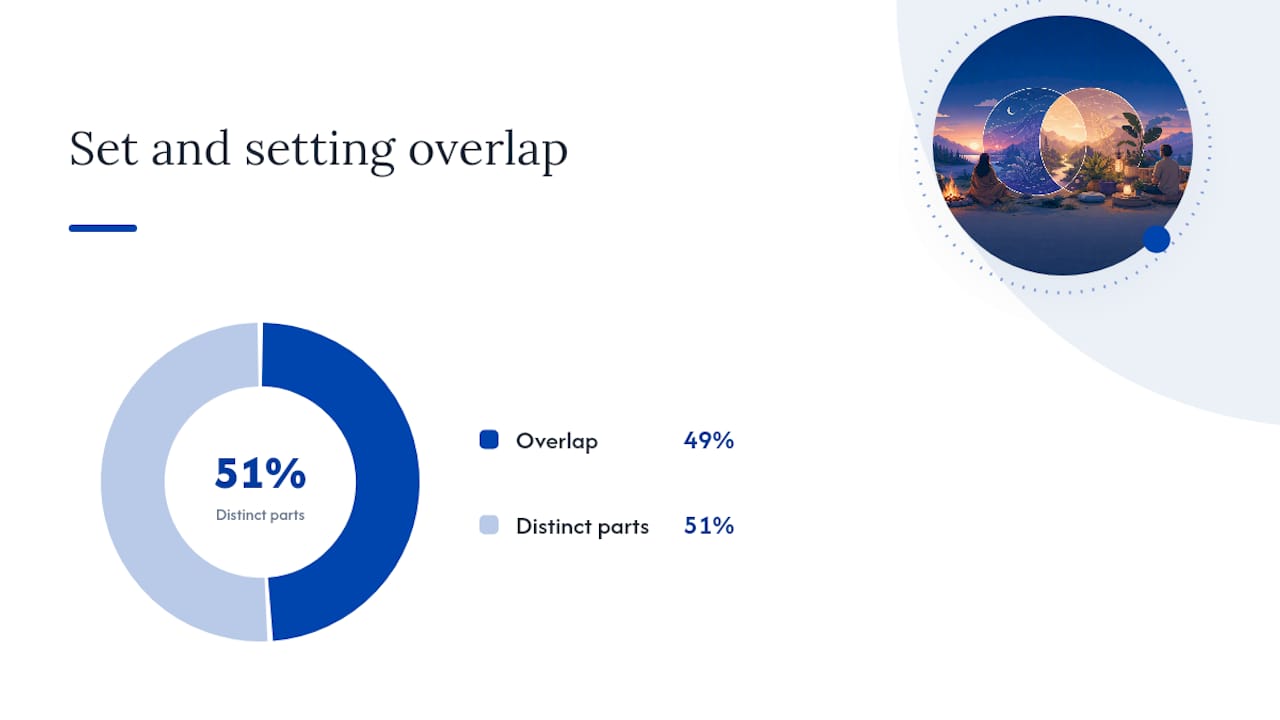
| Overlap is real | Experts estimate roughly 49 percent conceptual overlap between set and setting, so plan both together. |
| Integration extends the benefit | Journaling, professional support, and concrete behavior changes convert insight into lasting change. |
Ready to apply these principles with a product you can trust? Explore lab-tested mushroom strains chosen for therapeutic use and pair careful sourcing with the preparation steps above for the safest possible experience.
Table of Contents
- What Is Set and Setting, Exactly?
- Where Did the Term “Set and Setting” Come From?
- What Does the Research Actually Show?
- How Should You Prepare Your Mindset Before a Session?
- How Do You Design a Safe Physical and Social Setting?
- How Does Set and Setting Differ Across Therapeutic, Ritual, and Recreational Use?
- What Should Your Pre-Session Checklist Look Like?
- What Should Happen During the Session Itself?
- How Do You Integrate the Experience Afterward?
- What Mistakes and Red Flags Should You Watch For?
- What Questions Are Researchers Still Trying to Answer?
- A Practical Note From Someone Who Has Watched This Field Evolve
- Frequently Asked Questions
- Sources
What Is Set and Setting, Exactly?
“Set” refers to everything you bring into the experience internally. That includes your mood going in, your expectations about what will happen, your personality traits, your intentions for the session, and any recent life stress or trauma that might surface. Someone grieving a loss, going through a divorce, or nursing untreated anxiety carries a very different “set” than someone who is rested, curious, and emotionally stable. According to the conventional definition popularized through decades of psychedelic research, set is the psychological frame the substance acts on, not a passive backdrop.
“Setting” covers the external world during the experience: the physical room, who else is present, the music playing, the lighting, and the broader cultural context in which the session takes place. A sterile hospital room communicates something different to your nervous system than a softly lit living room with familiar objects around you.
- Set includes mood, expectations, intentions, personality, screening history, and recent stressors.
- Setting includes physical space, social company, sensory design, and cultural framing.
- The boundary between them blurs constantly. A loud, chaotic setting can generate anxious expectations before the substance even takes effect.
These two forces don’t operate in separate lanes. They interact continuously across three phases: preparation, the session itself, and integration afterward.
Experts who study this field don’t even fully agree on where set ends and setting begins. When surveyed for the ReSPCT Delphi consensus, researchers estimated the conceptual overlap between the two terms at roughly 49 percent on average. That’s not a footnote. It means even the people writing clinical guidelines treat this as a blended, not binary, concept.
Where Did the Term “Set and Setting” Come From?
The phrase entered common use in the 1960s, largely through psychologist Timothy Leary and his collaborators at Harvard, who observed that identical doses of the same substance produced wildly different outcomes depending on who took it and where. Al Hubbard, an early and unconventional figure in psychedelic research, independently emphasized environmental design decades before it became standard clinical language, favoring natural settings and careful preparation for his subjects. The concept was later formalized in Norman Zinberg’s 1984 book Drug, Set, and Setting, which remains a foundational reference in addiction and harm-reduction literature.
- Timothy Leary and Harvard-era researchers popularized the terminology in the 1960s.
- Al Hubbard’s early sessions emphasized deliberate environmental design before the term was widely used.
- Norman Zinberg’s Drug, Set, and Setting gave the concept its lasting academic framework.
- Indigenous and shamanic traditions used structured ritual, music, and communal roles long before Western researchers named the phenomenon, a continuity documented in evolutionary analyses of psychedelic ritual.
The idea persisted because it kept proving true in practice. Every generation of researchers who tried to isolate the pharmacological effect of psilocybin or LSD from context found that context refused to stay separate. That stubborn fact is why modern clinical trials now build screening, room design, and therapist presence directly into their protocols instead of treating them as background detail.
What Does the Research Actually Show?
The evidence for set and setting isn’t anecdotal folklore passed down from festival culture. It’s increasingly formalized in clinical research, and the biggest recent development is a 2025 international consensus effort that tried to pin down exactly which environmental variables matter enough to report.
A systematic review of setting components across clinical trials found that researchers consistently track four things: how participants are selected and screened, how the physical environment is managed, whether a trained monitor or guide is present, and what post-session support looks like. The problem is that reporting on these variables remains inconsistent from study to study, which makes it hard to compare outcomes across trials or build firm clinical recommendations. One team’s “comfortable room” might mean a hospital suite with art on the walls; another’s might mean an unremarkable exam room with a couch.
That inconsistency is exactly what prompted the ReSPCT Delphi consensus, published in Nature Medicine in 2025. Researchers convened an international panel of experts and worked toward agreement on which extra-pharmacological variables actually deserve standardized reporting in psychedelic trials. The panel reached consensus on 30 distinct items, ranging from room design to therapist training to music protocols, that they classified as “important” or “very important” to document.
The overlap number worth remembering: when the same Delphi panel was asked how separable “set” and “setting” really are as concepts, their average estimate put the conceptual overlap at approximately 49 percent. Nearly half. That’s a striking admission from the people writing the field’s guidelines: the terms are useful shorthand, but the line between them is genuinely blurry even to specialists.
Separately, a mechanism-first research proposal argues that the field’s biggest weakness isn’t disagreement about definitions. It’s vagueness. Instead of studying “setting” as one giant, undifferentiated variable, researchers are increasingly pushing to isolate specific, testable components, music choice, ambient lighting, degree of therapist directiveness, and measure each one’s effect independently. That shift matters for you as a reader because it means the checklist-style guidance later in this article isn’t guesswork. It reflects where the actual research is heading.
- Clinical trial reporting on set/setting variables remains inconsistent across studies.
- The 2025 ReSPCT Delphi consensus identified 30 reportable setting components.
- Experts estimate roughly 49 percent conceptual overlap between “set” and “setting.”
- A mechanism-first approach is replacing vague, catch-all definitions with testable variables.
How Should You Prepare Your Mindset Before a Session?
Preparing your “set” isn’t about hyping yourself up or forcing a specific emotional state. It’s an honest inventory of where you currently stand, mentally and physically, before you introduce a substance that will amplify whatever is already there.
- Assess your current mood. Are you anxious, depressed, grieving, or unusually stressed this week? Strong negative states don’t disqualify you outright, but they change how much support you need on hand.
- Review medications and psychiatric history. Certain antidepressants, mood stabilizers, and a personal or family history of psychosis or bipolar disorder are serious red flags that warrant professional consultation before proceeding.
- Clarify your intention. Are you seeking insight, processing grief, exploring curiosity, or something else? Vague or absent intentions tend to produce more confusing, harder-to-integrate experiences.
- Check for major life disruptions. A recent breakup, job loss, or unresolved conflict will surface during the session whether you plan for it or not.
- Identify recent substance use. Alcohol, stimulants, and certain prescription drugs can interact unpredictably; if you’re researching how dosing works, review interaction risks as part of that process, not as an afterthought.
If you’re screening someone else as a sitter or guide, ask directly: Have you ever experienced psychosis or mania? Are you currently on psychiatric medication? Has anything happened recently that you’re still processing? Answers that suggest active suicidal ideation, unmanaged psychosis, or a personal history of severe dissociation are reasons to pause and refer to a mental health professional instead of proceeding. Mood disorders and anxiety are common reasons people seek these experiences in the first place, and understanding how mushrooms interact with anxiety is worth doing before, not during, a session.
- Write your intention down the day before, not the morning of.
- Avoid scheduling a session during an already high-stress week.
- Don’t ignore anticipatory anxiety; naming it out loud to your sitter reduces its grip.
Pro Tip: If you notice anticipatory anxiety spiking the night before, don’t suppress it or try to “push through.” Name it to your sitter or write it down as its own intention: “I want to understand why I’m afraid of this.” Fear you acknowledge tends to soften; fear you fight tends to escalate mid-session.
How Do You Design a Safe Physical and Social Setting?
The room you’re in does more psychological work than most people realize. A cluttered, unfamiliar, or exposed space primes the nervous system for vigilance, which is the opposite of what supports a beneficial psychedelic state.
Start with the physical basics: choose a private space where you won’t be interrupted, control the temperature so you’re neither shivering nor overheated, remove sharp objects, breakable items, and anything you could trip over, and make sure a bathroom and water are easily accessible without navigating stairs or unfamiliar hallways. Soft, adjustable lighting beats harsh overhead fixtures. Comfortable seating and the option to lie down both matter more than people expect.

Social setting requires equal attention. Decide in advance who will be present and why. A qualified sitter isn’t necessarily someone with clinical credentials, but they should be sober, emotionally steady, familiar with what psychedelics can do, and someone you trust enough to be vulnerable in front of. Supportive presence during a session measurably shapes its course, and a poorly chosen sitter, someone anxious, judgmental, or unfamiliar with the substance, can inject exactly the kind of social tension that turns a manageable experience into a distressing one. Establish consent and boundaries beforehand: can the sitter touch you if you’re distressed? Are they allowed to play music without asking? Small unspoken assumptions become large problems when someone is in an altered state.
Music deserves its own planning. Curated playlists are a standard part of favorable session design, and the research increasingly treats music as a specific, testable lever rather than incidental atmosphere. Some sessions benefit from sensory minimization, such as an eye mask and instrumental music that blocks external distraction. Others benefit from sensory augmentation, natural light, art, or nature sounds that ground the experience in the present. Neither approach is universally correct; it depends on your intention and your history with anxiety or dissociation. If you’re drawing on cultural or ceremonial traditions for inspiration, do so with awareness that those practices carry meaning beyond aesthetics, and borrowing surface elements without context can feel hollow or even disrespectful.
- Remove hazards, secure privacy, and control temperature and lighting before dosing.
- Choose a sitter based on emotional steadiness and familiarity with the substance, not just availability.
- Set explicit consent boundaries around touch, conversation, and music before the session starts.
- Build a playlist in advance rather than choosing music in the moment.
Pro Tip: Do a “dry run” walk through your space sober, the day before. Sit in each spot you might occupy during the session and ask whether it feels safe and comfortable. What seems fine in an ordinary state of mind can feel completely different once perception shifts.
How Does Set and Setting Differ Across Therapeutic, Ritual, and Recreational Use?
The same core principles apply everywhere, but the emphasis shifts dramatically depending on context. A harm-reduction framework covering these modalities maps out how goals and safety priorities change from one setting to the next.
In therapeutic or clinical contexts, screening is rigorous and often involves formal psychiatric evaluation, the environment is deliberately controlled, and licensed or trained facilitators guide the session with structured preparation and integration built into the protocol. Medical oversight and emergency planning aren’t optional here; they’re the infrastructure the entire model depends on.

In ritual or ceremonial contexts, communal roles and shared cultural framework do much of the work that a clinical protocol would otherwise handle. Participants often defer to an experienced facilitator or elder whose role is partly spiritual and partly practical, managing group energy, timing, and individual distress within a tradition-specific structure.
In recreational or social contexts, screening is frequently informal or skipped entirely, and this is where the highest proportion of preventable bad experiences occurs. Recreational settings still benefit enormously from applying the same core discipline, a trusted sitter, a safe space, and basic screening, even without formal infrastructure behind it.
- Therapeutic settings require medical oversight, structured screening, and formal integration support.
- Ritual settings rely on communal roles, tradition, and an experienced facilitator’s judgment.
- Recreational settings carry the highest risk from skipped screening but still benefit from basic harm-reduction discipline.
- Any context involving a participant with psychiatric risk factors needs professional infrastructure regardless of the setting’s informality.
What Should Your Pre-Session Checklist Look Like?
Preparation works best as a timeline, not a single burst of planning the night before.
Days before:
- Confirm your intention in writing and share it with your sitter.
- Review medications with a doctor or pharmacist if you take anything that could interact, particularly SSRIs, lithium, or MAOIs.
- Choose your strain or product thoughtfully. Potency varies significantly, and understanding differences between mushroom strains helps you calibrate dose to your experience level.
- Arrange transportation for after the session; you should not drive for the remainder of the day.
- Notify one person outside the session (a friend or family member) of your general plans and timing, without necessarily disclosing details, as a safety backstop.
Day of:
- Eat a light meal several hours beforehand; a completely empty stomach can worsen nausea.
- Clear your calendar entirely. Nothing should be scheduled for the following 12 to 24 hours.
- Do a final space check: hazards removed, temperature comfortable, water and snacks accessible.
- Confirm your sitter is sober, present, and briefed on your trip-killer protocol.
Immediately before dosing:
- Weigh or measure your dose carefully rather than eyeballing it; dosing guidance matters more than most people assume, especially with potent strains.
- State your intention out loud one more time.
- Confirm your sitter knows your emergency contact and has a phone charged and accessible.
Medication interactions deserve special weight here. Combining psilocybin with lithium carries a documented seizure risk, and MAOIs can dangerously potentiate certain substances. If you’re on any psychiatric medication, pausing the session and consulting a prescriber first isn’t overcaution, it’s the responsible default. Laws governing psychedelic substances vary enormously by country and even by state or region, so understand your local legal status before proceeding; this article isn’t legal guidance, and ignorance of local law doesn’t reduce your actual legal exposure.
Build a recovery day into your plan. Block the day after the session for rest, gentle food, and no major obligations. Trying to jump straight back into work or high-stakes decisions the next morning undermines the entire preparation you just did.
- Never combine sessions with alcohol or unplanned recreational substances.
- Keep a written emergency contact list accessible to your sitter, not just yourself.
- Document dosage and timing in case medical questions arise later.
What Should Happen During the Session Itself?
A sitter’s job is presence, not performance. The most useful thing they can do most of the time is simply stay calm, stay nearby, and resist the urge to talk unless spoken to or unless something requires intervention.
- Maintain calm, quiet presence for the bulk of the session. Over-talking or over-managing tends to pull people out of valuable internal experiences unnecessarily.
- Check in periodically with simple, low-demand questions: “How are you doing?” rather than open-ended prompts that require complex thought.
- Watch for physical safety issues, unsteady movement, choking risk, or attempts to leave the space, and intervene only when necessary.
- Use grounding techniques for acute distress: slow the breathing pace out loud together, adjust lighting or temperature, offer a hand to hold if consented to beforehand, or shift music to something calmer.
- Deploy the trip-killer protocol if distress escalates beyond what grounding resolves, exactly as agreed upon in advance. Effective use depends entirely on prior training, not improvisation in the moment.
Red flags requiring emergency medical attention include chest pain, seizure activity, loss of consciousness, or signs of serotonin syndrome such as high fever combined with muscle rigidity, especially in anyone who may have combined substances against advice. Document the timeline of doses, symptoms, and interventions if a medical response becomes necessary; that information helps responders act faster.
Pro Tip: Resist the instinct to fix a difficult moment immediately. Sitting quietly alongside someone in distress, without rushing to solve it, often resolves more than active intervention. Reserve directive action for genuine safety concerns, not emotional discomfort that’s simply part of processing. For a deeper breakdown of de-escalation specifics, see this guide on avoiding a bad trip.
How Do You Integrate the Experience Afterward?
The hours immediately following a session call for rest, not analysis. Hydrate, eat something gentle, and avoid jumping into major decisions or difficult conversations while your nervous system resettles.
In the days that follow, journaling becomes one of the most useful tools available. Write down what you remember, including images, emotions, and any insights, even if they feel incomplete or strange in the light of ordinary consciousness. Patterns often become clearer a few days out than they did in the moment.
Over the following weeks, consider whether professional integration support makes sense, particularly if the session surfaced trauma, grief, or material that feels too heavy to process alone. A therapist familiar with psychedelic integration can help translate insight into actual behavioral change, which is where a lot of potential benefit otherwise gets lost.
- Hours after: rest, hydrate, eat lightly, avoid major decisions.
- Days after: journal freely, talk with your sitter about what came up, avoid over-analyzing too quickly.
- Weeks after: identify one or two concrete behavior changes suggested by the experience and schedule an integration session with a professional if the content was difficult.
- Ask yourself: What is one thing I want to do differently because of this?
- Revisit your written intention and compare it to what actually happened.
- Build a support routine, whether that’s therapy, a trusted friend, or a community integration group, rather than processing entirely alone.
What Mistakes and Red Flags Should You Watch For?
The most common mistake isn’t dosing error. It’s skipping screening entirely because the session feels casual or the substance feels familiar. Familiarity breeds complacency, and complacency is where preventable harm creeps in.
A persistent myth worth debunking directly: the idea that the substance alone determines the outcome regardless of context. That belief is precisely what the entire body of set and setting research contradicts. Identical doses in different environments with different mindsets produce measurably different experiences, which is the whole reason this framework exists.
Other frequent errors include choosing a sitter based on convenience rather than emotional steadiness, dosing in an unfamiliar or high-traffic location, and ignoring warning signs like active suicidal ideation or a personal history of psychosis because “it’s just mushrooms.” These aren’t minor oversights.
- Red flag: active suicidal ideation or recent self-harm, regardless of how stable someone otherwise seems.
- Red flag: personal or close family history of psychosis, schizophrenia, or bipolar disorder.
- Red flag: an unpredictable environment, public spaces, unreliable sitters, or unclear legal risk in your jurisdiction.
- Red flag: combining substances, especially alcohol, stimulants, or MAOIs, without professional guidance.
If any of these apply, pause and consult a mental health professional before proceeding rather than adjusting the dose or setting to compensate.
What Questions Are Researchers Still Trying to Answer?
The field is moving away from treating “setting” as one vague, catch-all variable and toward isolating specific, measurable components, music, lighting, therapist directiveness, that can each be tested independently for their actual causal effect.
The push toward mechanism-first research exists because vagueness has real costs: when “setting” means everything, it’s nearly impossible to say which specific ingredient actually produced a given outcome, or to replicate it reliably in a new trial.
The ReSPCT Delphi’s 30-item consensus gives researchers a shared checklist for what to report, which should make future trials far easier to compare against each other. Open questions remain substantial: how much does music specifically contribute versus general sensory calm? Do therapeutic outcomes generalize across cultures with very different ritual traditions? And how much of the “49 percent overlap” between set and setting reflects genuine conceptual blur versus simply imprecise measurement tools.
- Which specific setting components causally drive outcomes, independent of others?
- How well do findings from controlled clinical settings generalize to ritual or recreational contexts?
- Can standardized reporting reduce the current inconsistency across trials?
A Practical Note From Someone Who Has Watched This Field Evolve
The research on set and setting keeps confirming something that harm-reduction communities have argued for decades before it became academically fashionable: context isn’t decoration around the substance, it’s a variable you can actually control. That’s the empowering part often lost in more sensational coverage of psychedelics. You can’t change how a compound binds to a receptor, but you can absolutely change who’s in the room, what the lighting looks like, and whether you’ve thought through your intention beforehand.
What frustrates me most about casual psychedelic culture is how often the “setting” half of the equation gets treated as an afterthought, music playlists thrown together an hour before, sitters chosen because they happened to be free that weekend. The research increasingly rewards people who treat preparation as seriously as the dose itself. Fungipsilocybinmushroom’s educational resources on psilocybin exist precisely because informed preparation, not just product quality, determines whether an experience helps or harms.
Frequently Asked Questions
What does “set and setting” actually mean in simple terms?
Set is your mindset going into a psychedelic experience: mood, expectations, and intentions. Setting is the physical and social environment you’re in during the experience. Both shape the outcome as much as the substance itself.
Who coined the term “set and setting”?
Timothy Leary and colleagues popularized the phrase in the 1960s, though early researchers like Al Hubbard emphasized environmental design before the term became standard. Norman Zinberg’s 1984 book Drug, Set, and Setting later formalized the concept academically.
How much does setting really affect a psychedelic experience?
Substantially. Research consistently links environment, screening, and social support to outcome quality, and the 2025 Delphi consensus identified 30 distinct setting variables experts consider important enough to standardize in clinical reporting.
Do I need a professional guide, or can a trusted friend serve as a sitter?
For recreational or personal use, a sober, emotionally steady, and well-informed friend can serve well as a sitter. For anyone with psychiatric history, current medication concerns, or trauma they intend to process, a trained therapist familiar with psychedelic integration is strongly advisable instead.
What’s a “trip killer” and when should it be used?
It’s a pre-agreed intervention or substance used to reduce the intensity of a difficult psychedelic experience.
Is set and setting equally important for microdosing?
Mindset and environment matter less dramatically at sub-perceptual microdosing levels than during a full session, but consistent routine, mood tracking, and avoiding stressful triggers still support better outcomes.
This article is general information, not a substitute for advice from a qualified doctor. Consult a qualified healthcare professional about your own circumstances before acting on anything here.
Sources
For readers who want to go deeper than this guide, a few sources stand out as genuinely worth your time.
- An international Delphi consensus for reporting of setting in psychedelic clinical trials | Nature Medicine
- What are set and setting: Reducing vagueness to improve research and clinical practice – PMC
- Set and Setting for Psychedelic Harm Reduction
- Set and setting
Recommended
- How to Avoid a Bad Mushroom Trip: Complete Guide to Safe Psychedelic Experiences 2026
- Psilocybin Mushroom – Powerful Insights on DMT, Shrooms, LSD & More | Buy Psilocybin Mushroom Online 2026
- How to Dose Psilocybin Safely | Psilocybin Dosing Guide for Magic Mushrooms 5-10mg
- The Ultimate Guide to Finding Quality Psilocybin Mushrooms in California: Top 5 Trusted Sources