
Blog
0.05–0.5 g Microdosing Psilocybin: Science Informed Safety for Beginners


Microdosing means taking a sub-perceptual amount of psilocybin, typically somewhere between 0.05 and 0.5 grams of dried mushroom, often enough to notice subtle shifts in mood or focus but not enough to trip. The evidence for real benefit beyond placebo is still thin and mixed. If you’re going to try it anyway, the conservative starting points recommended by harm-reduction sources involve low doses taken on schedules such as the Fadiman one day on, two days off pattern, with medical consultation advised if you have any heart, mood, or psychiatric history.
TL;DR:
- Dosing doses around 0.1 grams of dried mushrooms roughly equal 1 milligram of psilocybin, but potency varies widely between batches.
- A week-long homogenous batch of ground mushrooms ensures accurate measurement, while pre-measured, lab-verified capsules reduce variability.
- The Fadiman schedule (one day on, two off) is common, but clinical trials often use once or twice weekly doses over 4 to 8 weeks, with deliberate breaks afterwards.
- People with psychosis, bipolar disorder, or unstable heart conditions should avoid microdosing without medical supervision due to significant health risks.
- Expectancy bias influences subjective effects; structured tracking and blinded testing help distinguish real benefits from placebo effects.
Table of Contents
- Quick Starter Checklist Before Your First Microdosing Psilocybin Guide Cycle
- Dosing Explained: Grams, Milligrams, and How to Find a Safe Starting Point
- Protocols and Schedules: Fadiman, Stamets, and What Clinical Trials Actually Test
- Safety, Contraindications, and Drug Interactions You Need to Know
- Legal Status Snapshot and How to Reduce Your Legal Risk
- How to Track Effects and Tell If Microdosing Is Actually Working
- Practical How-To: Sourcing, Preparing, Dosing, and Storing Your Supply
- What Beginners Consistently Get Wrong About Microdosing
- Fungi Psilocybin Mushroom: Lab-Tested Options for a Safer Microdosing Cycle
- Where to Go Next for the Research Behind This Guide
- Sources
Quick Starter Checklist Before Your First Microdosing Psilocybin Guide Cycle
Before you weigh out a single milligram, run through a short readiness check. Rushing this step is where most beginners create problems for themselves later.
- Check for red flags first. A personal or family history of psychosis, schizophrenia, or bipolar disorder is a reason to skip microdosing entirely, and anyone with unstable heart disease or on psychiatric medication should talk to a clinician before starting. If you take an MAOI or a serotonergic medication, stop here and get medical advice.
- Gather the right supplies. You need a precision scale accurate to at least 0.01 grams (10 mg), or pre-measured, lab-tested capsules if you’re buying finished product. Add a simple paper or app-based dosing log and a timer or calendar reminder so doses don’t get taken erratically.
- Set your baseline, then start small. Track your mood, sleep, and focus for a few days before your first dose. Pick the most conservative dose you can (0.05 to 0.1 g), choose a schedule like Fadiman’s one-on/two-off pattern, and begin.
A trusted source matters as much as the scale. Potency varies wildly between batches, and starting a dosing schedule with an unverified product undermines every other precaution on this list.
Dosing Explained: Grams, Milligrams, and How to Find a Safe Starting Point
Dried mushroom weight and psilocybin content are not the same measurement, and confusing them is the single most common beginner mistake. Dried Psilocybe cubensis potency swings from roughly 0.5% to over 1% psilocybin by weight depending on the strain, growing conditions, and how it was dried. That means a gram of one batch might carry twice the active compound of a gram from another source.
Community-reported microdose ranges run from about 0.05 to 0.5 grams dried mushroom, a wide spread that reflects just how inconsistent home dosing tends to be. A systematic review covering 11 studies and 3,262 adults found dried-mushroom microdoses reported across that same 0.05 to 1.0 gram range, with extreme heterogeneity in protocols and low certainty of evidence overall. Clinical trials, by contrast, tend to standardize around 2 mg of pure psilocybin, a dose chosen precisely because it removes the guesswork that plagues home dosing.
Here’s roughly how the two units relate, assuming an average potency batch:
- 0.1 g dried mushroom ≈ roughly 1 mg psilocybin, depending on strain potency.
- 0.2 to 0.25 g dried mushroom ≈ roughly 2 mg psilocybin, close to the dose used in several clinical trials.
- 0.5 g dried mushroom ≈ the dose used in a double-blind placebo-controlled study that found no consistent improvement in creativity or cognition at that level.
Because potency varies so much, weighing a single mushroom cap and guessing its strength is unreliable. The better approach is homogenizing an entire batch: grind multiple dried mushrooms from the same harvest into a fine, even powder, then weigh individual doses from that powder. This evens out the hot spots and weak spots that exist in any single mushroom.
If you’d rather skip the grinding and weighing altogether, pre-made extract or whole-mushroom capsules with lab-verified potency remove most of the variability. That’s the appeal of buying capsules with a batch test attached rather than eyeballing a dried cap from an unknown source.
Titration protocol, step by step:
- Start at the low end, 0.05 to 0.1 g dried (or the capsule equivalent), never higher on day one.
- Hold that dose for at least three to four dosing sessions before changing anything. One dose tells you almost nothing.
- If you notice no effect and no side effects after several sessions, increase by a small increment, no more than 0.05 g at a time.
- Never double a dose to “catch up” or chase a stronger effect. If a dose feels too strong (anxiety, restlessness, noticeable perceptual changes), scale back immediately.
- Keep every other variable steady while titrating. Sleep, caffeine, food timing, and stress levels all interact with how a dose feels, so changing several things at once makes it impossible to tell what caused what.
Pro Tip: Weigh out an entire week or cycle of doses in one sitting, right after you’ve homogenized your batch. Doing the math and measuring once, rather than eyeballing a fresh dose every dosing day, is where most measurement errors sneak in.
Protocols and Schedules: Fadiman, Stamets, and What Clinical Trials Actually Test
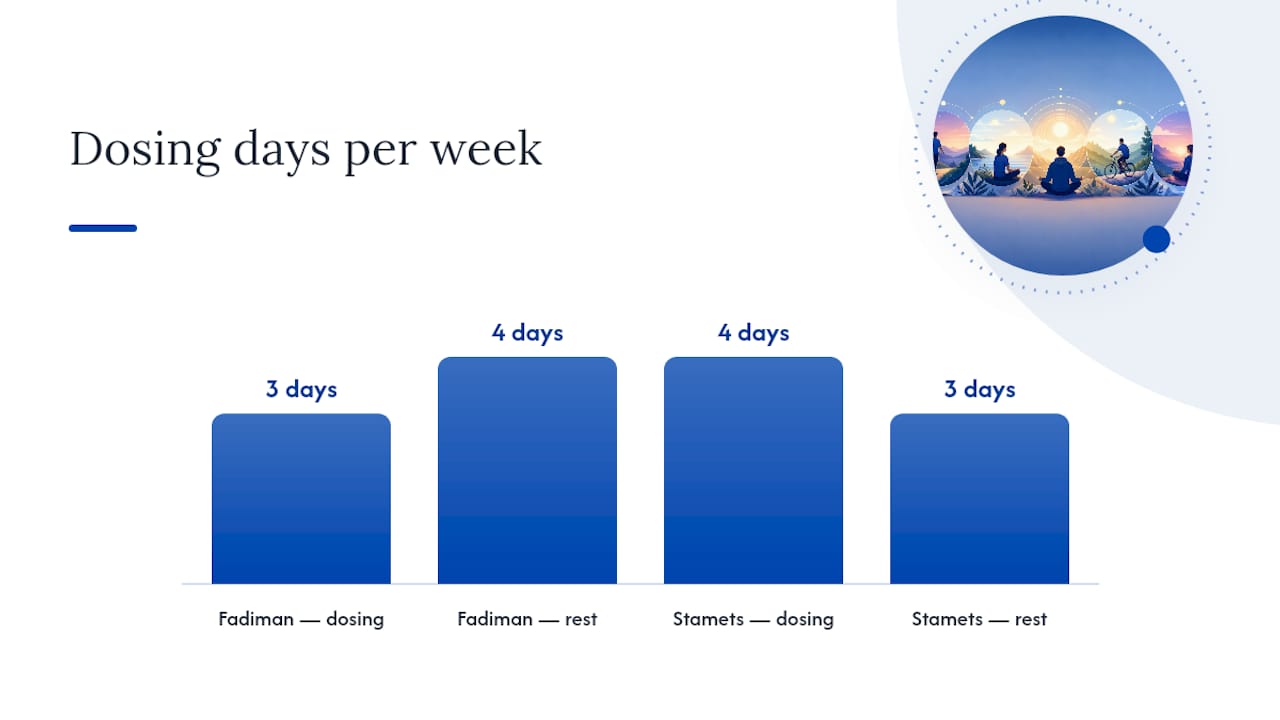
The Fadiman protocol, named for psychologist James Fadiman, follows a one-day-on, two-days-off rhythm: dose on day one, take two full days off, then repeat. The two off-days are meant to prevent tolerance buildup and give you a clear baseline to compare against on non-dosing days. It’s the most widely cited self-experimentation schedule in microdosing communities, largely because it’s simple to follow and easy to track.
The Stamets protocol, associated with mycologist Paul Stamets, runs a tighter cycle: four days on, three days off, often stacked with lion’s mane mushroom and niacin, based on a theory about neurogenesis that hasn’t been tested in controlled human trials. It’s more intensive than Fadiman’s approach and carries more cumulative exposure across a given month, which matters if you’re trying to minimize chronic dosing risk.
Clinical research looks different from either community protocol. Trials testing repeated low doses of psilocybin have used schedules ranging from once weekly to several times a week, generally over windows of 4 to 8 weeks, with some phase II trial designs extending follow-up monitoring out to two years to catch delayed or cumulative effects that a short study would miss.
Choosing and managing a schedule:
- If your goal is mood tracking with minimal exposure, Fadiman’s one-on/two-off pattern gives you the most rest days relative to dosing days.
- If you’re specifically trying to mirror clinical dosing patterns, a once or twice weekly 1 to 2 mg dose better resembles what trials actually test.
- Cap any cycle at 4 to 8 weeks before taking a deliberate break of at least two to four weeks. This mirrors the duration windows used in trial evidence rather than open-ended, indefinite use.
- Stop immediately, not just pause, if you notice mood worsening, sleep disruption, anxiety climbing, or any cardiovascular symptoms.
- Reassess after each cycle using your own tracked data before deciding to continue, adjust, or stop entirely.
There’s no clinically validated protocol that beats the others. What exists is a patchwork of anecdotal regimens that have never been directly compared in a controlled trial, which is exactly why the schedule you pick should be less important to you than the tracking you do while following it.
Safety, Contraindications, and Drug Interactions You Need to Know
Certain groups should not microdose, full stop. A personal or family history of psychosis, schizophrenia, or bipolar disorder puts you at meaningfully elevated risk, since psilocybin can trigger or worsen manic or psychotic episodes even at low doses. Unstable heart disease is a separate concern, discussed below in more detail.
Contraindications and interaction risks:
- Personal or family history of psychosis, schizophrenia, or bipolar disorder.
- Unstable or serious cardiovascular disease.
- Current use of MAOIs, which can interact dangerously with serotonergic compounds.
- Current use of SSRIs, SNRIs, lithium, or other psychiatric medications that affect serotonin signaling, where interactions are poorly studied at microdose levels.
- Pregnancy or breastfeeding, where no safety data exists at any dose.
- Active substance use disorder, where introducing another psychoactive substance complicates recovery and monitoring.
What the evidence actually shows: A phase II randomized trial of 39 adults with major depressive disorder tested repeated 2 mg psilocybin doses over 8 weeks and found symptom reductions comparable to placebo, a result that underscores how much of the reported benefit in open-label use may be expectancy rather than pharmacology.
The theoretical long-term risk that gets the least public attention is cardiovascular. Psilocybin and related compounds can stimulate the 5-HT2B serotonin receptor, the same receptor family implicated in valvular heart damage from other drugs that hit it chronically. Harvard’s Petrie-Flom Center has raised this concern directly, noting that repeated, chronic low-dose exposure introduces a different risk profile than an occasional full psychedelic dose, and that nobody has run the multi-year cardiac monitoring studies needed to rule this out definitively.
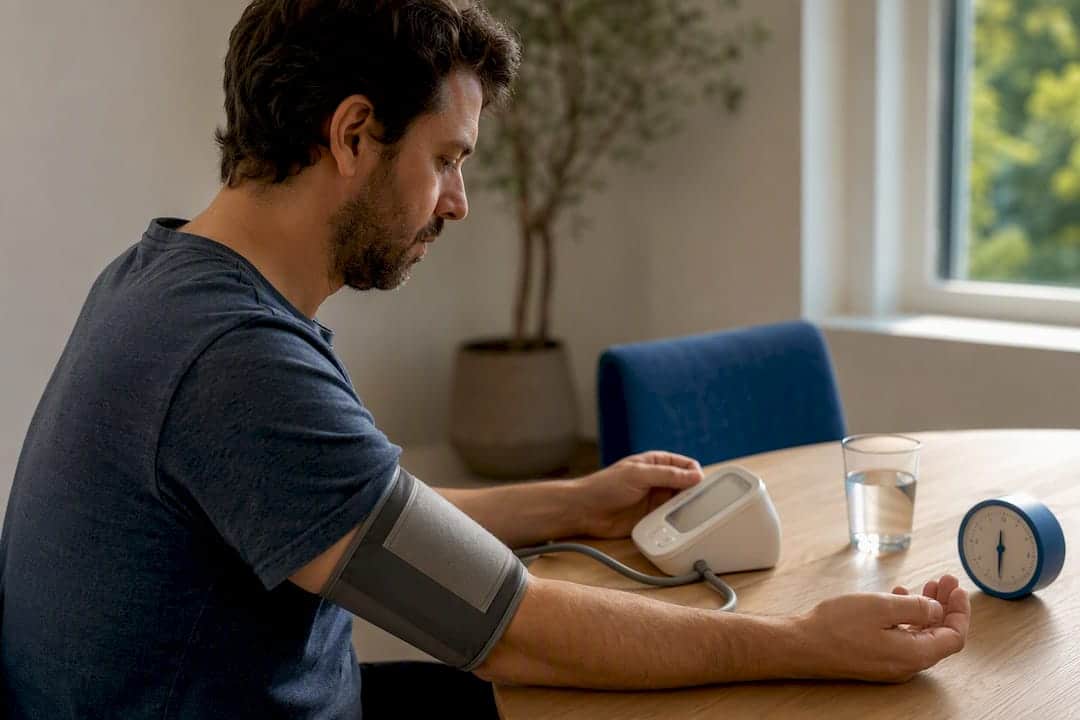
Monitoring for adverse effects while microdosing doesn’t require expensive equipment, just consistency. Track resting heart rate and blood pressure periodically if you have any cardiac risk factors at all. Note any new anxiety, irritability, sleep disruption, or mood swings in your log, and treat two or more consecutive bad sessions as a stop signal rather than something to push through.
Unblinding is a real confound worth taking seriously. Because you know you took a dose, your expectations color what you report feeling, and researchers studying microdosing point to expectancy bias as one of the biggest reasons open-label self-reports diverge so sharply from blinded trial results. A double-blind placebo-controlled study using 0.5 g dried mushroom found no consistent improvement in creativity or cognition, despite many participants subjectively feeling that something had changed. If you want a resource that lays out these safety considerations in more depth, Fungipsilocybinmushroom’s safety guide is a reasonable place to keep learning.
Legal Status Snapshot and How to Reduce Your Legal Risk
Psilocybin remains a Schedule I controlled substance under U.S. federal law as of 2026, which means possession, cultivation, and distribution are federally prohibited regardless of what any state has done. Two states have carved out regulated exceptions. Oregon’s Measure 109 created licensed service centers, operating since 2023, where adults can access supervised psilocybin sessions. Colorado’s Proposition 122 combined personal decriminalization with a healing center licensing structure that rolled out between 2024 and 2025. Outside those two frameworks, federal Schedule I status is the operative law almost everywhere in the country, and other jurisdictions worldwide vary just as widely, so what’s tolerated in one city or country can carry serious penalties in the next.
Practical steps to reduce legal exposure:
- Use a licensed service center where one legally exists, such as Oregon’s model, rather than assembling an unsupervised session on your own.
- Never ship psilocybin products across state or national borders, since that turns a possession issue into a trafficking-adjacent one under federal and international law.
- Check your specific state or country’s current statute before acting. Laws in this space are changing quickly and a guide written even a year ago may already be outdated.
- Keep any personal-use quantities and documentation minimal and private, and avoid any activity that could be construed as distribution.
None of this is legal advice for your specific situation. If you have real legal exposure concerns, a local attorney familiar with drug policy in your jurisdiction is the only reliable source, not a blog post.
How to Track Effects and Tell If Microdosing Is Actually Working
Expectancy bias is strong enough that you can talk yourself into feeling better from a dose that’s doing nothing pharmacologically. The only real defense is a structured tracking system you commit to before you start, not after you already have a hunch about the outcome.
- Establish your baseline for at least one week before dosing. Use a validated short scale like the PHQ-2 or PHQ-9 for mood, log your sleep hours and quality, rate your stress on a simple 1 to 10 scale, and time yourself on a basic focus task like a short reading or math drill.
- Log every dosing day and every off day the same way. Keep entries short: dose taken, time, mood score, sleep from the night before, any side effects, and a one-line note on anything unusual. A weekly summary that averages these daily entries will show trends a single day’s notes can’t.
- Run a blinded phase if you’re serious about separating real effect from expectancy. Have someone else prepare identical-looking capsules, some active and some inert, without telling you which is which on a given day, then compare your logged scores across both.
- Set decision rules in advance. Decide before you start what a meaningful improvement looks like on your chosen scale, what counts as a warning sign to pause immediately, and what counts as no-change data that means it’s time to stop and reassess with a clinician.
Pro Tip: Write your decision rules down on paper before your first dose, not in your head. It’s much harder to talk yourself out of a rule you already committed to in writing than one you’re deciding on in the moment, three weeks into a cycle that isn’t working.
If four to eight weeks pass with no measurable change on your tracked scores, that’s real data, not a reason to push the dose higher. Raising the dose to chase an effect that isn’t showing up is how sub-perceptual microdosing turns into something else entirely.
Practical How-To: Sourcing, Preparing, Dosing, and Storing Your Supply
Lab testing is the difference between knowing what you’re taking and guessing. A real test result shows potency (psilocybin and psilocin content by weight) and screens for contaminants like heavy metals, mold, or bacterial contamination that can grow on improperly dried or stored mushrooms. Skipping this step means every gram you measure afterward is built on an unknown.
- Start with a homogenized batch. Take your full dried supply from a single harvest or a single tested product, and grind it into a fine, even powder using a clean coffee grinder or mortar and pestle dedicated to this purpose. This step alone eliminates the hot-spot problem where one mushroom cap is far stronger than another from the same batch.
- Weigh individual doses with a precision scale. Use a scale accurate to 0.01 grams (10 milligrams), tare an empty container first, then measure each dose directly into that container rather than eyeballing a portion of a whole mushroom.
- Fill capsules for consistency and convenience. Standard-size capsules (00 or 0) hold most microdose amounts easily and remove the temptation to “just take a pinch” on a rushed morning.
- Label every batch clearly. Write the date, the source batch, and the estimated dose per capsule on the container. Memory is not a reliable label after the third or fourth batch.
- Store away from light, heat, and moisture. A dark, airtight container in a cool cabinet preserves potency far longer than a bag left near a stove or a sunny windowsill; potency can degrade meaningfully within months under poor storage conditions.
Dosing-day checklist:
- Take your dose at the same time each dosing day, generally with or shortly after breakfast, to control for how food affects absorption.
- Stay hydrated through the morning, since mild dehydration can amplify subjective side effects like headache or lightheadedness.
- Dose in a familiar, low-stress environment rather than before a high-pressure meeting or unfamiliar situation, especially in your first few sessions.
- Record your notes within an hour of dosing while the details are still fresh, not at the end of the day from memory.
Pro Tip: If you’re buying finished product rather than preparing your own, treat the batch certificate of analysis the same way you’d treat a nutrition label. If a seller can’t produce one, that’s your answer about whether to buy from them. Sourcing from a vendor that publishes lab results alongside its microdosing capsules removes the homogenizing and weighing steps entirely, at the cost of trusting someone else’s testing process instead of your own scale.
What Beginners Consistently Get Wrong About Microdosing
The evidence base for microdosing is genuinely weaker than most enthusiastic online communities let on, and that gap between hype and data is where most beginner mistakes start. People read anecdotal success stories, skip the baseline tracking, and jump straight to a dose that’s already at the high end of the community range instead of the low end. A double-blind trial and a large systematic review both point the same direction: self-reported benefits often shrink or vanish once expectancy is controlled for, which should temper how much weight you put on a single week of feeling “clearer.”
The three mistakes I see most often are dosing too high out of impatience, skipping any kind of log because “I’ll just notice if it’s working,” and ignoring a personal or family psychiatric history because a friend’s experience sounded fine. Each of those is fixable with about ten minutes of upfront planning. Weigh a conservative dose, write down a baseline before you start, and actually talk to a clinician if bipolar disorder or psychosis runs in your family. None of that is complicated. It’s just often skipped.
The habits that make the biggest difference aren’t exotic. A short daily journal entry, protected sleep, and a willingness to bring what you’re doing up with a therapist if you’re already in talk therapy all do more for outcome quality than switching between Fadiman and Stamets ever will. Microdosing works best as one input alongside those habits, not as a replacement for them.
— Alex
Fungi Psilocybin Mushroom: Lab-Tested Options for a Safer Microdosing Cycle
There are options available that include batch-level lab testing, which means the conversion math in this guide, grams to milligrams, dose to schedule, can hold up against what’s in the capsule you open.
When browsing a catalog, look for clear batch test disclosures, dose labeling that states milligrams per capsule rather than a vague “microdose” claim, and traceability back to a specific harvest or production run. The Seremoni psilocybin chocolate bar is a good example of a format that makes portioning simple without a scale, while strain pages like the Amazonian psilocybin mushroom guide walk through potency differences worth knowing before you pick a starting product. If you have a cardiac, psychiatric, or medication history covered in the safety section above, talk to a clinician before you order anything. Otherwise, browse the current lab-tested selection and start with the lowest dose option listed.
Where to Go Next for the Research Behind This Guide
The Frontiers in Psychiatry systematic review is the best single starting point for understanding how thin and heterogeneous the microdosing evidence base still is. Pair it with the double-blind placebo-controlled trial for a look at what happens when expectancy is controlled for, and the active phase II trial listing for what’s currently being tested with longer follow-up. For legal boundaries, check the DEA’s scheduling page directly rather than a secondhand summary. Anecdotal reports are useful for generating hypotheses, but treat trial data as the stronger signal whenever the two disagree.
This article is general information, not a substitute for advice from a qualified doctor. Consult a qualified healthcare professional about your own circumstances before acting on anything here.
Sources
- DEA — Drug scheduling (psilocybin)
- Frontiers in Psychiatry — The subtle science: a systematic review of psilocybin microdosing
- Translational Psychiatry — Microdosing with psilocybin mushrooms: a double-blind placebo-controlled study
- Clinicaltrials