Monthly Archives: September 2026

3,000 Years of Psilocybin History: Evolution to Clinics

Psilocybin is a serotonin-acting compound produced by more than 200 species of fungi, and it converts in the body to its active form, psilocin. Humans have used psilocybin-containing mushrooms in ritual and healing contexts for at least 3,000 years, Western science essentially ignored them until the 1950s, and a 1970 federal ban shut down research for decades before a clinical revival brought them back into hospitals and universities. Because mushroom tissue is mostly water, almost none of that early history survives as physical artifacts. It survives instead in stone carvings, painted codices, and colonial-era manuscripts.
TL;DR:
- Psilocybin originated in fungi for ecological purposes such as defense and spore dispersal, long before humans began to use it ritually.
- Archaeological evidence of ancient use is indirect, including carved stone effigies and colonial texts describing ceremonial mushroom consumption in Mesoamerica.
- Modern scientific research on psilocybin restarted after its chemical isolation in 1958, but was criminalized in 1970, halting most clinical studies for decades.
- Current clinical trials show promise for psilocybin in treating depression, anxiety, and addiction, though larger studies and long-term data are still needed.
- Authentic, lab-tested psilocybin products and guided protocols are recommended over unverified sources, and consulting a healthcare professional before use remains essential.
Table of Contents
- Psilocybin History: What the Compound Is and Why It Matters
- Where Psilocybin Came From: Origins and Evolutionary Origins
- Stone, Codex, and Chronicle: The Archaeological Record
- The Fungi Behind the History: Taxonomy and Chemistry
- When Europeans Wrote It Down: Colonial Contact and Early Chemistry
- Scientific Curiosity Meets a Federal Ban
- Psilocybin in Modern Therapy: The Research Renaissance
- Beyond Mesoamerica: Psilocybin and Shamanism Worldwide
- Psilocybin Across the Eras: From Sacred Rite to Clinical Protocol
- From Countercultural Icon to Cultural Mainstay
- Before the Clinical Trials: Early Chemistry and Pharmacology
- Reading History Without Romanticizing or Dismissing It
- Explore a selection of lab-tested mushrooms and related products
- Sources
- FAQ
Psilocybin History: What the Compound Is and Why It Matters
Psilocybin itself does very little on its own. Once ingested, the body strips off a phosphate group and converts it into psilocin, the molecule that actually binds to serotonin receptors in the brain and produces the altered perception, mood shifts, and visual effects people associate with “magic mushrooms.” That prodrug relationship, psilocybin as an inactive carrier and psilocin as the active agent, is one of the first things anyone researching psilocybin mushrooms history needs to understand before the archaeology and the clinical trials make sense.
The word itself is comparatively modern. Albert Hofmann and Roger Heim named the compound in 1958 after isolating it from Psilocybe mexicana, but the fungi that produce it are far older than any human record of using them. What is publicly documented is a species distribution spanning multiple continents, a genomic signature that shows up in fungi separated by tens of millions of years of evolution, and a human relationship with these mushrooms that predates writing itself in some regions. The rest of this piece works through that timeline in order: deep evolutionary time, the archaeological and colonial record, the chemistry, the mid-century rediscovery, the ban, and the research renaissance now underway.
Where Psilocybin Came From: Origins and Evolutionary Origins
Psilocybin is far older than any ceremony that ever used it. Genomic research shows that the biosynthetic gene cluster responsible for producing psilocybin appears in at least eight distantly related fungal genera, a distribution pattern that is difficult to explain through ordinary inheritance alone. Researchers studying the evolutionary role of psilocybin in nature argue that horizontal gene transfer, essentially one fungal lineage picking up genetic material from another unrelated lineage sharing the same decaying log or dung pile, better explains why the same gene cluster keeps turning up in fungi that otherwise share little evolutionary history.
That timing matters. Phylogenomic work on Psilocybe and related genera places the key divergence and transfer events for these gene clusters well before any human involvement, likely tied to shared wood-decay and dung-associated ecological niches rather than to any interaction with animals seeking altered states. The fungi were not making psilocybin for anyone. They were making it because it did something useful in their own environment.
What that something is remains genuinely unsettled. Three competing explanations dominate the ecological literature:
- Antifeedant defense. Psilocybin may deter insects and other invertebrates from consuming fungal fruiting bodies before spores mature, functioning similarly to other fungal toxins.
- Behavior modification for spore dispersal. Some researchers propose that altering invertebrate behavior could help spread spores further than passive dispersal would allow, though this is harder to test than simple deterrence.
- Nitrogen management. A less publicized hypothesis suggests the compound plays a role in nitrogen cycling within the fungus itself, independent of any effect on animals.
Early experimental work lends some support to the defensive hypothesis. Studies exposing fruit fly larvae to Psilocybe extracts recorded reduced survival and altered development, and metabarcoding of invertebrate communities around psilocybin-producing mushrooms shows distinct patterns compared to non-producing species nearby. None of this is conclusive. A 2023 review of psilocybin’s ecology and evolution is candid that the compound’s precise ecological function is still experimentally unresolved, even as the genomic evidence for its ancient wood and dung-decay origins keeps getting stronger.
Stone, Codex, and Chronicle: The Archaeological Record
You will not find a preserved psilocybin mushroom from 1,000 BCE in any museum. Mushroom tissue is roughly 80 to 90 percent water, so it breaks down almost immediately after death, leaving archaeologists to reconstruct ancient use from indirect evidence: carved stone effigies, painted manuscripts, and the written testimony of colonizers who witnessed ceremonies firsthand. That indirect chain of evidence is exactly why claims about psilocybin use in ancient cultures carry date ranges rather than precise years.
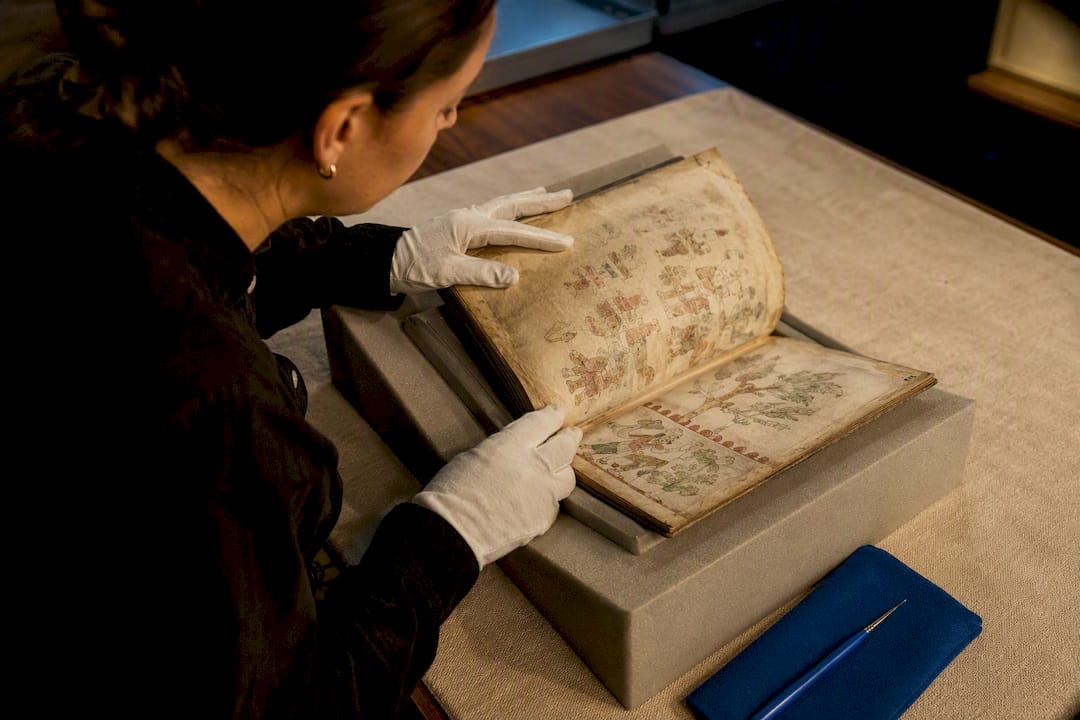
The strongest physical artifacts are “mushroom stones,” carved effigies found across Guatemala and highland Mexico that depict fungi, some dated to as early as 1000 BCE. Mixtec codices, including the Codex Vindobonensis, contain painted scenes interpreted by scholars as mushroom deities or ceremonial mushroom use. The most detailed textual evidence comes from the Florentine Codex, compiled under the Franciscan friar Bernardino de Sahagún in the 16th century. Book IX of that codex describes Nahua merchants consuming mushrooms called teonanácatl, mixed with honey or chocolate, during rites involving dancing and shared visionary experiences.
Sahagún’s informants described participants eating the mushrooms at gatherings, then singing, weeping, or seeing visions together, with some able to retain command of their senses throughout. The picture that emerges is not one of isolated intoxication but of structured, communal ceremony with recognized social rules.
That detail, participants often remaining lucid and socially engaged rather than incapacitated, is one of the more underappreciated findings in this whole record. Combined with the archaeological and codex evidence, researchers place documented ritual use in Mesoamerica at roughly 3,000 to 3,500 years, spanning Mixtec, Nahua, Maya, Mazatec, and Zapotec cultures. The recorded ceremonial purposes fall into a few consistent categories:
- Divination, using visionary states to answer questions about illness, theft, or the future.
- Healing rituals, often led by a curandero or ritual specialist who guided the experience.
- Communal bonding ceremonies, tied to merchant guilds or specific social occasions rather than solitary use.
Because none of this survives as physical fungal material, historians have to weigh colonial accounts against the biases of the colonizers writing them down, which is a real interpretive limitation worth keeping in mind before treating any single chronicle as a complete record.
The Fungi Behind the History: Taxonomy and Chemistry
Psilocybe is the genus most people picture when they hear “magic mushroom,” and it accounts for the majority of documented historical and modern use, but it is not the only genus that makes the compound. Psilocybin production has been confirmed across a taxonomically scattered group of fungi, which is part of what makes the horizontal gene transfer explanation so compelling:
- Psilocybe — the largest and most historically significant genus, found across the Americas, Europe, and Asia, including species like Psilocybe mexicana, Psilocybe cubensis, and Psilocybe semilanceata.
- Panaeolus — a genus of dung-loving mushrooms found on most continents, some species of which produce psilocybin.
- Gymnopilus — wood-decaying fungi with a more scattered global distribution.
- Inocybe and Pluteus — smaller genera with fewer confirmed psilocybin-producing species, but present in the biosynthetic gene cluster research nonetheless.
Chemically, the mushroom does not produce the psychoactive molecule directly. It produces psilocybin, a phosphorylated prodrug, which the human body dephosphorylates after ingestion into psilocin, the compound that actually binds serotonin 2A receptors. That two-step relationship explains a lot of the confusion in casual conversation about “psilocybin” versus “psilocin,” when in practical terms the fungus makes one and the body makes the other active.
Potency is not uniform across species, or even within the same species collected from different locations. Factors affecting how much psilocybin and psilocin a given mushroom contains, and how stable that content remains, include growing substrate, harvest timing, drying method, and storage conditions after harvest. That variability is one of the more practical reasons historical dosing accounts from colonial chronicles are hard to translate into precise modern equivalents, and it is also why lab testing of cultivated product matters more than folklore ever could.
When Europeans Wrote It Down: Colonial Contact and Early Chemistry
Sahagún’s Florentine Codex is valuable precisely because of how it was compiled. He worked with bilingual Nahua informants over years, cross-checking testimony rather than relying on a single secondhand account, which gives his descriptions of teonanácatl rites more credibility than typical colonial reporting, even accounting for the missionary lens he brought to the material.
Four centuries later, the practice resurfaced in Western consciousness almost by accident. In 1955, banker and amateur ethnomycologist R. Gordon Wasson traveled to Oaxaca and participated in a mushroom ceremony led by the Mazatec curandera María Sabina. His 1957 Life magazine account introduced millions of American readers to psilocybin mushrooms for the first time, and it triggered a wave of interest from scientists, tourists, and eventually countercultural figures that María Sabina herself later said disrupted her community’s traditional practice.
Wasson sent mushroom samples to Swiss chemist Albert Hofmann, already famous for synthesizing LSD, who isolated and named psilocybin and psilocin in 1958 and synthesized both compounds shortly after. That chemical isolation opened the door to the first wave of legitimate laboratory and clinical studies:
- Hofmann’s 1958 isolation gave researchers a stable, synthesizable compound rather than a variable natural product.
- Early psychiatric studies in the late 1950s and 1960s explored psilocybin for treating alcoholism, anxiety in terminal patients, and depression.
- Harvard’s Psilocybin Project, run by Timothy Leary and Richard Alpert starting in 1960, produced some legitimate data alongside growing institutional controversy.
Scientific Curiosity Meets a Federal Ban
The sequence that took psilocybin from laboratory curiosity to banned substance ran remarkably fast. Academic researchers spent the late 1950s and early 1960s running legitimate psychiatric trials. Media coverage, magazine features, and Leary’s own public advocacy for “turning on” turned a niche compound into a symbol of countercultural rebellion by the mid-1960s. That symbolism collided with a political backlash against the counterculture broadly, and psilocybin got swept into the same regulatory response aimed at LSD and cannabis.
- 1955 to 1958: Wasson’s Oaxaca trip and Hofmann’s chemical isolation establish psilocybin as a legitimate subject for Western science.
- 1960 to 1962: Harvard’s Psilocybin Project runs controlled studies, including the Concord Prison Experiment and the Marsh Chapel Experiment, alongside growing institutional concern over methodology and unsupervised use.
- 1962 to 1965: Leary and Alpert are dismissed from Harvard; media coverage shifts from scientific curiosity to countercultural spectacle.
- 1966 to 1969: Recreational use spreads well beyond research settings, feeding a moral panic that treats psychedelics as a symptom of social breakdown rather than a subject for study.
- 1970: The Controlled Substances Act places psilocybin in Schedule I, the most restrictive category, alongside heroin, defining it as having no accepted medical use and a high potential for abuse.
Historians examining this period describe the scheduling decision as driven at least as much by political reaction to counterculture as by pharmacological evidence. The practical consequence was severe: Schedule I status made federal funding and institutional approval for psilocybin research nearly impossible to obtain, and legitimate psychiatric trials that had shown early promise simply stopped for roughly three decades. Public perception shifted just as sharply, from “experimental psychiatric tool” to “dangerous street drug,” a framing that outlasted the scientific evidence that had originally supported the former.
Psilocybin in Modern Therapy: The Research Renaissance
Clinical research on psilocybin resumed in earnest starting in the early 2000s, after decades of near-total dormancy following the 1970 ban. The results since have been consistent enough to reshape how psychiatry talks about treatment-resistant conditions. Trials on psilocybin-assisted therapy for major depressive disorder, end-of-life anxiety in cancer patients, and substance use disorders including alcohol and tobacco dependence have reported meaningful improvements, typically delivered alongside structured psychological support rather than as a standalone pill.
Pro Tip: If you’re evaluating a psilocybin study, check whether it used a fixed protocol with trained facilitators and psychological preparation sessions before and after dosing. Studies that skip that structure tend to produce noisier, less comparable results.
The neuroscience behind these effects centers on the 5-HT2A serotonin receptor, the same receptor psilocin binds after conversion in the body. Activating this receptor appears to temporarily loosen the brain’s default mode network, the set of regions associated with self-referential thought and rigid thinking patterns. Neuroimaging studies describe a period of increased connectivity between brain regions that don’t normally communicate much, which researchers think may underlie the shifts in perspective that patients report during and after guided sessions.
None of this makes psilocybin a settled clinical tool yet. Several real limitations keep showing up across the research:
- Sample sizes remain small relative to standard psychiatric drug trials, which limits how confidently results generalize.
- Blinding is nearly impossible. Patients almost always know whether they received psilocybin or a placebo, given how distinct the subjective effects are.
- Long-term outcome data is thin. Most published trials track patients for weeks or months, not years.
- Study populations skew narrow, often underrepresenting older adults, people with complex psychiatric histories, and non-Western populations.
Reviewers are candid that the evidence base, while genuinely promising, is still emerging and needs larger controlled trials before psilocybin-assisted therapy becomes standard practice rather than an experimental protocol available mainly through clinical trials or, in limited jurisdictions, supervised legal programs. Readers curious about how these findings translate into dosing conversations can look at dosing guidance for magic mushrooms for a more practical breakdown, though nothing there substitutes for supervision from a qualified clinician.
Beyond Mesoamerica: Psilocybin and Shamanism Worldwide
Mesoamerica has the richest documented archaeological record, but it is far from the only culture with a historical relationship to psychoactive fungi. Siberian ethnography describes indigenous groups across Kamchatka and the broader Russian Far East using Amanita muscaria, a different psychoactive mushroom, in shamanic ritual contexts, and some ethnobotanists have proposed that the practice reflects a broader circumpolar pattern of fungal use tied to shamanic trance traditions, though Amanita’s chemistry differs substantially from psilocybin.
Ethnomycologists have also documented psilocybin-specific traditions among groups beyond the well-known Mazatec, including practices recorded among other Mexican Indigenous communities where mushroom use overlapped with broader healing and divinatory frameworks rather than existing as an isolated ritual. What ties these traditions together is not identical chemistry or shared origin, but a recurring pattern: societies across unrelated regions independently arrived at psychoactive fungi as tools for healing, divination, and communication with forces beyond ordinary experience.
That pattern matters for how we frame psilocybin in indigenous rituals generally. It was rarely treated as recreational. Across documented traditions, from Mesoamerican curanderos to Siberian shamanic practice, use tended to be structured, supervised by a designated specialist, and embedded in a specific social or spiritual purpose rather than left to individual discretion. Modern conversations about psychedelics sometimes flatten this diversity into a single “ancient shamanic use” narrative, which undersells how differently these traditions actually operated from one region to the next.
Psilocybin Across the Eras: From Sacred Rite to Clinical Protocol
The role psilocybin has played in human ritual life has shifted dramatically depending on the era, even when the underlying chemistry stayed the same. In pre-colonial Mesoamerica, mushroom ceremonies functioned within an established religious framework, tied to specific deities, calendar events, and the authority of a ritual specialist. Colonial suppression pushed these practices underground for centuries. Spanish missionaries actively worked to eliminate teonanácatl rites as pagan, and much of what survived did so in isolated rural communities like the Mazatec highlands, largely outside colonial oversight.
The 20th-century rediscovery reframed psilocybin again, this time as a subject of Western scientific inquiry rather than Indigenous religious practice. That reframing carried its own tensions. The same ceremonies that had persisted quietly for centuries were suddenly subject to outside visitors, media attention, and eventually a wave of tourism that María Sabina considered disruptive to the sacred function the mushrooms had always served in her community.
Today’s clinical protocols represent a third distinct mode entirely: supervised, secular, and designed around measurable psychiatric outcomes rather than spiritual cosmology. Some researchers and therapists have started incorporating elements borrowed from historical ritual structure, dim lighting, music, a trained guide present throughout, not because those elements are mystically necessary, but because the historical record suggests supportive context measurably shapes the experience. History and clinical science, in this narrow sense, are starting to talk to each other again.
From Countercultural Icon to Cultural Mainstay
Psilocybin’s cultural footprint after the 1960s counterculture didn’t disappear when the Controlled Substances Act took effect. It went underground and diversified. Through the 1970s, 80s, and 90s, mushroom use persisted in music festival culture, rave scenes, and a growing network of amateur mycologists who kept cultivation knowledge alive largely outside institutional science.
The 2010s and 2020s brought a second, very different wave of cultural visibility. Documentaries, bestselling books on psychedelic science, and a wave of city and state decriminalization measures shifted public conversation from “dangerous street drug” back toward something closer to the scientific curiosity of the 1950s. Microdosing, taking sub-perceptual amounts on a regular schedule for reported mood or focus benefits, became a recognizable cultural phenomenon in tech and creative industries, even though rigorous evidence for microdosing’s specific benefits still lags behind the enthusiasm surrounding it.
What makes this second wave different from the 1960s is the institutional backing. Universities, veteran nonprofits, and licensed clinical programs now drive much of the public conversation, rather than countercultural figures operating outside mainstream science. That shift in who is telling the story has done a lot to change how psilocybin gets covered in the media, and by extension how the public perceives it, even though the compound itself hasn’t changed at all.
Before the Clinical Trials: Early Chemistry and Pharmacology
Long before psilocybin became a subject of controlled psychiatric trials, it went through a distinct earlier phase of pharmacological curiosity. Hofmann’s 1958 isolation and synthesis at Sandoz Laboratories gave researchers something they had never had before: a stable, pure, reproducible compound rather than a variable dried mushroom sample of unknown potency.
That chemical stability enabled the first wave of formal pharmacology. Researchers ran early studies establishing basic dose response relationships, comparing psilocybin’s subjective effects to LSD, and testing it in small clinical contexts including anxiety in dying patients and treatment-resistant alcoholism. Sandoz distributed synthesized psilocybin under the brand name Indocybin to researchers throughout the early 1960s, which is part of why so much of the initial pharmacological literature traces back to a fairly small, interconnected group of European and American labs.
This period matters historically because it establishes that psilocybin’s clinical promise isn’t a recent discovery dressed up as a “renaissance.” Researchers in the late 1950s and early 1960s were already documenting the same core signal, meaningful shifts in mood and perspective under supervised conditions, that modern trials are now confirming with better methodology and imaging technology that simply didn’t exist sixty years ago. The 1970 ban didn’t interrupt a new field. It interrupted one that had already produced a real body of pharmacological groundwork.
Reading History Without Romanticizing or Dismissing It
The temptation with psilocybin’s history runs in two opposite, equally lazy directions: treating ancient use as proof of some timeless mystical truth, or dismissing it as primitive superstition now superseded by modern neuroscience. Neither holds up against the actual record. Mesoamerican ceremonial use was structured, supervised, and socially embedded in ways that deserve real scholarly respect, and the genomic evidence for psilocybin’s evolutionary origins is fascinating on its own terms, independent of any human meaning layered onto it later.
What the historical and scientific record actually supports is more interesting than either extreme: a compound that fungi evolved for reasons still not fully understood, that multiple human cultures independently recognized as significant, and that modern medicine is now studying with more rigor than at any point since Hofmann’s lab bench in 1958. Respecting Indigenous context and pursuing careful clinical research aren’t competing goals. Getting the history right is what makes both possible.
— Alex
Explore a selection of lab-tested mushrooms and related products
Reading about a compound’s history is one thing. Getting a version of it you can actually trust is another. Many vendors emphasize lab testing to ensure product quality, helping avoid reliance on folklore or guesswork about potency the way colonial chroniclers had to.
Whether you’re drawn to a high-potency option like Copelandia cyanescens or you’re starting with the educational side of things, dosing guides, cultivation kits, strain comparisons, the goal is the same: give you accurate information and a tested product instead of forcing you to piece it together from secondhand accounts. None of this replaces a conversation with a licensed clinician, especially if you’re considering psilocybin for a mental health condition. If you’re ready to look at strain options, browse the current selection at Fungipsilocybinmushroom and start with whichever category, tested mushrooms, edibles, or grow kits, fits what you’re actually trying to learn or experience.
This article is general information, not a substitute for advice from a qualified doctor. Consult a qualified healthcare professional about your own circumstances before acting on anything here.
Sources
- Ritual and religious uses of Psilocybe mushrooms in Mesoamerica
- Wherefore the Magic? The Evolutionary Role of Psilocybin in Nature
- Psilocybin history, action and reaction: A narrative clinical review
- The evolution and ecology of psilocybin in nature
FAQ
What food has psilocybin in it?
Psilocybin doesn’t occur in any conventional food; it’s produced naturally by certain fungi, primarily species in the genus Psilocybe, along with a smaller number of species in genera like Panaeolus and Gymnopilus.
Did psilocybin help humans evolve?
There’s no evidence that psilocybin shaped human evolution. The genomic evidence shows psilocybin evolved in fungi for their own ecological reasons, likely tied to wood and dung decay niches, long before humans had any interaction with it.
What is the oldest psychedelic?
There’s no single confirmed “oldest” psychedelic, but psilocybin-containing mushrooms rank among the earliest documented, with archaeological and ethnographic evidence placing Mesoamerican ritual use at roughly 3,000 to 3,500 years old.
Why did psilocybin become illegal?
Psilocybin was placed in Schedule I under the 1970 Controlled Substances Act, a decision historians link more to political backlash against 1960s counterculture than to pharmacological evidence, and that scheduling halted most clinical research for decades.
Is psilocybin used in modern therapy today?
Psilocybin-assisted therapy is currently studied in clinical trials for depression, anxiety, and addiction, with promising but still emerging results; it remains a Schedule I substance federally in the United States outside of approved research and limited state or local programs, so anyone considering therapeutic use should consult a licensed clinician and verify local law first.
Recommended
Peyote Legality in the US: Native Exemption, Texas Sales, Conservation
Peyote is a Schedule I controlled substance under federal law, which technically makes possession illegal for everyone. But 42 U.S.C. §1996a carves out a narrow exception: an Indian using or possessing peyote for bona fide traditional ceremonial purposes cannot be prosecuted under federal or state law for that specific use. Cultivation and sale to the general public remain illegal almost everywhere, and state law adds another layer of variation on top of the federal baseline.
TL;DR:
- Peyote possession by Native Americans for traditional ceremonies is protected only if their practice predates the 1994 law and involves bona fide religious purposes.
- Cultivation, sale, or transport of peyote outside specific licensed systems, especially for non-ceremonial or commercial purposes, remains illegal across all states.
- Texas stands out as the only state where selling peyote legally occurs through a regulated distribution chain, primarily serving verified Native American Church members.
- Most states criminalize planting, harvesting, drying, or processing peyote, with penalties varying from misdemeanors to felonies, especially in California.
- Alternatives like lab-grown psilocybin mushrooms or legal research compounds are available for those interested in psychedelic use without risking federal or state laws.
Peyote Legality Under Federal Law: The CSA and the Indian Exemption
Mescaline, the psychoactive compound in peyote, sits on Schedule I of the Controlled Substances Act, the same category as heroin and LSD. The DEA’s Orange Book lists mescaline and peyote-related substances there, meaning federal law presumes the plant has no accepted medical use and a high potential for abuse. That presumption drives every enforcement decision at the federal level, and it’s the reason peyote legality confuses so many people: the plant is simultaneously illegal and, for a specific group of people, legally protected.
The protection comes from a single, carefully worded statute: Congress passed 42 U.S.C. §1996a in 1994 specifically to settle a legal fight that had been dragging through the courts for years. The operative language states that the use, possession, or transportation of peyote by an Indian for bona fide traditional ceremonial purposes in connection with the practice of a traditional Indian religion is lawful, and shall not be prohibited by the United States or any state. That’s the entire exemption. It doesn’t legalize peyote outright. It protects a specific act, by a specific population, tied to a specific religious practice.
The DEA’s implementing regulation, 21 C.F.R. §1307.31, formalizes this by exempting the Native American Church and its members from prosecution for peyote used in bona fide religious ceremonies. A Department of Justice Office of Legal Counsel opinion goes further, clarifying just how tightly the exemption is drawn. According to the DOJ’s own analysis, the exemption was built around the Native American Church and religions with a comparable, documented history of peyote use. It was never intended as a blanket religious freedom pass for any group that adopts peyote ceremonies.
Pro Tip: If you’re trying to figure out whether a religious group’s peyote use is federally protected, ask whether that specific tradition has a documented history predating the statute. Newly formed groups claiming the exemption face a much steeper legal hurdle than the Native American Church does.
Here’s what the exemption does not cover, and this is where a lot of confusion sets in:
- General manufacturing or commercial distribution of peyote to the public
- Possession by non-Indians, even in a genuine spiritual context, absent a separate legal basis
- Cultivation for sale, gifting, or non-ceremonial personal use
- Transport across state lines for any purpose other than the protected ceremonial use
- Use by Indian individuals outside the context of a bona fide traditional religious ceremony
The legislative history behind §1996a, preserved in the U.S. Code’s preliminary text, shows Congress meant to protect traditional religious practice while still allowing reasonable regulation of how peyote gets grown, harvested, and moved. That balancing act is why cultivation and sale laws exist even in a country that has technically legalized ceremonial possession for one group. The exemption protects the ceremony. It does not protect the supply chain, except through one specific state mechanism discussed below.
Where Peyote Is Legal: State Laws, Texas, and Tribal Lands
Federal law sets the floor, but states decide how much further to go, and the differences are significant. Some states mirror the federal religious exemption almost word for word in their own controlled substances codes, explicitly protecting Native American Church members. Others say nothing about peyote at all beyond listing it as a controlled substance, which leaves practitioners relying entirely on federal preemption if state authorities ever push back. A handful of states have language broad enough to create real ambiguity about how local prosecutors would actually handle a ceremonial possession case.
Texas stands apart from every other state in one specific way: it’s the only place where selling peyote is legal, through a licensed and regulated distribution chain. Reporting from KUT Public Media documents how a small number of registered “peyoteros” in South Texas hold state licenses to harvest wild peyote and sell it to verified Native American Church members. This isn’t an open market. Buyers typically need to demonstrate tribal enrollment or documented NAC membership, and the whole system exists because South Texas happens to sit on top of most of the peyote habitat remaining in the country.
California takes the opposite approach on cultivation. California Health & Safety Code §11363 makes it a crime to plant, cultivate, harvest, dry, or process any plant of the genus Lophophora, which includes peyote, with no carve-out for personal or religious cultivation by non-tribal members. The federal exemption still applies to bona fide ceremonial possession for Indians even in California, but growing your own plant is a separate offense under state law regardless of intent.
Tribal lands complicate the picture further. Enforcement on reservations often falls under tribal law and, in some cases, federal jurisdiction rather than state authority, which can change how a ceremonial use case gets handled entirely. That doesn’t mean cultivation becomes automatically permissible on tribal land. It means the enforcing authority and applicable code may differ from the surrounding state.
| Jurisdiction type | Ceremonial possession by Indians | Cultivation | Sale/distribution |
|---|---|---|---|
| Federal baseline | Protected under §1996a | Not addressed by the exemption | Generally illegal |
| Texas | Protected, supported by licensing | Wild harvest only, by licensed peyoteros | Legal through registered sellers to verified NAC members |
| California | Protected by federal law | Explicitly criminalized under HSC §11363 | Illegal |
| Most other states | Varies by state code language | Generally illegal or unaddressed | Generally illegal |
State statutes change, and legislatures amend controlled substances schedules more often than most people realize. Treat any state-specific summary, including this one, as a starting point for your own search of the current code rather than a final answer.
What Conduct Gets Prosecuted: Cultivation, Sale, and Possession Explained
Peyote statutes generally target a specific sequence of acts rather than the plant’s mere existence. California’s §11363 spells this out clearly by naming five distinct actions as criminal: planting, cultivating, harvesting, drying, and processing. Each one can be charged separately, and prosecutors don’t need to prove intent to sell for a cultivation charge to stick.
- Planting or cultivating the plant, even for ornamental or personal spiritual reasons, triggers criminal liability in states like California regardless of whether you ever harvest it.
- Harvesting wild or cultivated peyote is treated as its own act under statutes modeled on California’s approach, separate from cultivation.
- Drying and processing the harvested plant into a usable form adds additional exposure, since these steps show intent to prepare the substance for consumption or distribution.
- Distribution or sale to anyone outside a licensed, verified channel is illegal in every state except Texas’s narrow registered system.
- Simple possession of prepared or dried peyote by a non-exempt individual is prosecuted differently than cultivation. Enforcement tends to focus more heavily on cultivation and distribution, since those acts touch supply rather than a single act of ceremonial use.
California’s cultivation offense is a “wobbler,” meaning prosecutors can charge it as either a misdemeanor or a felony depending on the circumstances, the defendant’s history, and the quantity involved. A misdemeanor conviction can carry county jail time and fines, while felony charges expose a defendant to state prison. That flexibility gives prosecutors significant discretion, which is exactly why cultivation cases are riskier to predict than straightforward possession cases.
One area that trips people up: seeds and small ornamental plants sold as botanical curiosities occupy a legal gray zone in some states, since a dormant seed isn’t the same as a prepared, consumable substance. That distinction doesn’t hold up everywhere, and several states treat the living plant itself, not just processed material, as the controlled substance. Anyone considering purchasing peyote seeds or buying a peyote cactus for collection needs to check their specific state code before assuming an ornamental sale is automatically lawful.
How Native Americans Access Peyote Legally, and What Non-Native Practitioners Face
For Native American Church members, lawful access runs almost entirely through two channels: NAC chapters that organize ceremonies and coordinate supply, and the licensed Texas peyoteros who sell to verified members under state registration. This system works because it keeps the entire chain, harvest, sale, and ceremonial use, inside a documented, bona fide religious context. Break that chain (buy from an unlicensed source, use outside a ceremony, resell to a non-member) and the federal protection no longer applies.
Non-Native individuals face a much harder legal path. Court decisions including Employment Division v. Smith and Gonzales v. O Centro Espírita Beneficente União do Vegetal shape how far religious freedom claims can stretch for substances outside the specific §1996a exemption. The DOJ’s OLC opinion discusses this history directly, and the upshot is sobering: RFRA claims have succeeded for other substances in narrow cases, but peyote’s exemption remains statutorily tied to Indian religious practice in a way that’s difficult for other groups to access through litigation.
Practical, lawful alternatives exist for people drawn to the broader tradition without qualifying for the exemption:
- San Pedro cactus, which contains mescaline but occupies different legal territory in most U.S. states since the plant itself isn’t scheduled
- Synthetic mescaline, available only through narrow research or clinical contexts, never as a consumer product
- Ceremonial retreats held in countries with different legal frameworks around mescaline-containing plants, though travelers need to research the destination country’s actual law rather than assume tolerance equals legality
Pro Tip: San Pedro’s legal status hinges on the plant being unscheduled, not on any exemption. Confirm your specific state hasn’t separately scheduled the plant before assuming that distinction protects you.
Enforcement Trends and Why Psychedelic Reform Rarely Includes Peyote
Federal prosecutors focus resources overwhelmingly on distribution and cultivation cases rather than ceremonial possession by verified Indian practitioners, since the latter carries almost no prosecutorial upside given the statutory exemption. States generally follow that same pattern, though enforcement intensity against unlicensed cultivation varies a lot by jurisdiction and by how aggressively local prosecutors treat wobbler offenses.
The bigger trend worth understanding: the wave of psychedelic decriminalization sweeping through states in recent years has largely carved peyote out entirely. Oregon’s psilocybin services program and Colorado’s Natural Medicine Health Act both focus on other substances, and explainers tracking these reforms note that peyote is routinely excluded from the plants and fungi covered by decriminalization measures. That exclusion isn’t an oversight. Tribal advocacy groups have pushed specifically to keep peyote out of broader reform, worried that expanded legal access would accelerate demand on an already strained wild supply.
A few points worth remembering:
- Tribal nations, including the Navajo Nation, have taken active conservation positions on peyote harvest, separate from any state or federal drug policy debate
- Broader psychedelic reform measures at the state level almost never extend legal access to peyote, even when they legalize psilocybin or other substances
- The practical outcome for readers: don’t assume a state’s psilocybin decriminalization law says anything at all about peyote’s legal status there
How to Verify Peyote’s Legal Status Before You Act
Getting this wrong carries real criminal exposure, so treat verification as a real step, not a formality.
- Pull the current text of your state’s controlled substances code directly from your state legislature’s official website, and note the statute number and its last amendment date. Secondhand summaries, including this one, can lag behind actual amendments.
- Cross-check the federal statute and DEA regulation. Read 42 U.S.C. §1996a and the DEA’s Schedule I listing directly rather than relying on paraphrases, since the exact wording determines what conduct is actually protected.
- Contact your state attorney general’s office if the statutory language is ambiguous about how cultivation, possession, or religious exemptions apply in your situation.
- If you’re claiming the religious exemption, consult NAC leadership or tribal religious authorities first. They can speak to whether your specific practice and community meet the “bona fide traditional ceremonial purposes” standard the statute requires.
- Retain counsel experienced in tribal and federal drug law before taking any action involving cultivation, transport, or distribution, even in a religious context.
Pro Tip: Never start cultivating, transporting, or supplying peyote based on an assumption about your legal standing. Get explicit clearance in writing from counsel or a tribal authority first. The wobbler penalties in states like California make guessing an expensive mistake.
Until you’ve done that homework, treat cultivation and sale as closed doors. That’s the safest working assumption for anyone outside a licensed Texas peyotero or a documented NAC ceremonial chain.
The Conservation Problem Behind Peyote’s Legal Restrictions
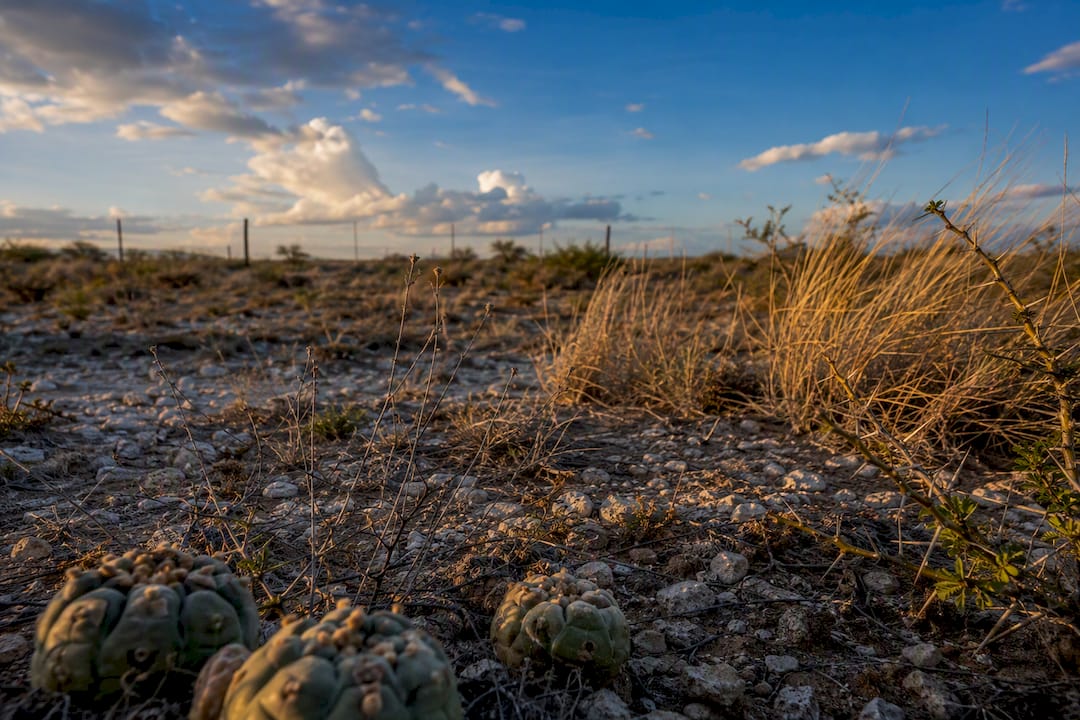
Peyote grows slower than almost any other cactus harvested for consumption, often taking a decade or more to mature. That biology is a big part of why cultivation and unauthorized harvest carry criminal penalties in states like California: unregulated demand can outpace the plant’s ability to regenerate in the wild, and South Texas habitat, the primary wild source supplying licensed peyoteros, has already shown signs of strain from overharvesting.
Native communities, particularly the Native American Church, view peyote as sacred rather than recreational, and many tribal leaders have spoken out against commercial exploitation or casual use by outsiders as a threat to both the plant’s survival and the integrity of the ceremony itself.
Tribal advocacy around peyote conservation isn’t about restricting access for its own sake. It reflects a concern that expanded non-ceremonial demand could permanently damage the wild populations that Native American Church practitioners depend on for a practice with no substitute material.
If you’re drawn to this plant’s history or its chemistry, the more responsible path runs through legal, ceremonial channels or through legal alternatives that don’t pressure an already limited wild supply. Fungi Psilocybin Mushroom’s broader guide to psychedelic legal frameworks covers how peyote’s legal treatment compares with psilocybin, which faces a very different regulatory trajectory in the U.S. right now.
- Peyote’s slow growth cycle limits how fast supply can recover from overharvesting
- The Native American Church and other tribal voices have actively opposed commercial or casual peyote use by non-practitioners
- Legal plant alternatives and research contexts exist for people who want to explore mescaline’s effects without pressuring wild peyote populations
What I’d Tell a Friend Asking About This
The gap between what people assume about peyote legality and what the statute actually says is enormous, and it’s not a small technicality. People hear “Native Americans can legally use peyote” and assume that means peyote is basically legal with an asterisk. It’s the reverse. Peyote is federally illegal with one extremely narrow, carefully bounded exception, and everything else, cultivation, sale, non-ceremonial possession, use by non-exempt individuals, remains squarely illegal in nearly every state.
What actually surprises most readers is Texas. A state famous for strict drug enforcement runs the only legal peyote sales chain in the country, purely because it happens to sit on the habitat and built a licensing system around supplying the Native American Church responsibly. That’s not a loophole. It’s a deliberate regulatory compromise that took decades to build, and it’s fragile precisely because the wild supply it depends on is shrinking.
If there’s one thing worth internalizing here, it’s that peyote’s legal story is really a conservation story wearing a drug-law costume. The restrictions on cultivation exist as much to protect a slow-growing plant from disappearing as they do to control a Schedule I substance. Treat that distinction seriously before treating peyote like just another substance with a legal gray area to exploit. Check your statute. Talk to a tribal authority or attorney if you have any real claim to the exemption. Do not guess.
— Alex
Legal, Lab Tested Alternatives Worth Exploring
Peyote’s legal path is narrow by design, and this article doesn’t encourage anyone around that. Instead, lawful, transparent alternatives exist for people interested in psychedelic exploration without the criminal exposure that comes with unauthorized peyote cultivation or purchase: lab-tested psilocybin mushrooms, grow kits, and microdosing products shipped with discreet, secure delivery.
If therapeutic use is what drew you to this topic in the first place, a guide to psilocybin’s legal therapeutic landscape in California walks through where mushroom-based options currently stand under state law, including delivery services built around compliance rather than guesswork. Lab testing behind products ensures you know what you’re getting before it arrives. Browse current selections and see which lawful option fits what you’re actually looking for.
This article is general information, not a substitute for advice from a qualified lawyer. Consult a qualified legal professional about your own circumstances before acting on anything here.
Sources
- 42 U.S.C. § 1996a — LII / Legal Information Institute
- Department of Justice — Peyote exemption (OLC opinion)
- California Health & Safety Code §11363 — California Legislative Information
- KUT Public Media — In the only state where selling peyote is legal, the cactus is threatened and still controversial
- DEA — Controlled Substances Alphabetical List (Orange Book)
Recommended
72 Hour Rescue Checklist for Growers: Trichoderma Contamination
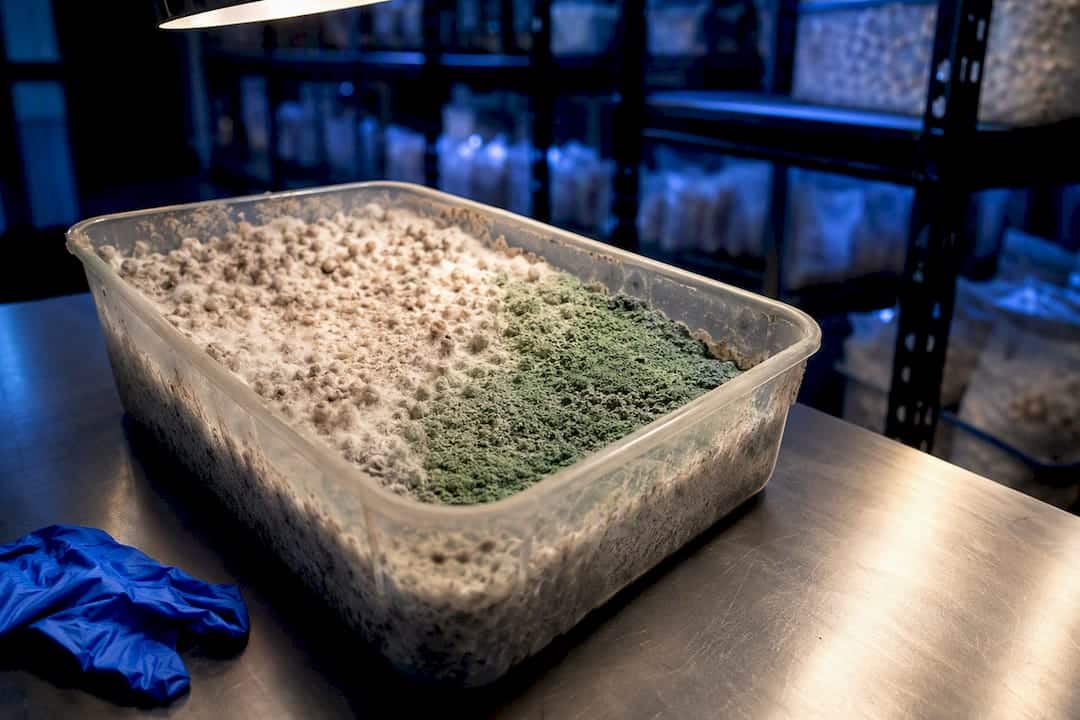
If you see white fluff turning bright green with a faint coconut smell, that’s almost certainly Trichoderma contamination. Never open a sporulating bag or bin indoors without a mask and gloves.
TL;DR:
- Trichoderma initially appears as dense, white mycelium that quickly turns green and sporulates within 24 to 48 hours, often starting at bag seams or ports.
- The fungus feeds on mushroom mycelium by secreting enzymes that break down its cell walls, making it highly destructive once established.
- Early signs include a coconut or sweet moldy smell and rapid growth, which can be confirmed by specific tests like smell, stickiness, or growth rate.
- Rescue is only possible if contamination is surface-level and caught quickly; otherwise, disposal and thorough decontamination are necessary to prevent spread.
- Prevention relies on using vigorous, lab-tested spawn, proper sterilization, pH control, and strict hygiene to give mycelium a competitive advantage over Trichoderma spores.
Table of Contents
- What Does Trichoderma Contamination Look Like?
- Why Does Trichoderma Spread So Fast and Damage Mycelium?
- Should You Rescue or Discard a Contaminated Grow?
- How Do You Prevent Trichoderma Contamination in the First Place?
- How Do You Decontaminate a Grow Room After an Outbreak?
- Is Trichoderma Contamination a Health Risk to People?
- Is Trichoderma Really That Different From Other Contaminants?
- Want a Lower-Risk Way to Start Your Next Grow?
- Where Can You Learn More About Trichoderma Contamination?
- Sources
What Does Trichoderma Contamination Look Like?
Trichoderma starts out looking almost innocent. It emerges as a patch of dense, white mycelium that could pass for healthy growth, which is exactly why so many growers miss the window to act. Within 24 to 48 hours, that white patch develops a yellowish tinge, then blooms into a distinct forest or emerald green as it sporulates. By the time you see solid green, the fungus has already been feeding for a day or two.
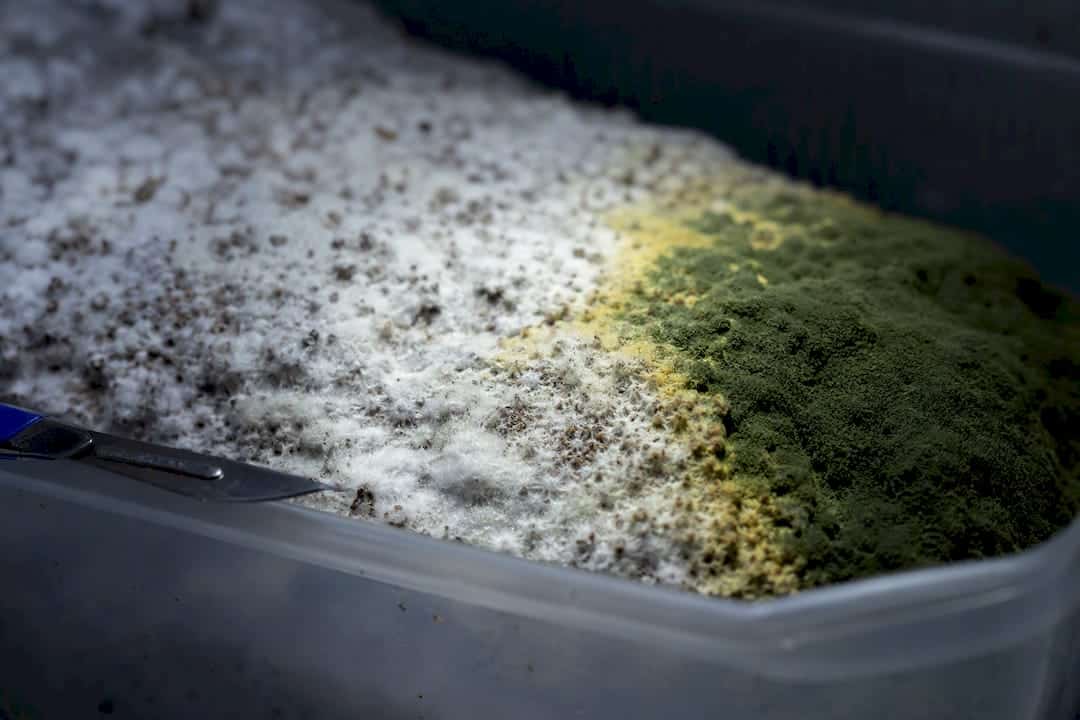
The texture gives it away faster than color sometimes does. Trichoderma mycelium grows tighter and more compact than the fluffy, rope-like strands of healthy oyster or Psilocybe mycelium. It often appears in concentric rings radiating outward from a single point of entry, almost like a target pattern pressed into the substrate.
Location matters too. Trichoderma tends to show up first at bag seams, injection ports, the edges of a monotub, or anywhere air exchange creates a gap in humidity control. These are the exact spots where spores from the room’s air have the easiest entry.
The scent is the most reliable early warning most growers overlook. Trichoderma produces a compound called 6‑PAP that smells distinctly like coconut or sometimes sweet, moldy hay, according to ShroomCraft Lab’s diagnostic guide. If you catch that coconut note before any green is visible, you’re looking at contamination in its earliest, most treatable stage.
A few quick checks help you confirm what you’re looking at before you panic:
- Smell test: Crack the lid or bag briefly and sniff for a coconut or sour, musty note rather than the neutral, earthy smell of healthy mycelium.
- Q-tip test: Lightly press a cotton swab into a suspicious patch. Trichoderma tends to release a faint green dust or leave a slightly slimy residue; clean white mycelium usually doesn’t.
- Light angle check: Tilt the container under a lamp. Healthy mycelium looks matte and fibrous; early Trichoderma often has a slightly wetter, denser sheen before it greens up.
- Growth speed: If a patch doubled in size overnight, that pace is far more typical of Trichoderma than of your intended mushroom species.
False positives happen constantly with beginners. Rhizomorphic mycelium, some cobweb mold (which stays gray and fuzzy, not green), and even certain lighting can trick a new grower’s eye. Cobweb mold grows loosely and collapses when touched; Trichoderma stays dense and doesn’t wilt. When you genuinely can’t tell, isolate the container and send a sample for lab identification rather than guessing.
Pro Tip: Keep a small notebook or phone log of when you first noticed any unusual patch. Trichoderma’s speed is one of its biggest tells, and knowing exactly how many hours passed between “looks fine” and “looks green” helps you and any lab confirm the diagnosis faster.
Why Does Trichoderma Spread So Fast and Damage Mycelium?
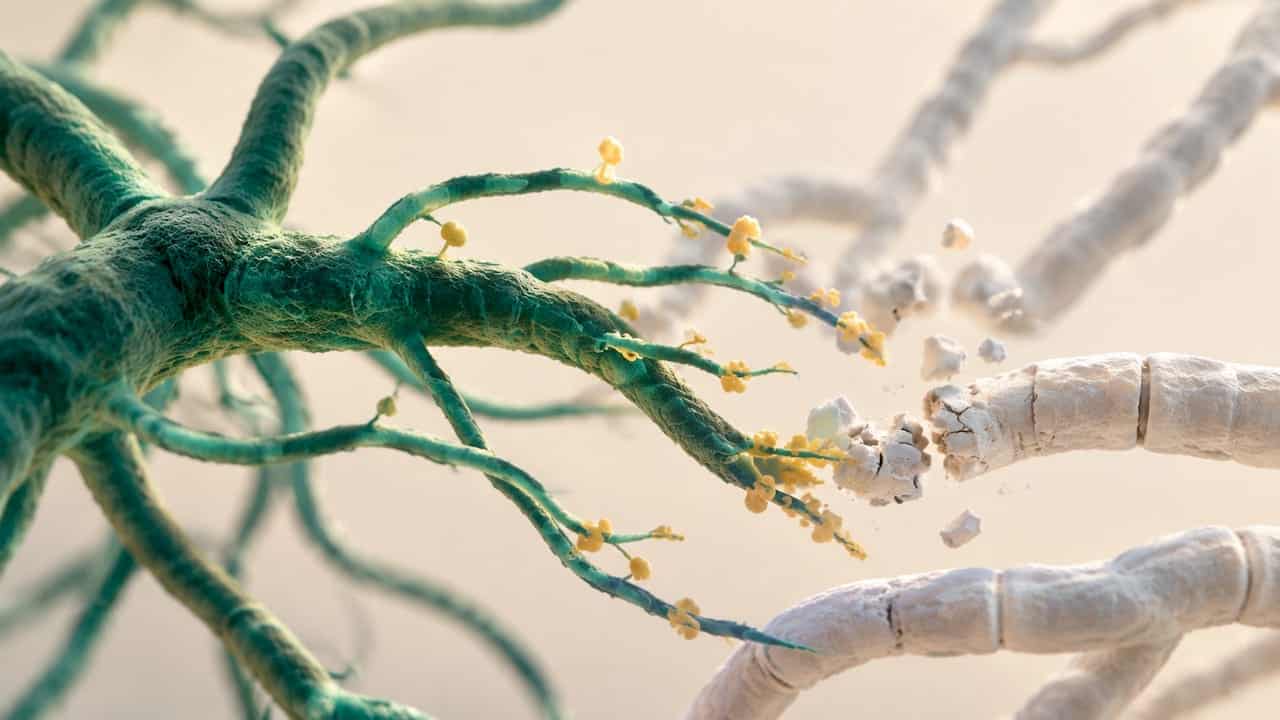
Trichoderma isn’t just a mold competing for space. It’s a mycoparasite, meaning it actively hunts down and digests other fungi, including the mushroom mycelium you’re trying to grow. It does this by secreting chitinases and glucanases, enzymes that break down the cell walls of competing hyphae, according to research on invasive Trichoderma infections. Once those enzymes go to work, your mushroom mycelium doesn’t just get crowded out. It gets eaten.
Spore ubiquity makes this worse. Trichoderma spores are practically everywhere: in soil, compost, wood chips, and floating in ambient air. A single overlooked crack in a fruiting chamber’s seal is often all it takes for spores to land and germinate.
Historical outbreaks in Pennsylvania mushroom houses caused crop losses ranging from 30% to 100% in affected growing rooms, largely traced back to contaminated personnel, tools, and rooms that weren’t steamed thoroughly enough between crops, according to Penn State Extension. That range alone tells you how unforgiving this contaminant can be once it establishes itself at scale.
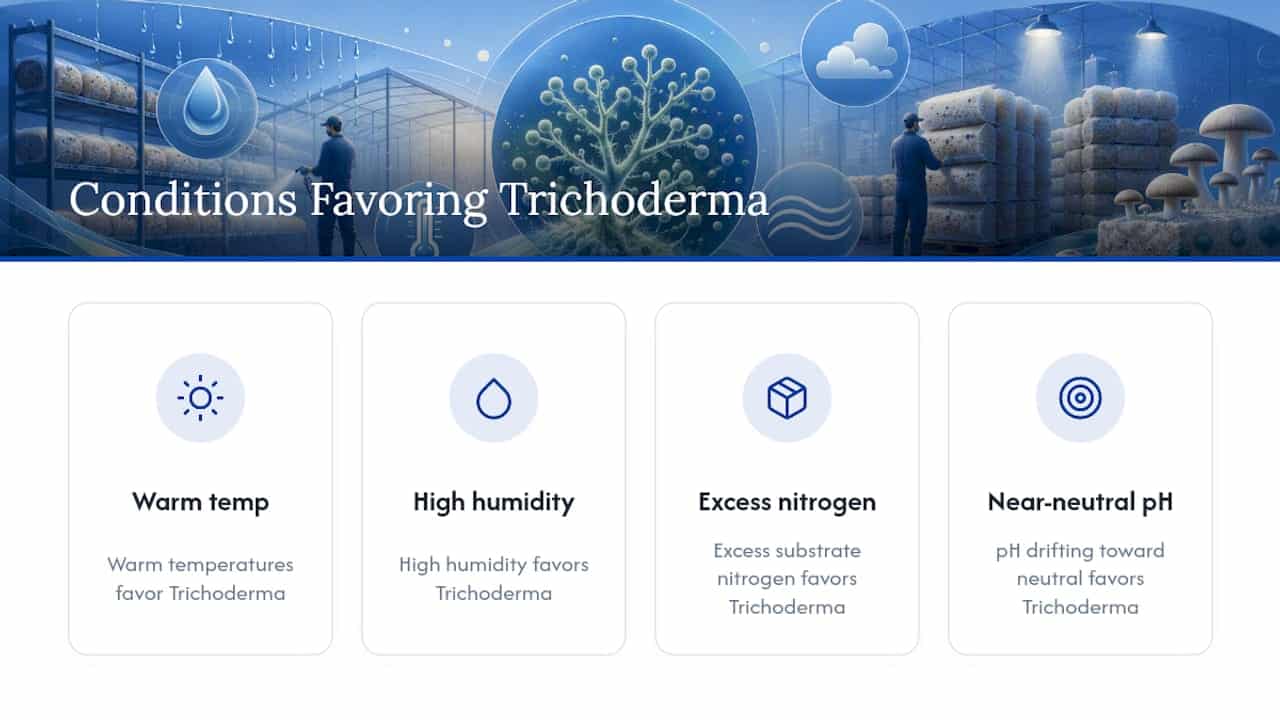
Not all Trichoderma species behave the same way. Some strains are aggressive colonizers that tear through a substrate within days, while others move more slowly and stay localized longer. Warm temperatures, high humidity, excess nitrogen in the substrate, and a pH drifting toward neutral all favor Trichoderma over your intended mushroom species. That’s the environmental sweet spot you’re trying to avoid creating in the first place, and it’s exactly why the prevention steps below focus so heavily on humidity, nitrogen, and pH control rather than treating contamination as pure bad luck.
Should You Rescue or Discard a Contaminated Grow?
The decision comes down to how far the contamination has spread and whether it’s still confined to the surface. Don’t negotiate with substrate that’s contaminated internally. It isn’t salvageable and trying to save it usually just spreads spores around your grow space.
If you’re in rescue territory, work through this sequence:
- Isolate the container immediately. Move it away from other active grows, ideally to a separate room or at minimum a closed container.
- Put on PPE before opening anything. A properly fitted respirator (not just a paper mask), nitrile gloves, and eye protection matter here. Trichoderma spores are a genuine respiratory irritant, and some species carry real infection risk, particularly for people with compromised immune systems, per the Journal of Antimicrobial Chemotherapy’s clinical review.
- Excise the patch with a generous margin. Cut out the visible contamination plus at least an inch of surrounding substrate that looks clean. Use a sterilized blade for each cut and don’t reuse it on healthy areas afterward.
- Treat the cut edges. A 3% hydrogen peroxide solution dabbed directly onto exposed cut surfaces, sometimes combined with a light dusting of table salt, works as an early-stage spot treatment, according to ShroomCraft Lab’s field guidance. Skip bleach on active porous substrate; it’s too harsh and can damage the mycelium you’re trying to save.
- Move the container to a rescue chamber. This should be a separate, lower-humidity space with stronger fresh air exchange (FAE) than your main setup, giving your mushroom mycelium a fighting chance to outcompete any remaining spores.
- Watch daily for 72 hours. Any return of green growth means the rescue failed. Discard immediately rather than trying a second round.
If you’re past the rescue threshold, disposal is about containment, not conservation:
- Double bag the contaminated substrate before it leaves the grow room, sealing each bag before moving it.
- Dispose of it outdoors in regular trash. Don’t add it to a home compost pile unless that pile reliably sustains internal temperatures above 160°F, which most backyard setups don’t.
- Disinfect every tool and surface the contaminated material touched, including the outside of gloves before you remove them.
- Wash your hands thoroughly and change clothes if you were in close contact with a sporulating patch.
Pro Tip: Never shake, blow on, or vacuum a green, sporulating patch. Any of those actions aerosolizes millions of spores into your air, which is the single fastest way to seed contamination into every other grow in the room.
How Do You Prevent Trichoderma Contamination in the First Place?
Prevention beats rescue every time, and it starts before you ever inoculate a substrate. Extension specialists are blunt about this: total elimination of Trichoderma from your environment is not realistic, since spores are essentially everywhere. The real goal is giving your mushroom mycelium such a strong head start that Trichoderma never gets a foothold, an approach Penn State Extension frames as out-competing rather than eliminating the contaminant.
A handful of practices make the biggest difference:
- Start with fresh, lab-tested spawn. Vigorous spawn colonizes faster, and speed is your best defense since Trichoderma needs time and an open niche to establish itself.
- Match your sterilization method to your substrate. Pressure sterilization at 15 PSI for roughly 90 minutes is the standard for nutrient-rich, bran-amended substrates, according to guidance from the AHDB knowledge library on managing Trichoderma in commercial mushroom production. For lower-nutrient lignocellulosic materials like straw or sawdust, hot-water immersion at moderate temperatures for extended periods or immersion in alkalinized water have been shown in controlled experiments to reduce Trichoderma growth, offering gentler alternatives to full sterilization.
- Don’t over-sterilize and then re-expose. Sterilized substrate that gets re-inoculated with even trace Trichoderma can actually favor the contaminant, because sterilization wipes out the competing microflora that would normally help keep it in check, a finding documented in research on lignicolous mushroom cultivation.
- Watch your nitrogen levels. Excess nitrogen supplementation shifts your carbon-to-nitrogen ratio in a direction Trichoderma exploits. Balance is more protective than piling on extra nutrients.
- Buffer your casing layer with hydrated lime. Raising casing pH above roughly 8.0 with calcium hydroxide inhibits Trichoderma spore germination while most gourmet mushroom mycelia tolerate the shift fine. Test on a small batch first since tolerance varies by species and strain.
- Run a sealed chamber with scheduled fresh air exchange. Growers using app-controlled or timer-based FAE report noticeably fewer green mold incidents than those relying on manual humidity tents, based on operator observations from Lykyn’s grower guide.
- Enforce clean-handling discipline. Dedicated grow-room clothing, tools that never touch outdoor soil or compost, and a habit of washing hands before opening any container all close off the entry points Trichoderma relies on most.
Reliable spawn is worth emphasizing on its own. If you want a deeper look at how spawn vigor drives faster colonization and stronger competitive resistance, our guide to growing B+ mushrooms with 100% mycelium walks through exactly why that head start matters.
How Do You Decontaminate a Grow Room After an Outbreak?
Once contaminated material is gone, the room itself still needs real attention before you restart anything. Skipping this step is how a single outbreak turns into a recurring problem.
- Empty the space completely and dispose of all contaminated substrate, casing, and disposable liners before cleaning anything else.
- Wipe down every hard surface with a disinfectant appropriate for the material. Diluted bleach solutions work well on non-porous surfaces like plastic bins and metal shelving, with a contact time of at least 10 minutes before rinsing.
- Replace anything porous that touched the contamination directly. Foam gaskets, cloth filters, and cardboard simply can’t be reliably sterilized.
- Clean or replace HVAC filters, humidifier reservoirs, and any HEPA filtration in your fruiting chamber, since spores lodge in these far more than most growers expect.
- Consider ozone or UV treatment for a persistent recurring problem in a dedicated grow space, but only with proper ventilation and never while people or pets are present in the room.
- Wait at least 48 to 72 hours after cleaning, then run an empty test cycle to confirm no green growth appears before introducing a new batch.
Pro Tip: Run a clean, uninoculated substrate sample through your decontaminated room for a few days as a canary test. If it stays clean, your room is genuinely ready. If green shows up on the test sample, you’ve got a lingering source somewhere you haven’t found yet.
Is Trichoderma Contamination a Health Risk to People?
For most healthy growers, brief exposure to Trichoderma spores causes mild respiratory irritation at worst, similar to reacting to any household mold. The bigger concern is for people who are immunocompromised, where certain species have been linked to genuinely invasive infections rather than just surface irritation, according to clinical reviews of Trichoderma infections.
A few points worth keeping in mind:
- Some strains produce mycotoxins, including gliotoxin, which is one more reason contaminated mushrooms should never be eaten, harvested, or salvaged for consumption.
- Growers with chronic lung conditions, autoimmune disorders, or suppressed immunity should avoid handling sporulating material entirely and let someone else manage disposal if possible.
- Seek medical attention if you develop persistent respiratory symptoms, skin irritation that doesn’t resolve, or any fever following heavy exposure, and tell your clinician specifically that you were exposed to Trichoderma mold spores and mention your immune status.
Is Trichoderma Really That Different From Other Contaminants?
Most beginner troubleshooting guides lump Trichoderma in with cobweb mold, black pin mold, and bacterial wet spot as if they’re roughly interchangeable problems. They’re not. Cobweb mold is mostly a nuisance you can often out-grow with a light hydrogen peroxide misting. Trichoderma is a predator with a chemical arsenal built specifically to break down fungal cell walls, and that distinction should change how seriously you treat the first sighting.
What surprises a lot of new growers is that sterilization, the step everyone assumes is the safest possible substrate prep, isn’t automatically the winning move against this particular contaminant. Wiping out the competing microbial community on a substrate and then reintroducing even a trace of Trichoderma can hand it an open field with no rivals left to slow it down. That’s a genuinely counterintuitive result, and it’s why matching your prep method to your substrate type matters more than defaulting to the most aggressive-sounding option.
The other thing worth saying plainly: rescue attempts fail more often than beginner forums admit. Anything beyond that is usually money and time better spent starting clean than fighting a losing battle and risking your entire growing space in the process. Starting with pre-colonized, lab-tested material removes a huge share of the guesswork that leads to contamination in the first place, simply because you’re not the one managing every variable from raw grain to first pins.
— Alex
Want a Lower-Risk Way to Start Your Next Grow?
Every prevention step above boils down to one idea: give your mycelium the fastest possible head start so contaminants never get a foothold. A pre-colonized, lab-tested starter block does exactly that by skipping the riskiest phase of the process, the early grain-to-substrate window where most home contamination actually begins.
Some suppliers build their kits around that principle. Look for three things in any kit you consider: documented lab testing for contaminants, clear step-by-step instructions that match your experience level, and a support channel you can actually reach if something looks off. Our 100% mycelium B+ grow kit guide breaks down what fast, verified colonization looks like in practice, and our grow kit FAQ covers the troubleshooting questions beginners ask most. If you’re ready to skip the highest-risk stage of the process entirely, browse our full lineup of fresh grow kits and pick a starter block built to outcompete contamination from day one.
Where Can You Learn More About Trichoderma Contamination?
For deeper reading beyond this guide, Penn State Extension’s green mold overview remains the standard reference on outbreak patterns and prevention in commercial settings. The peer-reviewed study on substrate treatments offers the experimental data behind hot-water and alkaline immersion methods. For the clinical side, the Journal of Antimicrobial Chemotherapy’s review of invasive infections and the PMC review on Trichoderma harzianum safety cover human health risk in detail. For hands-on species identification, ShroomCraft Lab’s diagnostic guide remains one of the most practical field references available.
Sources
- Green mold of mushrooms (Penn State Extension)
- Efficiency of treatments for controlling Trichoderma spp during spawning in cultivation of lignicolous mushrooms
- Invasive Trichoderma spp. infections: clinical presentation and outcome (Journal of Antimicrobial Chemotherapy)
- How to Identify Trichoderma: Technical Diagnosis of the Green Monster — ShroomCraft Lab
Recommended

Psilocybin Legal Status: 4 Steps to Verify U.S. and Global Rules
Psilocybin remains a Schedule I controlled substance under federal law, meaning possession, cultivation, and distribution are federal crimes anywhere in the United States. Oregon and Colorado are the two exceptions that matter: both run state-licensed programs where adults can legally access supervised psilocybin experiences. More than 30 U.S. cities have deprioritized enforcement, but that’s a policing choice, not a change to state or federal law, and it offers no real protection if you’re caught with mushrooms.
TL;DR:
- Federal law classifies psilocybin as a Schedule I drug, making possession and distribution illegal nationwide, despite some state and city decriminalization efforts.
- Oregon and Colorado have established regulated frameworks for supervised psilocybin use, but both programs operate within strict on-site, supervised models that do not legalize take-home possession.
- The lack of FDA approval for psilocybin-based medicines means it remains in Schedule I until clinical trials in progress conclude, which could take several years.
- City deprioritization policies reduce enforcement but do not change the legal status of psilocybin, and crossing jurisdictions or borders still involves federal legal risks.
- International legal approaches vary, with some countries allowing personal use or selective legality of certain product forms, but most still treat psilocybin as a controlled substance without broad legal access.
Table of Contents
- Is Psilocybin Legal Under Federal Law?
- Where Are Oregon and Colorado Different From Everywhere Else?
- What Does City Deprioritization Actually Change?
- How Do Other Countries Handle Psilocybin?
- What’s Driving Legal Change Right Now?
- What Are the Real Legal Risks of Using or Carrying Psilocybin?
- How Do You Check the Actual Law Where You Live?
- Publisher Resources for Safety and Education
- What Should Readers Watch for Next?
- Explore Fungipsilocybinmushroom’s Safety and Product Resources
- Sources
Is Psilocybin Legal Under Federal Law?
No. Psilocybin sits in Schedule I of the Controlled Substances Act, the same tier as heroin, reserved for substances the DEA considers to have a high potential for abuse and no accepted medical use. That classification makes possession, growing, selling, or transporting psilocybin mushrooms a federal offense in all 50 states, regardless of what your city council or state legislature has done. The DEA’s drug scheduling framework hasn’t budged on psilocybin, and as of September 2026, there’s still no FDA-approved psilocybin medicine on the market.
That last point matters more than people realize. Schedule I status isn’t just a label. It’s tied to a specific legal finding that a drug has no accepted medical use, and the primary way to overturn that finding is for the FDA to approve a drug containing it. Two things have to happen, in sequence, before psilocybin could move to a lower schedule or off the schedule entirely:
- A drug maker completes Phase 3 clinical trials and files a New Drug Application with the FDA.
- The FDA approves that application, which then gives the DEA legal grounds to reschedule the compound (or the DEA moves on its own through administrative rescheduling, a rarer and slower path).
Neither has happened yet. Compass Pathways and Usona Institute both have Phase 3 programs in progress, and their outcomes are the single biggest lever on federal change. The FDA’s drug approval process explains why this takes years rather than months: trial data has to hold up, manufacturing standards have to be locked in, and safety signals get scrutinized across thousands of patient hours before anything reaches a pharmacy shelf.
Federal Schedule I status means no FDA-approved psilocybin drug exists nationwide as of September 2026, and every state-level program operates as a carve-out, not a challenge to that federal baseline.
The practical fallout from Schedule I status goes beyond criminal exposure. Federal employees and contractors can face termination or security clearance denial for psilocybin use, even where a state has legalized it. Immigration consequences can be severe. A drug conviction, or in some cases even an admission of drug use, can affect a green card application or naturalization case. Crossing state lines with mushrooms, even from a legal-access state to another, is a federal transport issue because it treats the substance as contraband the moment it crosses a border the federal government controls.
Where Are Oregon and Colorado Different From Everywhere Else?
Oregon and Colorado are the only two states that have built regulated frameworks for legal psilocybin access, and they took different routes to get there.
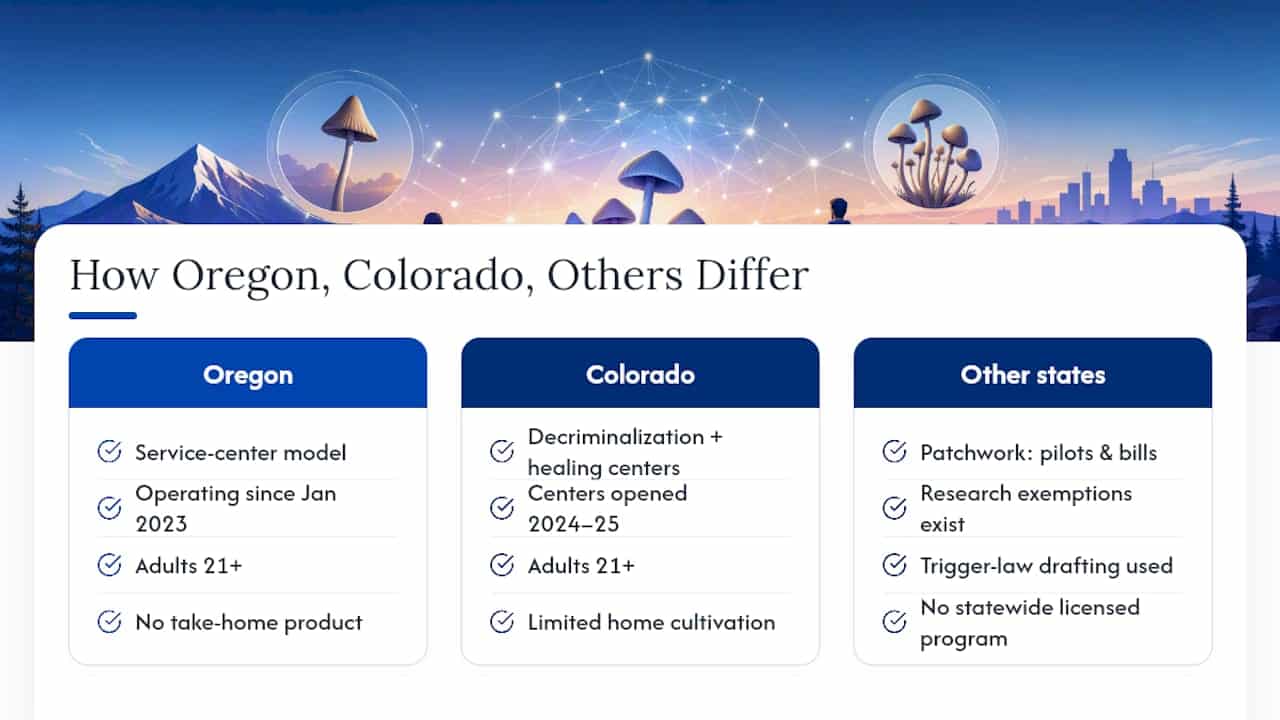
Oregon passed Measure 109 in 2020, and the resulting service center model has been operating since January 2023. Adults 21 and older can book a supervised psilocybin session at a state-licensed service center, but there’s no prescription involved and no take-home product. You consume it on-site, under supervision, and leave without any mushrooms in your possession. More than 100 licensed centers were operating by 2026, and a typical session runs $1,800 to $3,500, a price point that reflects facilitator time, facility costs, and the multi-hour commitment a full session requires. The Oregon Health Authority regulates the program, and in 2026 it merged its psychedelic mushroom oversight with its medical marijuana regulatory arm, partly to address budget shortfalls. That merger came with proposed licensing fee increases, a reminder that these programs are still finding their financial footing years after voters approved them.
Colorado took a broader approach with Proposition 122 in 2022. It decriminalized personal possession, use, and limited home cultivation and sharing for adults, on top of building a licensed healing-center framework similar in spirit to Oregon’s. Licensed centers began opening in 2024 and 2025, regulated through the state’s Division of Professions and Occupations. The distinction that trips people up: decriminalization under Prop 122 applies broadly to personal use, while the licensed healing-center piece is the supervised, paid-session model, closer to what Oregon offers. Both tracks exist side by side under state law.
Outside these two states, the picture is a patchwork of pilot programs, research exemptions, and bills that haven’t crossed the finish line. Several states have introduced legislation modeled on Oregon or Colorado, and a growing number have adopted what’s called trigger law language, meaning a statute that only activates certain psilocybin allowances if and when the FDA approves a psilocybin drug or the DEA reschedules it. That drafting choice matters because it determines how fast a state could move if federal rules change. A state with a trigger law already on the books could have a functioning program within months of federal rescheduling. A state starting from zero would need years to write and pass new legislation.
Pro Tip: Before assuming any state “allows” psilocybin, check whether the law is a full decriminalization statute, a licensed-access program, or just a pending bill that hasn’t passed yet. All three get reported in the news using similar language, and conflating them is one of the most common mistakes readers make.
State law and federal law don’t cancel each other out. Oregon and Colorado residents using licensed programs are still technically violating federal law, even though federal prosecutors have shown little interest in pursuing individual users in states with regulated access. That gap between what’s tolerated and what’s technically illegal is the defining feature of psilocybin law in 2026.
What Does City Deprioritization Actually Change?
Not much, legally speaking. City deprioritization is a local government or district attorney’s decision to make psilocybin enforcement the lowest law enforcement priority, or to direct police and prosecutors not to pursue simple possession cases. It’s an administrative directive, not a change to the underlying statute. The mushrooms are still illegal under state and federal law in every deprioritized city. What changes is the likelihood that local police will make an arrest or that a local prosecutor will file charges.
More than 30 U.S. cities have passed some version of this policy, including well-known examples like Denver (which deprioritized psilocybin before Colorado’s statewide measure passed), Oakland, Santa Cruz, Ann Arbor, and Seattle. Each city’s policy language differs slightly. Some cover only personal possession; others extend to cultivation for personal use or gifting between adults.
Two limitations deserve attention:
- Deprioritization can be reversed by a new city council, a new district attorney, or a new police chief without any ballot measure or legislative vote.
- It provides zero protection outside city limits. A deprioritized city sitting inside a state where psilocybin is still fully criminalized doesn’t change your legal exposure the moment you cross into county jurisdiction, drive to a neighboring town, or get stopped by state or federal authorities rather than local police.
Reporters and advocates often blur the line between local deprioritization and actual decriminalization, and that confusion creates false expectations for people who assume “my city deprioritized it” means “it’s legal here.” It doesn’t. It means enforcement is a lower priority, which is a meaningfully different thing than the possession laws actually changing.
How Do Other Countries Handle Psilocybin?
International approaches to psilocybin fall into four rough categories: fully scheduled and criminalized, decriminalized for personal use, regulated medical access, and a gray zone where a specific product form (like fresh truffles) is tolerated while dried mushrooms remain illegal.
The Netherlands is the clearest example of that last category. Dried psilocybin mushrooms have been banned since 2008, but psilocybin-containing truffles remain legal for sale in licensed smartshops because they weren’t included in the original ban’s plant classification. Visitors to Amsterdam regularly buy truffles legally while assuming, incorrectly, that mushrooms carry the same status.
A few other notable examples:
- Jamaica has never scheduled psilocybin mushrooms, which has made it a hub for commercial retreat centers operating in a genuinely unscheduled legal environment rather than a gray area.
- Brazil doesn’t explicitly schedule psilocybin mushrooms, and that regulatory ambiguity has allowed retreat operators to run legally ambiguous but practically tolerated businesses.
- Canada doesn’t have broad legal access, but its Special Access Program allows physicians to request psilocybin for patients with serious or life-threatening conditions who haven’t responded to standard treatments, a narrow medical exception rather than general legalization.
- Many other countries, including most of the EU beyond the Netherlands’ truffle carve-out, still treat psilocybin as a fully scheduled controlled substance with no legal personal-use pathway.
If you’re planning to attend a retreat abroad, verifying legal status is only half the job. Retreat legitimacy and medical staffing vary enormously even within countries where the practice is tolerated. A center operating in a legal gray zone in Brazil or Jamaica may or may not have a physician on-site, may or may not screen for contraindicated medications or heart conditions, and may or may not carry any liability insurance. Country-level legality tells you whether you’ll get arrested. It tells you nothing about whether the facilitators know what they’re doing.
Access even within legal state programs isn’t as open as headlines suggest. Cost and geography limit uptake in both Oregon and Colorado, since licensed sessions aren’t covered by mainstream insurance and centers remain concentrated in a handful of metro areas rather than spread statewide.
What’s Driving Legal Change Right Now?
Three forces are shaping where psilocybin law goes next: ballot initiatives, trigger laws, and the clinical trials that could unlock federal rescheduling.
Ballot measures have had a mixed record. Oregon’s Measure 109 and Colorado’s Prop 122 both passed, but similar measures in other states have stalled at the signature-gathering stage or failed outright at the ballot box. That inconsistency reflects genuine public split on the issue rather than a clear national trend in one direction. Some states are instead moving through the legislature, introducing bills that mirror the Oregon service-center model or Colorado’s decriminalization-plus-licensing structure, with mixed success getting them out of committee.
Trigger laws are the quieter but arguably more important development. These are statutes drafted so that certain psilocybin allowances only activate once the FDA approves a psilocybin-based drug or the DEA reschedules the compound. States adopting this language are essentially pre-positioning themselves for a federal change they can’t control the timing of, so they can move quickly instead of starting the legislative process from scratch. Watching policy trackers is the most reliable way to see which states have this language on the books and which bills are actively moving.
The clinical trial pipeline is the piece that could reshape everything else. Compass Pathways’ COMP360 and Usona Institute’s IPR001 are both in Phase 3, the last stage before an FDA New Drug Application. Neither has produced an approved drug as of mid-2026, but a successful outcome for either program would be the strongest catalyst for federal rescheduling that currently exists. It would also likely accelerate every trigger law sitting on a state’s books, turning conditional statutes into active law almost overnight.
None of this means change is imminent. Phase 3 trials, FDA review, and any subsequent DEA rescheduling process typically take years even in a best-case scenario. Readers tracking this space should expect incremental movement, not a single announcement that flips the legal picture nationwide.
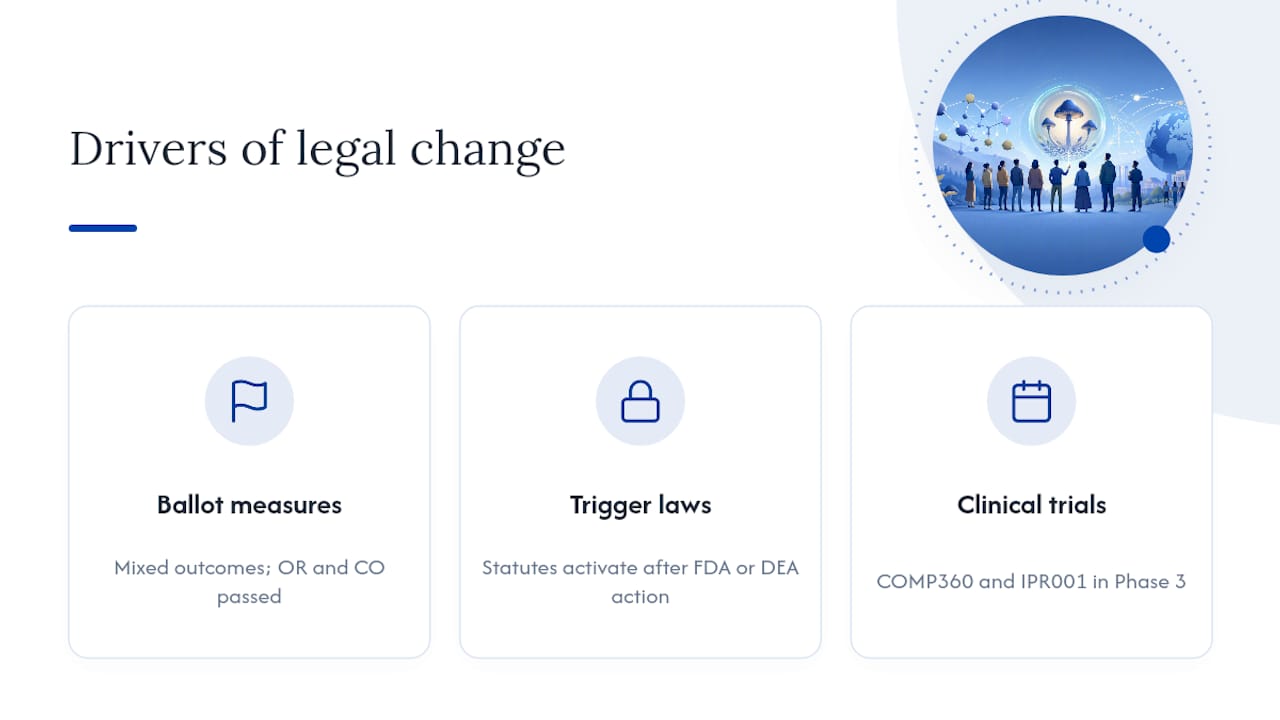
What Are the Real Legal Risks of Using or Carrying Psilocybin?
Federal prosecution of individual users for simple possession is uncommon in practice, but “uncommon” isn’t “impossible,” and the variables that push a case toward prosecution include quantity, intent to distribute, prior record, and whether the case intersects with another federal matter (a border stop, an immigration proceeding, a firearms investigation). Federal resources tend to focus on distribution and trafficking rather than personal use, but that pattern isn’t a guarantee, and it can shift with political priorities.
Collateral consequences often matter more than the criminal charge itself:
- Federal employees, contractors, and security-clearance holders can lose their jobs or clearance over psilocybin use, even in a legal-access state.
- Immigration consequences can include denial of a green card, naturalization, or reentry, since federal immigration law treats controlled substance violations harshly regardless of state legality.
- Federal benefits and firearms eligibility can both be affected by a drug conviction, since federal law prohibits firearm possession by unlawful drug users.
- Child custody proceedings sometimes treat psilocybin use as evidence of impaired judgment, even where the underlying use was legal under a state program.
Transporting psilocybin across any border, state or international, carries outsized risk compared to using it in a fixed location. Crossing state lines turns simple possession into a potential federal trafficking or transport issue, and crossing an international border adds customs law and the receiving country’s own statutes on top of that. Airports and ports of entry are federal jurisdiction by definition, which erases any state-level protection the moment you’re in that space.
Different product forms also get treated inconsistently. Spores are legal to possess in most U.S. states because they don’t contain psilocybin themselves, even though germinating them into mushrooms is illegal almost everywhere spores are sold. Edibles and concentrates sometimes fall into legal gray areas that dried mushroom possession doesn’t, simply because older statutes were written before those product forms existed.
Pro Tip: If you’re relying on a state’s licensed program, keep documentation of your session (receipts, facility licensing info) rather than any product. Oregon and Colorado programs are built around consumption on-site, and carrying product away from a licensed facility puts you outside the protection the program was designed to offer.
How Do You Check the Actual Law Where You Live?
Verifying psilocybin’s legal status where you live, or where you’re traveling, takes a few concrete steps rather than a single Google search.
- Start with the DEA’s scheduling page to confirm the federal baseline hasn’t changed.
- Check your state legislature’s official website for the actual statute text, not a news summary, and note its effective date.
- If your state has a licensed program (currently Oregon or Colorado), review the regulating agency’s site (Oregon Health Authority or Colorado’s Division of Professions and Occupations) for current licensing rules and any recent fee or policy updates.
- Cross-reference with a dedicated tracker, since these compile bill numbers, ballot text, and municipal measures in one place.
A few resources are worth bookmarking rather than searching for each time:
- The Psychedelic Alpha law and policy tracker for near-real-time updates on state bills and municipal measures.
- The Berkeley Center for the Science of Psychedelics law and policy map for a state-by-state legal overview.
- Your state’s official legislative website for primary statute text, which always outranks a news article’s summary of that text.
Practical risk reduction comes down to a short list: never transport psilocybin across state or international borders, consult an attorney before assuming any high-stakes use case (employment, custody, immigration) is safe, and if you’re using a licensed state program, keep records showing you followed its rules.
Publisher Resources for Safety and Education
A reputable supplier maintains lab-testing standards across its product catalog and publishes harm-reduction material because legal access and safe use are two separate problems that both deserve real answers. Readers researching dosing guidance will find practical, experience-level breakdowns rather than vague advice, and the site’s broader psilocybin education hub covers everything from strain differences to how psilocybin compares with other psychedelics.
None of this is legal advice. Nothing in this article should be read as a recommendation to violate any law in your jurisdiction. Laws vary by state and country, change over time, and carry consequences that a general information page can’t account for. If you’re facing a specific legal question, a licensed attorney in your jurisdiction is the only reliable source for advice you can act on.
What Should Readers Watch for Next?
Phase 3 results from Compass Pathways and Usona Institute are the single biggest variable to track over the next few years. A positive outcome would likely accelerate trigger laws already sitting in multiple state legislatures, turning conditional statutes into active programs faster than a normal legislative process would allow. Short of that, expect the current pattern to continue: more cities deprioritizing enforcement, a handful of states experimenting with pilot programs, and Oregon and Colorado working out the operational kinks in their licensing systems.
My advice is unglamorous but durable: verify the actual statute before you act, not a headline or a friend’s summary of one. Use trackers like Psychedelic Alpha for anything time-sensitive, and treat state-level access as narrower and more conditional than most coverage implies.
— Alex
Explore Fungipsilocybinmushroom’s Safety and Product Resources
Understanding where psilocybin stands legally is only useful once you’re also thinking about quality and safety; reputable vendors typically ensure their products ship with lab-testing so users know what they’re taking. That matters more in a legal landscape this fragmented, where the substance itself often isn’t the risky part of the equation, but an untested, unverified source can be.
For readers exploring options, the Copelandia Cyanescens listing shows what a rigorously tested, high-potency strain looks like on the market, and the therapeutic strains guide breaks down options by experience level rather than marketing hype. Fungipsilocybinmushroom ships discreetly worldwide and backs every order with the same testing standards discussed throughout this guide. Browse the current catalog and see which strain fits your experience level before you place an order.
This article is general information, not a substitute for advice from a qualified lawyer. Consult a qualified legal professional about your own circumstances before acting on anything here.
Sources
Recommended

0.05–0.5 g Microdosing Psilocybin: Science Informed Safety for Beginners
Microdosing means taking a sub-perceptual amount of psilocybin, typically somewhere between 0.05 and 0.5 grams of dried mushroom, often enough to notice subtle shifts in mood or focus but not enough to trip. The evidence for real benefit beyond placebo is still thin and mixed. If you’re going to try it anyway, the conservative starting points recommended by harm-reduction sources involve low doses taken on schedules such as the Fadiman one day on, two days off pattern, with medical consultation advised if you have any heart, mood, or psychiatric history.
TL;DR:
- Dosing doses around 0.1 grams of dried mushrooms roughly equal 1 milligram of psilocybin, but potency varies widely between batches.
- A week-long homogenous batch of ground mushrooms ensures accurate measurement, while pre-measured, lab-verified capsules reduce variability.
- The Fadiman schedule (one day on, two off) is common, but clinical trials often use once or twice weekly doses over 4 to 8 weeks, with deliberate breaks afterwards.
- People with psychosis, bipolar disorder, or unstable heart conditions should avoid microdosing without medical supervision due to significant health risks.
- Expectancy bias influences subjective effects; structured tracking and blinded testing help distinguish real benefits from placebo effects.
Table of Contents
- Quick Starter Checklist Before Your First Microdosing Psilocybin Guide Cycle
- Dosing Explained: Grams, Milligrams, and How to Find a Safe Starting Point
- Protocols and Schedules: Fadiman, Stamets, and What Clinical Trials Actually Test
- Safety, Contraindications, and Drug Interactions You Need to Know
- Legal Status Snapshot and How to Reduce Your Legal Risk
- How to Track Effects and Tell If Microdosing Is Actually Working
- Practical How-To: Sourcing, Preparing, Dosing, and Storing Your Supply
- What Beginners Consistently Get Wrong About Microdosing
- Fungi Psilocybin Mushroom: Lab-Tested Options for a Safer Microdosing Cycle
- Where to Go Next for the Research Behind This Guide
- Sources
Quick Starter Checklist Before Your First Microdosing Psilocybin Guide Cycle
Before you weigh out a single milligram, run through a short readiness check. Rushing this step is where most beginners create problems for themselves later.
- Check for red flags first. A personal or family history of psychosis, schizophrenia, or bipolar disorder is a reason to skip microdosing entirely, and anyone with unstable heart disease or on psychiatric medication should talk to a clinician before starting. If you take an MAOI or a serotonergic medication, stop here and get medical advice.
- Gather the right supplies. You need a precision scale accurate to at least 0.01 grams (10 mg), or pre-measured, lab-tested capsules if you’re buying finished product. Add a simple paper or app-based dosing log and a timer or calendar reminder so doses don’t get taken erratically.
- Set your baseline, then start small. Track your mood, sleep, and focus for a few days before your first dose. Pick the most conservative dose you can (0.05 to 0.1 g), choose a schedule like Fadiman’s one-on/two-off pattern, and begin.
A trusted source matters as much as the scale. Potency varies wildly between batches, and starting a dosing schedule with an unverified product undermines every other precaution on this list.
Dosing Explained: Grams, Milligrams, and How to Find a Safe Starting Point
Dried mushroom weight and psilocybin content are not the same measurement, and confusing them is the single most common beginner mistake. Dried Psilocybe cubensis potency swings from roughly 0.5% to over 1% psilocybin by weight depending on the strain, growing conditions, and how it was dried. That means a gram of one batch might carry twice the active compound of a gram from another source.
Community-reported microdose ranges run from about 0.05 to 0.5 grams dried mushroom, a wide spread that reflects just how inconsistent home dosing tends to be. A systematic review covering 11 studies and 3,262 adults found dried-mushroom microdoses reported across that same 0.05 to 1.0 gram range, with extreme heterogeneity in protocols and low certainty of evidence overall. Clinical trials, by contrast, tend to standardize around 2 mg of pure psilocybin, a dose chosen precisely because it removes the guesswork that plagues home dosing.
Here’s roughly how the two units relate, assuming an average potency batch:
- 0.1 g dried mushroom ≈ roughly 1 mg psilocybin, depending on strain potency.
- 0.2 to 0.25 g dried mushroom ≈ roughly 2 mg psilocybin, close to the dose used in several clinical trials.
- 0.5 g dried mushroom ≈ the dose used in a double-blind placebo-controlled study that found no consistent improvement in creativity or cognition at that level.
Because potency varies so much, weighing a single mushroom cap and guessing its strength is unreliable. The better approach is homogenizing an entire batch: grind multiple dried mushrooms from the same harvest into a fine, even powder, then weigh individual doses from that powder. This evens out the hot spots and weak spots that exist in any single mushroom.
If you’d rather skip the grinding and weighing altogether, pre-made extract or whole-mushroom capsules with lab-verified potency remove most of the variability. That’s the appeal of buying capsules with a batch test attached rather than eyeballing a dried cap from an unknown source.
Titration protocol, step by step:
- Start at the low end, 0.05 to 0.1 g dried (or the capsule equivalent), never higher on day one.
- Hold that dose for at least three to four dosing sessions before changing anything. One dose tells you almost nothing.
- If you notice no effect and no side effects after several sessions, increase by a small increment, no more than 0.05 g at a time.
- Never double a dose to “catch up” or chase a stronger effect. If a dose feels too strong (anxiety, restlessness, noticeable perceptual changes), scale back immediately.
- Keep every other variable steady while titrating. Sleep, caffeine, food timing, and stress levels all interact with how a dose feels, so changing several things at once makes it impossible to tell what caused what.
Pro Tip: Weigh out an entire week or cycle of doses in one sitting, right after you’ve homogenized your batch. Doing the math and measuring once, rather than eyeballing a fresh dose every dosing day, is where most measurement errors sneak in.
Protocols and Schedules: Fadiman, Stamets, and What Clinical Trials Actually Test
The Fadiman protocol, named for psychologist James Fadiman, follows a one-day-on, two-days-off rhythm: dose on day one, take two full days off, then repeat. The two off-days are meant to prevent tolerance buildup and give you a clear baseline to compare against on non-dosing days. It’s the most widely cited self-experimentation schedule in microdosing communities, largely because it’s simple to follow and easy to track.
The Stamets protocol, associated with mycologist Paul Stamets, runs a tighter cycle: four days on, three days off, often stacked with lion’s mane mushroom and niacin, based on a theory about neurogenesis that hasn’t been tested in controlled human trials. It’s more intensive than Fadiman’s approach and carries more cumulative exposure across a given month, which matters if you’re trying to minimize chronic dosing risk.
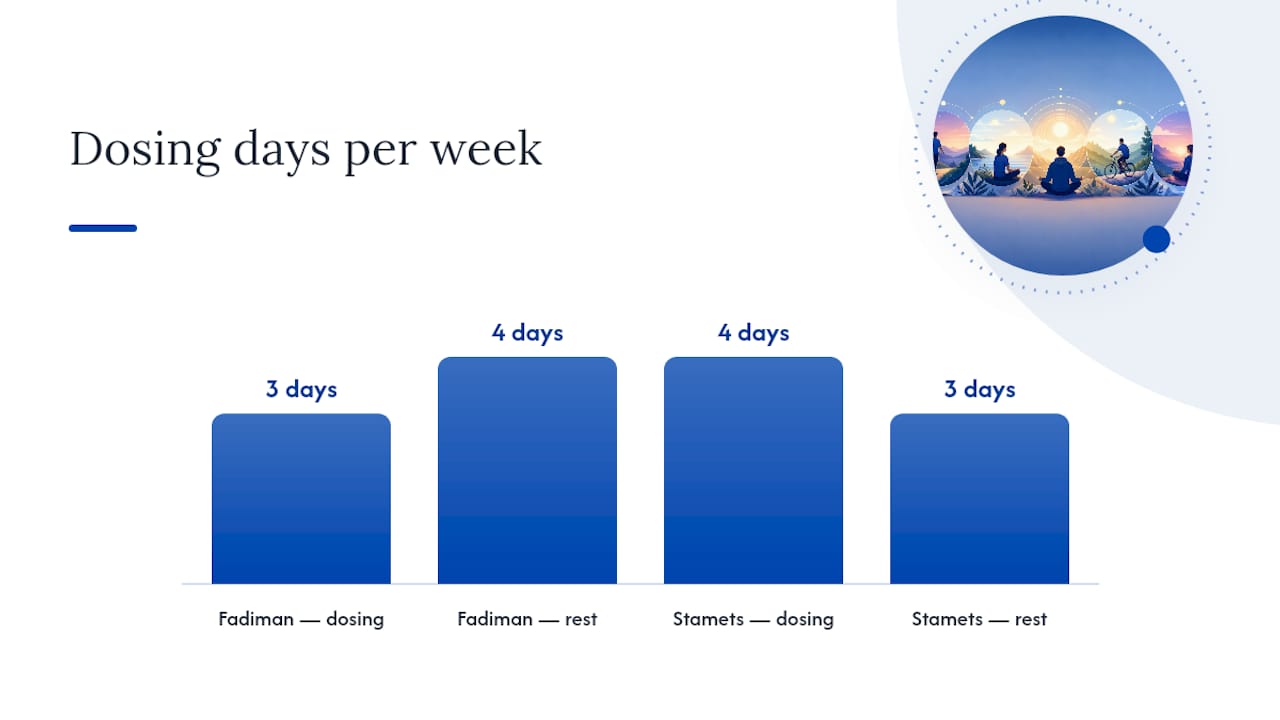
Clinical research looks different from either community protocol. Trials testing repeated low doses of psilocybin have used schedules ranging from once weekly to several times a week, generally over windows of 4 to 8 weeks, with some phase II trial designs extending follow-up monitoring out to two years to catch delayed or cumulative effects that a short study would miss.
Choosing and managing a schedule:
- If your goal is mood tracking with minimal exposure, Fadiman’s one-on/two-off pattern gives you the most rest days relative to dosing days.
- If you’re specifically trying to mirror clinical dosing patterns, a once or twice weekly 1 to 2 mg dose better resembles what trials actually test.
- Cap any cycle at 4 to 8 weeks before taking a deliberate break of at least two to four weeks. This mirrors the duration windows used in trial evidence rather than open-ended, indefinite use.
- Stop immediately, not just pause, if you notice mood worsening, sleep disruption, anxiety climbing, or any cardiovascular symptoms.
- Reassess after each cycle using your own tracked data before deciding to continue, adjust, or stop entirely.
There’s no clinically validated protocol that beats the others. What exists is a patchwork of anecdotal regimens that have never been directly compared in a controlled trial, which is exactly why the schedule you pick should be less important to you than the tracking you do while following it.
Safety, Contraindications, and Drug Interactions You Need to Know
Certain groups should not microdose, full stop. A personal or family history of psychosis, schizophrenia, or bipolar disorder puts you at meaningfully elevated risk, since psilocybin can trigger or worsen manic or psychotic episodes even at low doses. Unstable heart disease is a separate concern, discussed below in more detail.
Contraindications and interaction risks:
- Personal or family history of psychosis, schizophrenia, or bipolar disorder.
- Unstable or serious cardiovascular disease.
- Current use of MAOIs, which can interact dangerously with serotonergic compounds.
- Current use of SSRIs, SNRIs, lithium, or other psychiatric medications that affect serotonin signaling, where interactions are poorly studied at microdose levels.
- Pregnancy or breastfeeding, where no safety data exists at any dose.
- Active substance use disorder, where introducing another psychoactive substance complicates recovery and monitoring.
What the evidence actually shows: A phase II randomized trial of 39 adults with major depressive disorder tested repeated 2 mg psilocybin doses over 8 weeks and found symptom reductions comparable to placebo, a result that underscores how much of the reported benefit in open-label use may be expectancy rather than pharmacology.
The theoretical long-term risk that gets the least public attention is cardiovascular. Psilocybin and related compounds can stimulate the 5-HT2B serotonin receptor, the same receptor family implicated in valvular heart damage from other drugs that hit it chronically. Harvard’s Petrie-Flom Center has raised this concern directly, noting that repeated, chronic low-dose exposure introduces a different risk profile than an occasional full psychedelic dose, and that nobody has run the multi-year cardiac monitoring studies needed to rule this out definitively.
Monitoring for adverse effects while microdosing doesn’t require expensive equipment, just consistency. Track resting heart rate and blood pressure periodically if you have any cardiac risk factors at all. Note any new anxiety, irritability, sleep disruption, or mood swings in your log, and treat two or more consecutive bad sessions as a stop signal rather than something to push through.
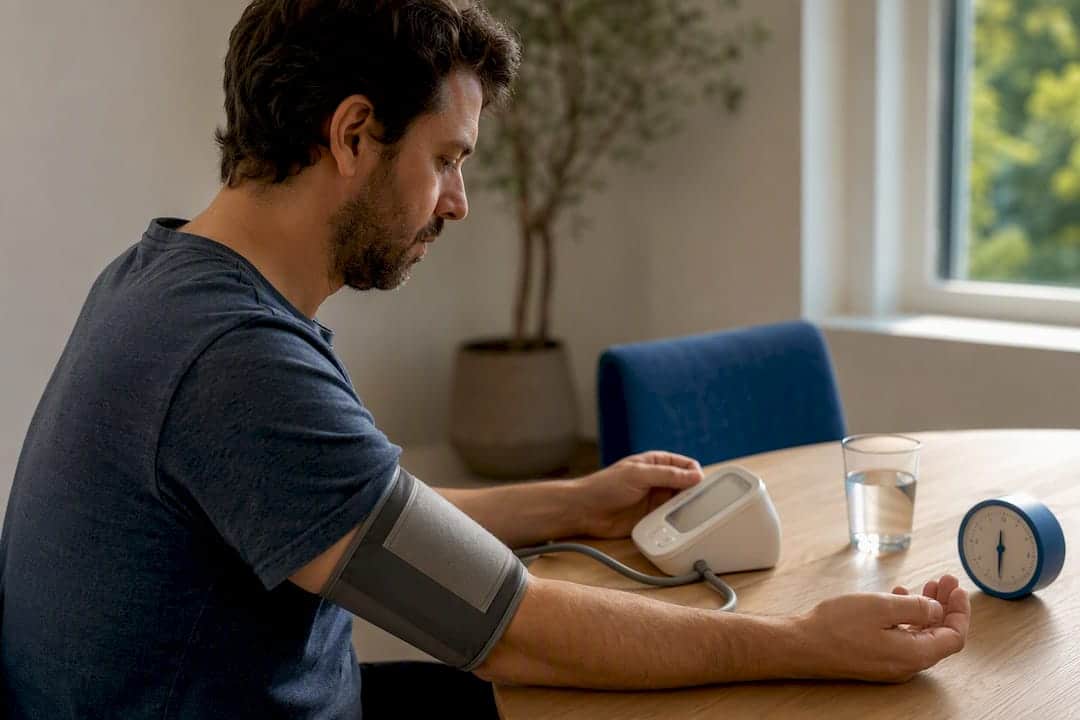
Unblinding is a real confound worth taking seriously. Because you know you took a dose, your expectations color what you report feeling, and researchers studying microdosing point to expectancy bias as one of the biggest reasons open-label self-reports diverge so sharply from blinded trial results. A double-blind placebo-controlled study using 0.5 g dried mushroom found no consistent improvement in creativity or cognition, despite many participants subjectively feeling that something had changed. If you want a resource that lays out these safety considerations in more depth, Fungipsilocybinmushroom’s safety guide is a reasonable place to keep learning.
Legal Status Snapshot and How to Reduce Your Legal Risk
Psilocybin remains a Schedule I controlled substance under U.S. federal law as of 2026, which means possession, cultivation, and distribution are federally prohibited regardless of what any state has done. Two states have carved out regulated exceptions. Oregon’s Measure 109 created licensed service centers, operating since 2023, where adults can access supervised psilocybin sessions. Colorado’s Proposition 122 combined personal decriminalization with a healing center licensing structure that rolled out between 2024 and 2025. Outside those two frameworks, federal Schedule I status is the operative law almost everywhere in the country, and other jurisdictions worldwide vary just as widely, so what’s tolerated in one city or country can carry serious penalties in the next.
Practical steps to reduce legal exposure:
- Use a licensed service center where one legally exists, such as Oregon’s model, rather than assembling an unsupervised session on your own.
- Never ship psilocybin products across state or national borders, since that turns a possession issue into a trafficking-adjacent one under federal and international law.
- Check your specific state or country’s current statute before acting. Laws in this space are changing quickly and a guide written even a year ago may already be outdated.
- Keep any personal-use quantities and documentation minimal and private, and avoid any activity that could be construed as distribution.
None of this is legal advice for your specific situation. If you have real legal exposure concerns, a local attorney familiar with drug policy in your jurisdiction is the only reliable source, not a blog post.
How to Track Effects and Tell If Microdosing Is Actually Working
Expectancy bias is strong enough that you can talk yourself into feeling better from a dose that’s doing nothing pharmacologically. The only real defense is a structured tracking system you commit to before you start, not after you already have a hunch about the outcome.
- Establish your baseline for at least one week before dosing. Use a validated short scale like the PHQ-2 or PHQ-9 for mood, log your sleep hours and quality, rate your stress on a simple 1 to 10 scale, and time yourself on a basic focus task like a short reading or math drill.
- Log every dosing day and every off day the same way. Keep entries short: dose taken, time, mood score, sleep from the night before, any side effects, and a one-line note on anything unusual. A weekly summary that averages these daily entries will show trends a single day’s notes can’t.
- Run a blinded phase if you’re serious about separating real effect from expectancy. Have someone else prepare identical-looking capsules, some active and some inert, without telling you which is which on a given day, then compare your logged scores across both.
- Set decision rules in advance. Decide before you start what a meaningful improvement looks like on your chosen scale, what counts as a warning sign to pause immediately, and what counts as no-change data that means it’s time to stop and reassess with a clinician.
Pro Tip: Write your decision rules down on paper before your first dose, not in your head. It’s much harder to talk yourself out of a rule you already committed to in writing than one you’re deciding on in the moment, three weeks into a cycle that isn’t working.
If four to eight weeks pass with no measurable change on your tracked scores, that’s real data, not a reason to push the dose higher. Raising the dose to chase an effect that isn’t showing up is how sub-perceptual microdosing turns into something else entirely.
Practical How-To: Sourcing, Preparing, Dosing, and Storing Your Supply
Lab testing is the difference between knowing what you’re taking and guessing. A real test result shows potency (psilocybin and psilocin content by weight) and screens for contaminants like heavy metals, mold, or bacterial contamination that can grow on improperly dried or stored mushrooms. Skipping this step means every gram you measure afterward is built on an unknown.
- Start with a homogenized batch. Take your full dried supply from a single harvest or a single tested product, and grind it into a fine, even powder using a clean coffee grinder or mortar and pestle dedicated to this purpose. This step alone eliminates the hot-spot problem where one mushroom cap is far stronger than another from the same batch.
- Weigh individual doses with a precision scale. Use a scale accurate to 0.01 grams (10 milligrams), tare an empty container first, then measure each dose directly into that container rather than eyeballing a portion of a whole mushroom.
- Fill capsules for consistency and convenience. Standard-size capsules (00 or 0) hold most microdose amounts easily and remove the temptation to “just take a pinch” on a rushed morning.
- Label every batch clearly. Write the date, the source batch, and the estimated dose per capsule on the container. Memory is not a reliable label after the third or fourth batch.
- Store away from light, heat, and moisture. A dark, airtight container in a cool cabinet preserves potency far longer than a bag left near a stove or a sunny windowsill; potency can degrade meaningfully within months under poor storage conditions.
Dosing-day checklist:
- Take your dose at the same time each dosing day, generally with or shortly after breakfast, to control for how food affects absorption.
- Stay hydrated through the morning, since mild dehydration can amplify subjective side effects like headache or lightheadedness.
- Dose in a familiar, low-stress environment rather than before a high-pressure meeting or unfamiliar situation, especially in your first few sessions.
- Record your notes within an hour of dosing while the details are still fresh, not at the end of the day from memory.
Pro Tip: If you’re buying finished product rather than preparing your own, treat the batch certificate of analysis the same way you’d treat a nutrition label. If a seller can’t produce one, that’s your answer about whether to buy from them. Sourcing from a vendor that publishes lab results alongside its microdosing capsules removes the homogenizing and weighing steps entirely, at the cost of trusting someone else’s testing process instead of your own scale.
What Beginners Consistently Get Wrong About Microdosing
The evidence base for microdosing is genuinely weaker than most enthusiastic online communities let on, and that gap between hype and data is where most beginner mistakes start. People read anecdotal success stories, skip the baseline tracking, and jump straight to a dose that’s already at the high end of the community range instead of the low end. A double-blind trial and a large systematic review both point the same direction: self-reported benefits often shrink or vanish once expectancy is controlled for, which should temper how much weight you put on a single week of feeling “clearer.”
The three mistakes I see most often are dosing too high out of impatience, skipping any kind of log because “I’ll just notice if it’s working,” and ignoring a personal or family psychiatric history because a friend’s experience sounded fine. Each of those is fixable with about ten minutes of upfront planning. Weigh a conservative dose, write down a baseline before you start, and actually talk to a clinician if bipolar disorder or psychosis runs in your family. None of that is complicated. It’s just often skipped.
The habits that make the biggest difference aren’t exotic. A short daily journal entry, protected sleep, and a willingness to bring what you’re doing up with a therapist if you’re already in talk therapy all do more for outcome quality than switching between Fadiman and Stamets ever will. Microdosing works best as one input alongside those habits, not as a replacement for them.
— Alex
Fungi Psilocybin Mushroom: Lab-Tested Options for a Safer Microdosing Cycle
There are options available that include batch-level lab testing, which means the conversion math in this guide, grams to milligrams, dose to schedule, can hold up against what’s in the capsule you open.
When browsing a catalog, look for clear batch test disclosures, dose labeling that states milligrams per capsule rather than a vague “microdose” claim, and traceability back to a specific harvest or production run. The Seremoni psilocybin chocolate bar is a good example of a format that makes portioning simple without a scale, while strain pages like the Amazonian psilocybin mushroom guide walk through potency differences worth knowing before you pick a starting product. If you have a cardiac, psychiatric, or medication history covered in the safety section above, talk to a clinician before you order anything. Otherwise, browse the current lab-tested selection and start with the lowest dose option listed.
Where to Go Next for the Research Behind This Guide
The Frontiers in Psychiatry systematic review is the best single starting point for understanding how thin and heterogeneous the microdosing evidence base still is. Pair it with the double-blind placebo-controlled trial for a look at what happens when expectancy is controlled for, and the active phase II trial listing for what’s currently being tested with longer follow-up. For legal boundaries, check the DEA’s scheduling page directly rather than a secondhand summary. Anecdotal reports are useful for generating hypotheses, but treat trial data as the stronger signal whenever the two disagree.
This article is general information, not a substitute for advice from a qualified doctor. Consult a qualified healthcare professional about your own circumstances before acting on anything here.
Sources
- DEA — Drug scheduling (psilocybin)
- Frontiers in Psychiatry — The subtle science: a systematic review of psilocybin microdosing
- Translational Psychiatry — Microdosing with psilocybin mushrooms: a double-blind placebo-controlled study
- Clinicaltrials
Recommended

Psilocybin and SSRIs for Clinicians: Why Half Report Blunted Effects
Combining psilocybin with SSRIs has not been linked to widespread severe harm in the medical literature, but it is not risk-free either. The most consistent finding is attenuation: many people on SSRIs report a noticeably weaker psychedelic experience, not a dangerous one. Serious interactions do exist, mostly in polypharmacy situations. Talk to your prescriber before changing anything, and never stop an SSRI cold to “clear the way” for a mushroom experience.
TL;DR:
- About half of SSRI users report weaker psilocybin effects, with SNRIs more likely to blunt and bupropion least likely to do so, but outcomes vary.
- Controlled trials suggest SSRIs may soften adverse effects while leaving some positive experiences intact, though the research data remains limited and caution is advised.
- Serotonin syndrome risks are rare with SSRIs alone but increase when combined with other serotonergic drugs like lithium or MAOIs, requiring careful medication review.
- Receptor adaptation from long-term SSRI use can prolong attenuation effects, sometimes lasting weeks or months after stopping the medication, depending on the specific drug.
- Always consult a healthcare professional before combining psilocybin with SSRIs, disclose your full medication list, and avoid abrupt discontinuation to prevent withdrawal or adverse interactions.
Table of Contents
- Psilocybin and SSRI Interaction: What the Research Actually Shows
- Why SSRIs Change the Way Psilocybin Feels
- Serotonin Syndrome and Other Documented Risks
- How Long Attenuated Effects Last and What That Means for Treatment
- What to Discuss With Your Prescriber Before Combining Psilocybin and SSRIs
- Where Fungipsilocybinmushroom Fits Into This Conversation
- A Frank Take on Access Versus Caution
- Lab-Tested Products Built for an Informed, Careful Choice
- Sources
Psilocybin and SSRI Interaction: What the Research Actually Shows
Four types of evidence shape what clinicians and researchers currently know about mixing psilocybin with SSRIs: retrospective surveys, controlled trials, scoping reviews, and scattered case reports. None of them tell exactly the same story, and that mismatch is itself useful information for anyone weighing this decision.
The largest and most cited data point comes from a 2023 retrospective survey. that collected self-reports from people who used psilocybin mushrooms while on antidepressants. The survey found that concurrent SSRI use was associated with weaker-than-expected psilocybin effects in a substantial share of cases, with SNRIs showing an even higher rate and bupropion showing the lowest. This is the single dataset most people point to when they say “SSRIs blunt shrooms,” and it deserves a closer look because the numbers are more specific than most articles let on.
Those figures come with confidence intervals wide enough to remind you this is self-reported survey data, not a lab measurement. Still, the pattern holds up: serotonergic antidepressants blunt the experience for a meaningful minority, sometimes a slight majority, of users. The same survey noted something clinicians find more clinically relevant than the percentages themselves: attenuation can persist for up to three months after stopping the antidepressant, which challenges the common assumption that a two-week break resets everything.
Controlled trial data tells a more nuanced version of the same story. A randomized, double-blind, placebo-controlled crossover study pretreated healthy volunteers with escitalopram for 14 days before giving them psilocybin. The result was not simple blunting across the board. Escitalopram pretreatment reduced adverse physiological effects, including anxiety and cardiovascular symptoms, but the positive subjective effects were not eliminated. Psilocin pharmacokinetics stayed unchanged, meaning the drug reached the bloodstream the same way regardless of escitalopram exposure. The interaction looks less like “SSRIs cancel out mushrooms” and more like “SSRIs may take the edge off the rough parts while leaving the meaningful parts intact,” at least in this small sample of healthy subjects.
That distinction matters because it partially contradicts the survey data, which trends toward broad-strokes attenuation rather than selective softening of adverse effects. A 2025 scoping review synthesizing case reports, trials, and observational data tried to reconcile this gap and landed on a cautious middle ground. Concomitant use appears generally safe and tolerable, but the controlled-trial base is still thin, and more rigorous studies are needed before anyone should treat these findings as settled.
Case reports fill in the risk side of the picture, though rarely with psilocybin and SSRIs alone. Documented adverse events involving serotonin toxicity tend to appear when psychedelics are combined with other serotonergic or interacting drugs, particularly lithium or MAOIs, rather than SSRIs in isolation. That is not a reason to relax; it is a reason to be far more careful about your full medication list than about the SSRI-psilocybin pairing specifically.
A few practical points fall out of this evidence base:
- Attenuation is common but not universal. Roughly half of SSRI users notice weaker effects, so plan for either outcome rather than assuming complete blunting.
- SNRIs appear more likely to blunt effects than SSRIs, and bupropion appears least likely among the three.
- Controlled trials and naturalistic surveys don’t fully agree, and that gap should make anyone cautious about treating either dataset as the final word.
- Serious adverse events in the literature involve polypharmacy far more often than SSRI use alone.
- The NIDA psilocybin research summary gives useful context on mechanism and the current state of therapeutic investigation for readers who want a plain-language starting point.
Why SSRIs Change the Way Psilocybin Feels
The interaction between psilocybin and SSRIs comes down to receptor biology, not a direct chemical clash between the two drugs. Psilocybin itself is essentially inactive until your body converts it into psilocin, which is the molecule doing the real work. Psilocin binds primarily to the 5-HT2A serotonin receptor, and that binding is what drives the classic psychedelic effects: altered perception, mood shifts, and the sense of expanded or dissolved boundaries people describe after a session.
SSRIs work through an entirely different mechanism. They block the reuptake of serotonin at the synapse, which raises the amount of serotonin circulating in the brain over time. That sounds like it should amplify a serotonin receptor agonist like psilocin, but the opposite tends to happen. Chronic SSRI use triggers downstream adaptations, including downregulation and desensitization of certain serotonin receptors, as the brain tries to recalibrate to the elevated baseline. The 5-HT2A receptor is one of the receptors affected by this adaptation, and a desensitized receptor responds less strongly when psilocin arrives to activate it.

That is the leading explanation for attenuation: not a chemical standoff, but a receptor system that has already adjusted its sensitivity before psilocybin ever enters the picture.
Pro Tip: If you’ve been on an SSRI for years, your 5-HT2A receptor sensitivity has likely had a long time to adjust. That history matters more than the dose you’re currently taking, so mention how long you’ve been on the medication, not just the current dose, when discussing this with a prescriber.
Transporter occupancy, the mechanism that dominates conversations about MDMA and SSRIs, plays a smaller role here. MDMA depends heavily on serotonin transporters to produce its effects, so an SSRI occupying those transporters directly blocks MDMA’s mechanism of action. Classic psychedelics like psilocybin don’t rely on the transporter the same way, since psilocin acts directly on postsynaptic receptors rather than needing transporter-mediated release. That is one reason the psilocybin and SSRI interaction looks different, and generally milder, than the psilocybin and MAOI interaction or the MDMA and SSRI interaction.
Pharmacokinetics complicate the picture further, especially around timing. Different SSRIs clear the body at very different speeds:
- Sertraline and escitalopram have relatively short half-lives, generally clearing within days to about a week after the last dose.
- Paroxetine also clears fairly quickly but can produce more pronounced discontinuation symptoms.
- Fluoxetine is the outlier. Its long half-life and active metabolite, norfluoxetine, can remain pharmacologically active for several weeks after the last dose.
This is exactly why a blanket “two-week washout” rule, which shows up constantly in casual advice and even in some older trial protocols, does not hold up for every medication. Two weeks might clear sertraline from your system reasonably well. It barely dents fluoxetine’s active metabolite. Receptor-level adaptations add another layer on top of pharmacokinetic clearance: even after the drug itself is gone, the desensitized 5-HT2A receptors may take additional time, potentially weeks to months, to return to a baseline sensitivity. That is the biological basis for the persistence finding in the retrospective survey. The drug leaves faster than the receptor adaptation reverses.
None of this means SSRIs make psilocybin dangerous at the receptor level. It means the timeline for “clearing” an SSRI before expecting a full-intensity psilocybin experience is longer and more individualized than most casual guidance suggests, and it depends on which specific SSRI, how long you’ve taken it, and your own receptor biology.
Serotonin Syndrome and Other Documented Risks
Serotonin syndrome is the adverse event most people worry about when they hear “psilocybin and SSRI,” and it deserves a precise definition rather than vague alarm. It’s a cluster of symptoms caused by excess serotonergic activity, typically appearing within hours of a triggering exposure, and it spans three symptom categories:
- Autonomic instability: rapid heart rate, high blood pressure, elevated temperature, sweating, diarrhea.
- Neuromuscular abnormalities: tremor, muscle rigidity, involuntary muscle jerks (myoclonus), overactive reflexes.
- Altered mental state: agitation, confusion, restlessness, and in severe cases, delirium.
Mild cases can look like simple anxiety or an intense psychedelic experience, which is part of what makes this genuinely tricky to self-diagnose during a session. Severe cases involve high fever, seizures, and cardiovascular instability that require emergency treatment.
Here’s the reassuring part, backed by actual data rather than guesswork: serious adverse events in the trial and survey literature on psilocybin plus SSRIs specifically are rare. The scoping review covering concomitant antidepressant and classic psychedelic use found the combination generally safe and tolerable across the studies it synthesized, while still flagging the shortage of large controlled trials as a real limitation. The escitalopram pretreatment RCT found reduced adverse effects, not increased ones, when the SSRI was on board.
Where things get more serious is polypharmacy. Case reports and clinical literature describing serotonin toxicity with psychedelics tend to involve additional interacting drugs, most notably lithium and MAOIs, rather than SSRIs in isolation. Lithium combined with serotonergic psychedelics has produced documented seizure risk and toxicity in case reports. MAOIs prevent the breakdown of serotonin entirely, and stacking that mechanism with a serotonin receptor agonist is one of the more dangerous combinations described in the literature, distinct from and generally riskier than a straightforward SSRI pairing.
A 2024 case report documenting psilocybin-assisted psychotherapy alongside serotonergic antidepressants found the combination tolerated during concurrent use. What stood out in that same report was a complication after abrupt discontinuation of one antidepressant: the person experienced a withdrawal-like worsening. That single case reinforces a theme this article keeps returning to: stopping an SSRI carelessly is arguably a bigger practical risk than the drug interaction itself.
When symptoms warrant emergency evaluation:
- Fever above 100.4°F combined with agitation or confusion
- Muscle rigidity, uncontrolled shaking, or jerking movements that don’t resolve as the trip progresses
- A racing heart rate that keeps climbing rather than leveling off
- Any combination of these symptoms appearing hours after ingestion, since serotonin syndrome onset is typically fast and progressive
If any of these appear, that’s an emergency room situation, not a “wait it out” situation. Tell emergency staff the full medication list and the timing of psilocybin ingestion; that detail changes how quickly they can identify serotonin syndrome versus a purely psychological reaction.
People with cardiac conditions, or those taking any medication that prolongs the QTc interval on an EKG, need an added layer of caution. Psilocybin can produce transient increases in heart rate and blood pressure on its own, and stacking that with a QTc-prolonging medication (certain antipsychotics, some antibiotics, and select antiarrhythmics) raises the theoretical risk of dangerous heart rhythm changes. This is a conversation for a cardiologist or prescriber, not a forum thread, before any psilocybin use is considered.
How Long Attenuated Effects Last and What That Means for Treatment
The figure showing about half from the retrospective survey deserves unpacking, because a single percentage hides a lot of texture. That number reflects self-reported experiences pooled across a wide range of settings, doses, and personal expectations, and the data is vulnerable to recall bias and the influence of expectation itself. Someone who read online that SSRIs “kill the trip” may unconsciously interpret an ordinary experience as weaker than it actually was. That doesn’t invalidate the finding, but it means the true biological attenuation rate could sit somewhere different from the reported one.
The RCT data adds a genuinely useful complication rather than simple confirmation. In the escitalopram pretreatment study, the reduction showed up mainly in adverse and uncomfortable effects, not across the board in positive subjective effects. If you extrapolate that finding, it suggests SSRIs might smooth out the rough edges of a psilocybin experience more than they flatten the entire thing, at least over a 14-day pretreatment window in healthy volunteers. Survey respondents describing a broadly “weaker” experience and a controlled trial showing selective softening of bad effects are not necessarily describing the same phenomenon, and reconciling that gap is exactly the kind of work the scoping review says still needs to happen.
Persistence after discontinuation is where the survey data gets most clinically relevant. That timeline lines up with what’s known about fluoxetine’s extended half-life and active metabolite, but the persistence effect shows up even with shorter-acting SSRIs, which points back toward receptor-level adaptation rather than simple drug clearance as the main driver.
The therapeutic implication is where this gets genuinely important for anyone considering psilocybin for depression. A weaker subjective experience is not automatically a weaker therapeutic outcome. Some researchers and clinicians argue that the intensity of the acute experience and the durability of any mood benefit are not the same variable, even though clinical trial designs have historically assumed a strong “peak experience” is necessary for benefit. That assumption is part of why most current trials require an SSRI washout at all: researchers want a clean signal, unmuddied by attenuation, to measure the drug’s effect. But that same design choice creates a research gap. It excludes exactly the population, people currently stable on an SSRI, who are most likely to actually consider this treatment in real life.
This is one of the more overlooked tensions in the field. Trial protocols optimize for scientific clarity by requiring washout, while real-world patients optimize for staying mentally stable by staying on their medication. Those two goals point in opposite directions, and no amount of survey data alone will resolve which approach produces better outcomes until more trials specifically enroll people who remain on SSRIs throughout.

What to Discuss With Your Prescriber Before Combining Psilocybin and SSRIs
Nothing in this article substitutes for an actual conversation with the person managing your medication, but you can walk into that conversation prepared. A clinician can only give you useful guidance if you hand over complete information, not a filtered version of your history.
- Full medication list, including over-the-counter supplements. St. John’s Wort, certain migraine medications (triptans), and some supplements carry their own serotonergic activity and compound the risk picture beyond SSRIs alone.
- Exact SSRI or SNRI name and how long you’ve taken it. Fluoxetine’s washout timeline looks nothing like sertraline’s, and duration of use affects receptor adaptation more than current dose does.
- Prior response to the antidepressant, including whether you’ve had side effects, partial relief, or treatment resistance. This shapes whether a prescriber sees continuing the SSRI as protective or as an obstacle to a meaningful experience.
- Cardiac history, especially arrhythmia, prior heart attack, or use of any QTc-prolonging medication.
- History of suicidal ideation or psychiatric hospitalization. This affects how a clinician weighs the risk of medication changes, not just the psilocybin decision itself.
Abrupt SSRI discontinuation carries its own well-documented risk profile independent of psilocybin entirely: discontinuation syndrome, rebound anxiety, and in some cases a genuine relapse into depressive symptoms. The case report describing withdrawal-like worsening after abrupt antidepressant discontinuation during psilocybin therapy is a small but pointed illustration of this exact risk. Clinical taper strategies are individualized based on the specific drug, dose, and duration of use, and they should always involve the prescribing clinician rather than a self-directed schedule pulled from an online forum.
Whether a clinician recommends continuing the SSRI or requires a washout period typically depends on a few factors: how psychiatrically stable you currently are, whether this is happening inside a formal clinical trial (where FDA guidance shapes strict protocol requirements) versus a personal decision outside a trial setting, and your personal history of relapse risk when medications change.
For anyone using psilocybin outside a supervised clinical setting, a few harm-reduction basics apply regardless of where you land on the SSRI question:
- Never combine psilocybin with MAOIs or lithium; these carry the most serious documented interaction risk in the literature.
- If you’re uncertain how your body will respond, start with a lower dose than you’d otherwise consider. Careful dosing guidance matters even more when medication interactions are a variable.
- Have a sober, trusted person present, and know where the nearest emergency care is located before you start.
- Don’t make any medication changes, starting, stopping, or adjusting doses, in the days immediately surrounding a planned psilocybin session without prescriber input.
Pro Tip: Write down your exact medication, dose, and last-taken date before your appointment. Prescribers can give faster, more specific guidance with concrete numbers in front of them instead of “I’m on some antidepressant.”
Where Fungipsilocybinmushroom Fits Into This Conversation
Fungipsilocybinmushroom exists to supply lab-tested psilocybin products and the education people need to use them thoughtfully, not to replace medical care. The product range spans a variety of strains, providing options rather than a one-size-fits-all product.
That range matters in the exact context this article covers. Someone who suspects their SSRI will blunt the experience has different considerations than someone with no medication history at all, and having strain and format options, including dosing guidance built for exactly this kind of decision, gives people room to make an informed choice rather than a guess.
A few things worth being direct about:
- Fungipsilocybinmushroom is an information and product supplier, not a medical provider, and nothing here replaces a conversation with a licensed prescriber.
- Educational resources on the site, including safety considerations beyond psychotropic medications, are built to complement clinical guidance, not substitute for it.
- Lab testing addresses product purity and potency; it does not, and cannot, screen for how your personal medication history will interact with a given dose.
If you’re on an SSRI and considering psilocybin, the product and the medical decision are two separate conversations. Get the second one settled with a clinician first.
A Frank Take on Access Versus Caution
The honest position here isn’t a comfortable middle ground, it’s a recognition that both sides of this debate are right about something. The people pushing for more accessible psilocybin research are right that mandatory SSRI washout excludes the exact population most likely to seek this treatment in real life. The people urging caution are right that the controlled-trial data is still thin, and thin data deserves humility, not confidence.
What frustrates me most about how this topic gets discussed online is the flattening. It’s not “SSRIs kill the trip” and it’s not “SSRIs are irrelevant.” It’s a receptor system that adapts over months, a drug interaction that’s mild for most people and genuinely dangerous in specific polypharmacy situations, and a research field that hasn’t caught up to the number of people already making this decision on their own. More trials that actually enroll people currently on SSRIs, rather than requiring washout as a default, would tell us far more than another survey of self-reported intensity ever could.
Until that data exists, the responsible path is unglamorous: read the actual studies, bring your full medication history to a real conversation with your prescriber, and don’t stop a medication that’s keeping you stable just to chase a stronger trip.
— Alex
Lab-Tested Products Built for an Informed, Careful Choice
Products are lab tested before delivery, so the variable being managed is medication history and dosing plan, not product purity. That distinction matters most for readers seeking a psilocybin experience without uncertainty about product contents.
If you’ve read this far and you’re weighing whether to combine psilocybin with your current SSRI, start with the dosing and safety guidance built specifically to help people calibrate dose against personal risk factors, including medication history. From there, browse strains suited to a therapeutic, lower-intensity approach if attenuation is a concern for you. Always follow your local laws on psilocybin possession and use, and loop your prescriber into any decision before you place an order.
This article is general information, not a substitute for advice from a qualified doctor. Consult a qualified healthcare professional about your own circumstances before acting on anything here.
Sources
- Concomitant use of antidepressants and classic psychedelics: A scoping review
- Attenuation of psilocybin mushroom effects during and after SSRI/SNRI antidepressant use
- Acute Effects of Psilocybin After Escitalopram or Placebo Pretreatment in a Randomized, Double-Blind, Placebo-Controlled, Crossover Study in Healthy Subjects
- FDA issues first draft guidance on clinical trials for psychedelic drugs
- NIDA: Psilocybin (Magic Mushrooms)
Recommended
- Psilocybin Depression Treatment California: Your Complete Guide to Legal Mushroom Delivery Services and Therapeutic Options 2025
- Mushrooms for Anxiety – Natural, Calming, and Powerful Support for a Healthier Mind 2025
- Microdosing Psychedelics: Unveiling Remarkable Health Benefits and Therapeutic Potential 2026
- Discover the 5 Best Magic Mushroom Strains for Therapy – Transform Your Mind Today!

Psilocybin Addiction Risk: Low Physical Dependence, Psychological Harms
Psilocybin carries a low risk of physical addiction, but it can still lead to psychological dependence and problematic use patterns in a small subset of people. The National Institute on Drug Abuse finds no recognized physical dependence associated with psilocybin, and the DSM-5 places compulsive hallucinogen use in its own diagnostic category rather than alongside opioids or alcohol. Context, dose, and mental health history determine most of the actual danger.
TL;DR:
- Most clinical data on psilocybin’s abuse potential come from controlled environments with screened participants, limiting generalizability to recreational use.
- Repeated dosing causes rapid tolerance, and stopping the drug does not produce physical withdrawal symptoms, reducing long-term physiological risks.
- Signs of problematic use include preoccupation, escalation, using to escape, failed attempts to cut back, neglecting responsibilities, and polysubstance patterns.
- Serious adverse long-term risks are rare but can include hallucination persistening disorder, anxiety, depressive symptoms, and psychosis in vulnerable individuals.
- Harm reduction involves screening, spaced sessions, avoiding mix of substances, and supervised environments to lower psychological and acute dangers.
Table of Contents
- Is Psilocybin Addictive? What the Research Consensus Says
- Why Psilocybin Rarely Causes Physical Withdrawal
- Signs That Psilocybin Use Has Become a Problem
- What Can Go Wrong: Acute and Long-Term Risks
- Who Should Be Most Careful With Psilocybin
- How Harm Reduction and Clinical Protocols Lower the Risk
- Getting Help for Problematic Psilocybin Use
- Where the Real Risk Lives, and Where It Doesn’t
- Explore Lab-Tested Options and Safety Resources
- Sources
Is Psilocybin Addictive? What the Research Consensus Says
The short version: psilocybin doesn’t hook the brain’s reward circuitry the way nicotine, alcohol, or opioids do. NIDA’s research summary states plainly that psilocybin use does not typically lead to addiction, and animal studies back this up. Rodents and primates given the chance to self-administer psilocybin generally don’t keep pressing the lever for more, which is the classic signature researchers look for when judging a substance’s abuse potential.
A 2018 analysis applied all eight factors the Controlled Substances Act uses to judge abuse potential, including actual abuse patterns, psychic or physiological dependence, and public health risk. The conclusion: psilocybin shows limited reinforcing effects and low abuse potential overall, supporting consideration for a lower drug schedule if used medically.
That doesn’t mean the research is airtight. A few caveats matter:
- Most clinical trials screen out people with psychosis risk, bipolar disorder, or heavy substance use histories, so results don’t automatically generalize to unsupervised recreational users.
- Long-term data beyond a year or two of follow-up is still thin.
- Systematic reviews of classic psychedelics consistently report fewer adverse events inside controlled trials than in uncontrolled, real-world settings.
- A systematic review of psilocybin in addiction treatment found relatively low rates of serious adverse events when dosing included screening and structured psychotherapy.
None of this erases risk. It shifts where the risk actually lives, from the drug’s chemistry to the circumstances of its use.
Why Psilocybin Rarely Causes Physical Withdrawal
Psilocybin works by activating serotonin 5-HT2A receptors, the same receptor family involved in mood regulation, and this triggers short bursts of neuroplasticity rather than the dopamine-flooding cycle that drives compulsive drug seeking. Addictive substances like opioids hijack reward pathways directly. Psilocybin instead produces an altered perceptual state that most users don’t crave in the same repetitive, escalating way.
Repeated dosing over a few days causes rapid receptor desensitization, commonly called tantric or acute tolerance. Take a second dose the next day and you’ll feel noticeably less. This is pharmacologically different from the withdrawal seen with benzodiazepines or opioids, where stopping suddenly triggers physical symptoms like tremors, seizures, or severe cravings. Psilocybin tolerance fades within days to a couple of weeks, and stopping doesn’t produce a physiological withdrawal syndrome.
Worth noting: preclinical self-administration models, the animal studies researchers use to predict abuse potential in humans, don’t perfectly capture human psychological motivations for use, like escapism or self-medication. Biology explains why physical dependence is rare. It doesn’t fully explain why some people still develop unhealthy patterns.

Signs That Psilocybin Use Has Become a Problem
A single supervised psilocybin session, or even two to three spaced weeks apart, looks nothing like a use disorder. The concern starts when use becomes frequent, unsupervised, and tied to avoidance rather than intention.
- Preoccupation. Spending significant time thinking about, planning, or seeking out the next trip.
- Escalating frequency. Moving from occasional use to weekly or near-daily dosing, often chasing a diminishing effect.
- Using to escape. Reaching for psilocybin specifically to avoid stress, grief, or unresolved emotional pain rather than to explore or reflect.
- Failed attempts to cut back. Trying to stop or slow down and finding it harder than expected.
- Neglecting responsibilities. Work, relationships, or basic self-care start slipping because of use or preoccupation with it.
- Polysubstance patterns. Combining psilocybin with alcohol, stimulants, or other drugs, which tends to mask the line between recreational use and self-medication.
The DSM-5’s “other hallucinogen use disorder” category exists precisely because psychological dependence, even without physical withdrawal, is a real clinical phenomenon worth naming.
What Can Go Wrong: Acute and Long-Term Risks
The immediate risks are the ones most people already picture: overwhelming anxiety, panic, disorientation, and occasionally dangerous behavior if someone wanders into traffic or climbs somewhere unsafe while disoriented. These acute episodes, often called bad trips, are the most common adverse event tied to psilocybin, though most resolve within hours without lasting harm.
A 2025 harm-reduction analysis found that a minority of non-clinical psychedelic users in survey samples reported functional difficulties lasting more than a day, with some cases continuing for weeks or months.
Longer-term risks, while less common, are real enough to name directly:
- Hallucinogen persisting perception disorder (HPPD): ongoing visual disturbances like trails, halos, or static that persist after the drug wears off.
- Persistent anxiety or depressive symptoms: especially in people who had a distressing trip without support to process it afterward.
- Triggered psychosis: a serious risk concentrated almost entirely in people with a personal or family history of psychotic or bipolar disorders.
Clinical trials report meaningfully fewer adverse events than uncontrolled recreational settings, and that gap comes down to screening people out who are at elevated risk, controlling dose, and providing supervision during the experience. Remove those safeguards and the risk profile changes.
Who Should Be Most Careful With Psilocybin
Risk isn’t distributed evenly. Some people face meaningfully higher odds of a harmful outcome, and situational factors can push otherwise low-risk use into dangerous territory.
- Personal or family history of psychosis or bipolar disorder. This is the single strongest predictor of a severe adverse reaction, including triggered psychotic episodes.
- Adolescents. Brain development during this period makes the psychological effects less predictable and potentially more disruptive.
- Unstable psychiatric conditions. Active depression, anxiety disorders, or PTSD without professional support can complicate how a person processes an intense psychedelic experience.
- Frequent, unsupervised, high-dose use. Removing structure and spacing increases both psychological harm and the odds of dangerous behavior during the acute effects.
- Polysubstance use. Mixing psilocybin with alcohol, stimulants, or other psychiatric medications makes outcomes far less predictable.
If any of these apply to you or someone you know, a conversation with a clinician before use isn’t optional caution. It’s the responsible baseline.
How Harm Reduction and Clinical Protocols Lower the Risk
The difference between a difficult experience and a dangerous one usually comes down to preparation, not luck. A few practical habits matter more than anything else:
- Set and setting. Use in a familiar, safe space with people you trust, never alone during a first or high-dose experience.
- Space out sessions. Waiting weeks between doses avoids rapid tolerance and reduces the temptation to escalate.
- Skip the mix. Avoid alcohol, stimulants, or other psychiatric drugs in the same window as psilocybin.
- Never drive or operate machinery during or immediately after a session.
- Start low. Especially with unfamiliar strains, a lower dose reduces the odds of an overwhelming experience.
Clinical programs formalize these same principles: psychiatric screening beforehand, controlled and measured dosing, trained staff present during the session, and structured integration support afterward to help process what came up. This model is exactly why trial-based safety data looks so different from recreational-use statistics. If you want a deeper walkthrough of dosing structure, Fungipsilocybinmushroom’s guide on how to dose magic mushrooms covers the fundamentals. The guide to avoiding a bad trip walks through set-and-setting basics in more detail.
Pro Tip: If you’re microdosing, track your doses and days off in a simple log. Rapid tolerance builds fast, and a written record makes it obvious when you’re drifting toward daily use instead of the spaced schedule you started with.
Getting Help for Problematic Psilocybin Use
If psilocybin use has started interfering with work, relationships, or your ability to function, that’s the signal to act, not wait it out. Cognitive behavioral therapy and counseling with a provider familiar with substance use are the standard first steps, and addiction treatment services can help address patterns of self-medication that often sit underneath compulsive use.

Integration therapy, working through a difficult or confusing psychedelic experience with a trained therapist, is increasingly recommended even outside formal addiction treatment, though the evidence base for specific integration models is still developing.
Seek urgent medical attention if someone shows signs of persistent psychosis, expresses thoughts of self-harm, or simply can’t function day to day after use. A local crisis line or emergency department is the right first call in that situation, not a wait-and-see approach. Community support spaces, including groups focused on post-experience integration, can also help people process difficult sessions before they escalate into something worse.
Where the Real Risk Lives, and Where It Doesn’t
The data genuinely supports treating psilocybin differently than opioids or benzodiazepines. That’s not a fringe opinion. It’s what NIDA, the CSA’s own eight-factor test, and multiple systematic reviews converge on. But I think the safety conversation around psilocybin has a blind spot: people hear “low addiction potential” and mentally file it under “safe,” which skips right past the psychological risks that are very real for a smaller group of users.
The honest framing isn’t that psilocybin is safe or dangerous. It’s that psilocybin is context-dependent in a way that alcohol and opioids simply aren’t. A supervised, spaced-out session with screening and integration support looks almost nothing like unsupervised daily use stacked on top of untreated anxiety and a couple of drinks. Same molecule, wildly different risk profile. Anyone approaching this seriously owes it to themselves to get screened, go slow, and treat the aftermath, not just the dose, as part of the process.
— Alex
Explore Lab-Tested Options and Safety Resources
Reading about risk is one thing. Knowing exactly what’s in what you’re taking is another, and that’s the gap Fungipsilocybinmushroom exists to close. Every product listed goes through lab testing before it reaches you, so you’re not guessing about potency or contamination the way you would buying from an unverified source.
If you’ve decided supervised, informed use is the right path for you, start with strains suited to a controlled, lower-intensity experience rather than jumping straight to the most potent option on the shelf. Fungipsilocybinmushroom’s guide to therapeutic-friendly mushroom strains is a reasonable starting point, and the dosing guide pairs well with it before your first order. All products ship discreetly and remain subject to your local laws, so check your jurisdiction before ordering. When you’re ready, browse the current product selection and place an order with lab-verified potency behind every listing.
This article is general information, not a substitute for advice from a qualified doctor. Consult a qualified healthcare professional about your own circumstances before acting on anything here.
Sources
- Psilocybin (Magic Mushrooms) | National Institute on Drug Abuse
- The abuse potential of medical psilocybin according to the 8 factors of the Controlled Substances Act
- Narrative review: harms and safety of classic psychedelics
- Minimizing risk and harm in the use of psychedelics (consensus/gap review)
Recommended
Clinicians: Which Psilocybin Mechanism Links Are Proven in Humans
Psilocybin itself does almost nothing. Once swallowed, it converts to psilocin, which binds cortical 5-HT2A receptors and triggers a fast cascade: cortical excitability rises, the default mode network loses its usual coherence, and signal entropy climbs across the brain. That acute disruption appears to open a window for molecular plasticity, involving BDNF and related signaling, that may outlast the trip itself and help explain why a single dose can shift mood and outlook for weeks.
TL;DR:
- Psilocybin is rapidly converted into psilocin in the gut, with peak plasma levels reaching around two hours after dosing, but subjective effects often peak slightly later.
- Differences in metabolism due to genetic variations in UGT, CYP2D6, and CYP3A4 enzymes lead to significant individual variability in psilocin levels, even with identical doses.
- Activation of 5-HT2A receptors on cortical pyramidal neurons causes acute brain network disruptions, including loss of default mode network coherence and increased inter-network connectivity.
- Neuroplasticity markers like BDNF and mTOR increase after dosing, but their role in long-term clinical benefits is still less certain than receptor-level and network effects.
- Combining precise pharmacokinetic, imaging, and electrophysiological data is critical for understanding psilocybin’s mechanisms and optimizing clinical protocols.
Table of Contents
- Psilocybin Mechanism 101: From Prodrug to Psychedelic Effect
- Metabolism and Pharmacokinetics: How Psilocybin Becomes Psilocin
- Receptor Pharmacology: Why 5-HT2A Sits at the Center
- Network-Level Disruption: The Default Mode Network Comes Apart
- Brainwave and Electrophysiology Signatures Under Psilocybin
- Neuroplasticity Beyond the Trip: BDNF and Synaptic Growth
- What Animal Models and PBPK Simulations Reveal
- From Receptor to Recovery: How Mechanism Shapes Clinical Protocols
- Safety Profile, Individual Variability, and Drug Interactions
- Grading the Evidence: What We Know and What’s Still Guesswork
- What the Evidence Actually Adds Up To
- Key Studies and Reviews Worth Reading
- Sources
Psilocybin Mechanism 101: From Prodrug to Psychedelic Effect
Every explanation of the psilocybin mechanism starts with a simple pharmacological fact: psilocybin is a prodrug. It has to be converted before it does anything to the brain. That conversion, receptor activation, and the downstream neural reorganization it triggers form a chain with three well-supported links and at least two genuine gaps, and understanding where solid data ends and hypothesis begins matters if you’re trying to reason about this substance rather than just repeat talking points about it.
The first link is metabolic: dephosphorylation of psilocybin into psilocin, largely completed in the gut before the molecule ever reaches systemic circulation. The second is receptor pharmacology: psilocin’s affinity for 5-HT2A on cortical pyramidal neurons, which drives the acute subjective and electrophysiological effects. The third is network-level reorganization, visible on functional MRI as a marked loosening of the default mode network (DMN) and a corresponding increase in connectivity between networks that normally stay segregated. Layered on top of all three is a slower, less understood process: molecular plasticity that may persist long after psilocin has cleared the bloodstream.
Each of these stages has a different evidentiary weight. The metabolism and receptor pharmacology are grounded in decades of pharmacokinetic and radioligand-binding data. The network effects have strong, recent human imaging support. The plasticity story is compelling in animal models but still largely inferential in humans. That distinction runs through everything below.
Metabolism and Pharmacokinetics: How Psilocybin Becomes Psilocin
Psilocybin doesn’t cross into the brain as psilocybin. Non-specific alkaline phosphatases and esterases in the intestinal wall strip a phosphate group almost immediately after ingestion, a process largely completed in the jejunum and colon before the drug reaches systemic circulation in meaningful amounts. What arrives in the bloodstream, and eventually the brain, is psilocin, the actual psychoactive molecule.
Human PK-PD studies give a fairly consistent kinetic picture. Oral psilocin typically reaches peak plasma concentration (Tmax) around two hours after dosing, with concentrations rising in a dose-proportional fashion. A controlled dosing study using 15, 25, and 30 mg doses recorded mean peak psilocin concentrations of 11, 17, and 21 ng/mL, respectively, with elimination half-lives clustering between 1.4 and 1.8 hours and subjective effects lasting roughly 5.5 to 6.4 hours. Notably, body weight didn’t significantly shift these numbers in that cohort, which runs counter to the common assumption that dosing should scale tightly with body mass.
Pro Tip: If you’re trying to map a session’s timeline against the pharmacokinetics, remember Tmax and peak subjective intensity don’t align perfectly. Subjective effects tend to build for another 30 to 60 minutes after psilocin peaks in plasma, which is one reason session planning benefits from a dosing guide rather than a flat mg-per-kg formula.
Psilocin doesn’t just disappear once metabolized. It’s cleared through two main routes, and where those routes diverge is where individual variability enters the picture.
- Phase II glucuronidation by UGT enzymes, particularly UGT1A9 and UGT1A10, is the dominant clearance pathway, producing psilocin glucuronide as the major inactive metabolite.
- CYP2D6 and CYP3A4 contribute smaller Phase I oxidative pathways, and genetic polymorphisms in these enzymes can meaningfully shift exposure in either direction.
- A minor fraction of psilocin metabolism may involve monoamine oxidase, though this pathway is far less characterized than glucuronidation.
A systematic review of psilocybin pharmacokinetics confirms this UGT-dominant, CYP-assisted metabolic profile and flags substantial interindividual variability in clearance rates as a real confound in dose-response research. Two people taking an identical dose can land in noticeably different plasma ranges, which complicates any effort to standardize psilocybin dosing purely by weight or milligrams.
The pharmacodynamic payoff of all this kinetic detail is straightforward: plasma psilocin level correlates with the intensity of the experience. Studies pairing plasma sampling with subjective ratings and imaging find that as plasma psilocin rises, so does self-reported drug intensity, alongside measurable reductions in brain network integrity. The kinetics aren’t just pharmacological trivia; they’re a direct predictor of what’s happening in the network data covered further down.
Receptor Pharmacology: Why 5-HT2A Sits at the Center
Psilocin binds a handful of serotonin receptor subtypes, but 5-HT2A agonism is the receptor interaction that matters most for the acute psychedelic state. That’s not a guess; it’s demonstrated through pharmacological blockade experiments where pretreatment with 5-HT2A antagonists blunts or eliminates the subjective effects almost entirely, which is about as close to causal proof as receptor pharmacology gets.
Psilocin also binds 5-HT1A and 5-HT2C with meaningfully lower affinity than 5-HT2A. These secondary interactions likely modulate the overall response, particularly aspects of mood and anxiety during the session, but they don’t drive the core hallucinogenic signature the way 5-HT2A does.
The anatomical detail worth knowing: 5-HT2A receptors are densely expressed on layer V pyramidal neurons in the cortex, the large excitatory neurons that project both locally within cortical columns and to distant regions. Activating these receptors increases cortical excitability and appears to disrupt normal top-down signaling patterns, the kind of predictive, expectation-driven processing the cortex normally relies on to interpret sensory input efficiently. That disruption is a plausible cellular basis for why the psychedelic state feels less filtered and more raw.
- 5-HT2A agonism is the proximal, pharmacologically validated driver of acute hallucinogenic effects.
- 5-HT1A and 5-HT2C contribute secondary modulation, likely affecting mood and anxiety responses rather than perceptual intensity.
- Layer V pyramidal neurons carry the highest cortical density of 5-HT2A, making them the anatomical hub for psychedelic drug action.
- Activation here increases excitability and appears to loosen normal predictive, top-down cortical processing.
The frontier research question is whether all of this needs to happen together. 5-HT2A signals primarily through Gq protein coupling, but receptors like it can also engage alternative intracellular pathways, sometimes called biased signaling. Emerging work explores whether the Gq pathway can be pharmacologically separated from whatever downstream signaling drives lasting plasticity, essentially asking whether a molecule could trigger the therapeutic cascade without producing hallucinations at all.
That question isn’t academic curiosity. If biased signaling at 5-HT2A really does separate perceptual effects from plasticity-driving effects, it opens the door to non-hallucinogenic drug candidates built on the same receptor target. Whether that’s a net positive for psychedelic medicine, given how much of the therapeutic literature ties subjective intensity to outcome, is genuinely unresolved and worth watching over the next several years of pharmacology research.
Network-Level Disruption: The Default Mode Network Comes Apart

The clearest, most reproducible imaging finding in psychedelic neuroscience is what happens to the default mode network under psilocybin. The DMN, the set of interconnected regions active during self-referential thought and mind-wandering, loses internal coherence, while connectivity between networks that normally operate somewhat independently spikes upward.
A recent longitudinal high-frequency MRI study put actual numbers on the scale of this disruption: functional connectivity changes under high-dose psilocybin were more than three times greater than those observed under methylphenidate, a striking magnitude for a single-session pharmacological intervention. That same study tracked participants over weeks and found reduced hippocampus–DMN connectivity persisting well beyond the acute drug window, a detail with real clinical weight given the hippocampus’s role in memory and mood regulation.
- Within-network coherence in the DMN drops sharply during acute psilocin exposure.
- Between-network connectivity rises, effectively blurring boundaries that are normally well maintained.
- Hippocampus–DMN connectivity reductions have been observed persisting for weeks post-dose.
- The magnitude of connectivity change correlates with plasma psilocin level and subjective intensity ratings.
This is where the pharmacokinetics and the imaging data connect directly. Studies pairing plasma sampling with resting-state fMRI find that plasma psilocin level correlates negatively with DMN integrity and positively with the degree of network desegregation, giving researchers a rare direct line from a measurable blood concentration to a measurable brain-state change.
None of this happens in a vacuum, though. Task state, prior expectation, and the physical and social environment (the “set and setting” language common in psychedelic research) modulate how large these connectivity shifts turn out to be. A person lying still in an MRI scanner with headphones and a research assistant nearby is not experiencing the same context as someone in an unfamiliar setting, and network-level effects appear sensitive to that context in ways researchers are still working to quantify precisely.
Brainwave and Electrophysiology Signatures Under Psilocybin
Functional MRI shows where connectivity changes; electrophysiology shows how fast they happen. EEG and MEG studies of the acute psilocybin state consistently report broadband reductions in alpha power, the dominant resting rhythm typically strongest over posterior cortical regions during relaxed wakefulness. Alongside that, measures of neural signal complexity and entropy tend to rise, a pattern some researchers interpret as the brain moving away from its usual, more predictable oscillatory patterns toward a less constrained state.
Preclinical electrophysiology fills in cellular-level detail that human scalp recordings can’t capture. Local field potential and single-unit recordings in animal models show altered firing patterns and disrupted synchrony following 5-HT2A receptor activation, generally consistent with the desynchronization seen at the network level in human imaging. This is where the temporal resolution advantage of electrophysiology earns its place in the mechanistic story: fMRI captures network states averaged over seconds, while LFP recordings can track millisecond-scale shifts in firing and phase relationships that plausibly explain how a receptor-level event cascades into a network-level one so quickly.
- Alpha power reductions are among the most consistently replicated EEG findings during acute psilocybin effects.
- Increases in signal entropy and complexity metrics accompany that alpha suppression.
- Animal LFP and single-unit studies show altered firing synchrony tied directly to 5-HT2A activation.
- Electrophysiology’s fine temporal resolution helps bridge millisecond receptor events to slower network-level imaging findings.
The gap here is translational rather than conceptual. Researchers have a reasonably clear picture of what 5-HT2A activation does to cortical neurons and a reasonably clear picture of what happens to large-scale networks, but the precise electrophysiological signature that predicts a specific subjective experience, ego dissolution versus visual distortion versus emotional release, remains largely unmapped. Closing that gap is one of the more tractable near-term research goals in the field.
Neuroplasticity Beyond the Trip: BDNF and Synaptic Growth
The acute hallucinogenic signaling described above is fast and receptor-driven. What may sustain benefits after the drug clears is a slower, molecular process, and this is where the psilocybin mechanism story shifts from electrophysiology to cell biology.
Animal studies and some human biomarker proxies point toward increased brain-derived neurotrophic factor (BDNF) expression and mTOR pathway activation following psychedelic dosing, both associated with synaptic growth and dendritic spine formation. Reviews synthesizing this literature describe these neurotrophic cascades as mechanistically distinct from the acute 5-HT2A signaling that produces the trip itself, meaning the molecule that gets someone high and the molecule pathway that potentially helps their depression may not be the same thing wearing different hats.
That distinction matters for a practical reason: sustained mood improvement likely depends on more than the biology alone. Structured psychotherapeutic integration around the dosing session appears to compound whatever plasticity window the drug opens, which is consistent with why most clinical protocols pair dosing with preparation and follow-up therapy rather than treating the substance as a standalone intervention.
- Preclinical studies report elevated BDNF and mTOR activity following psychedelic exposure, both linked to synaptic growth.
- These neurotrophic mechanisms appear distinct from the acute 5-HT2A hallucinogenic pathway.
- Durable mood benefits likely depend on plasticity cascades combined with psychotherapeutic integration, not the drug alone.
- Dose and frequency thresholds required for lasting plastic change in humans remain undefined.
Pro Tip: Don’t conflate “neuroplasticity” with “the trip felt profound.” The molecular plasticity markers researchers track (BDNF expression, dendritic spine density) are measured independently of subjective reports, and the two don’t always move in lockstep in animal models, a reminder that intensity of experience and depth of biological change aren’t guaranteed to be the same thing.
What’s genuinely unresolved is dosing frequency for durable change. A single high dose, repeated moderate doses, and microdosing regimens likely engage these plasticity pathways differently, and human data mapping dose and frequency directly onto structural brain change is still thin. That gap sits near the top of most researchers’ priority lists.
What Animal Models and PBPK Simulations Reveal
Physiologically based pharmacokinetic (PBPK) models take PK data a step further by simulating drug concentration across multiple body compartments simultaneously rather than just tracking plasma levels. A recent PBPK model spanning mice, rats, and humans structures the simulation around eight compartments, including brain, liver, kidney, gut, and adipose tissue, and incorporates UGT-mediated metabolic parameters fitted from in vitro enzyme kinetics data.
One notable output from that modeling: predicted brain psilocin concentrations can exceed plasma concentrations, consistent with psilocin’s lipophilicity and its efficient crossing of the blood-brain barrier. That’s a useful correction for anyone assuming plasma levels are a direct proxy for brain exposure; the model suggests brain tissue may actually be more concentrated than blood at certain time points.
- PBPK models use multi-compartment structures to simulate concentration in brain, liver, kidney, and other tissues simultaneously.
- Predicted brain concentrations of psilocin can exceed plasma concentrations at relevant time points.
- Cross-species scaling relies on allometric adjustments, which introduce real uncertainty when extrapolating rodent findings to human dosing.
- Several minor Phase I metabolic pathways remain undercharacterized, leaving gaps in even well-built PBPK frameworks.
Translation from animal to human data always carries a cost, and psilocybin research is no exception. Allometric scaling and in vitro to in vivo extrapolation (IVIVE) are standard pharmacology tools, but they’re approximations, not certainties, and the metabolic and receptor-density differences between rodent and human cortex mean behavioral findings in mice need to be read as mechanistically suggestive rather than directly predictive of human dosing outcomes.
From Receptor to Recovery: How Mechanism Shapes Clinical Protocols
The pharmacokinetic timeline maps directly onto how therapeutic sessions get structured. Subjective onset typically begins within one to two hours of dosing, aligning closely with psilocin’s Tmax, peak effects cluster around the two-hour mark, and the overall subjective experience commonly runs five to six hours before resolving. That timeline is why clinical and guided protocols block out a full day for a dosing session rather than a couple of hours, and it’s the same logic behind structured dosing guidance built around realistic session windows rather than rushed timing.
The more interesting clinical hypothesis is that the acute network desynchronization described earlier creates a temporary window of heightened plasticity, one where a person’s usual cognitive patterns and self-referential narratives are less rigidly enforced by the DMN. If that window is real and clinically exploitable, psychotherapy delivered during or shortly after that period may help consolidate insight into something that outlasts the drug’s pharmacokinetic clearance.
Whether the subjective experience itself is a necessary ingredient for the clinical benefit, or just a side effect of the biology that actually does the work, is one of the most contested open questions in the field. It’s the exact question biased-signaling research is trying to answer at the receptor level: if a compound could activate the plasticity-relevant signaling cascade at 5-HT2A without producing the perceptual disruption, would the therapeutic outcome hold up? Nobody has a confirmed answer yet.
- Onset of subjective effects generally begins one to two hours post-dose, tracking psilocin’s Tmax.
- Peak subjective intensity clusters around the two-hour mark, slightly trailing peak plasma concentration.
- Total subjective effect duration commonly runs five to six hours in controlled dosing studies.
- Acute network desynchronization may open a transient plasticity window that structured psychotherapy could help consolidate.
Given all of this, the strongest clinically relevant research designs pair pharmacokinetic sampling with imaging and standardized outcome measures in the same cohort, rather than studying PK, brain imaging, and clinical results in separate, disconnected samples. That kind of paired design is still the exception rather than the rule in published psychedelic trials.
Safety Profile, Individual Variability, and Drug Interactions
Mechanistic understanding of psilocybin carries direct safety implications, particularly around what else is in someone’s system when they dose. A handful of interaction classes deserve specific attention from anyone researching or overseeing psilocybin use.
- SSRIs and other 5-HT2A-relevant medications can blunt subjective intensity and shift the physiological response to psilocin, since these drugs compete for or downregulate the same receptor system psilocin depends on.
- Lithium and certain mood stabilizers carry case-report-level associations with serious adverse events, including seizures, when combined with psychedelics, which is a strong argument for conservative exclusion criteria rather than case-by-case judgment calls.
- CYP2D6 and CYP3A4 polymorphisms shift individual exposure levels meaningfully. A systematic review of psilocybin pharmacokinetics documents this variability directly, and it means two people at an identical dose can end up with different effective exposure based on genetics alone.
- UGT enzyme activity differences compound the CYP-related variability, since glucuronidation is the dominant clearance pathway for psilocin and differs across individuals.
For researchers and clinicians, the practical takeaway is straightforward: a thorough medication review before any planned dosing session isn’t optional caution, it’s a mechanistic necessity given how many common psychiatric medications intersect with the same serotonergic and metabolic systems psilocin relies on. Anyone weighing safety questions in more depth should consult dedicated safety-focused resources alongside a qualified medical provider, particularly when other medications are already part of the picture.
Grading the Evidence: What We Know and What’s Still Guesswork
Not every piece of the psilocybin mechanism rests on equally solid ground, and it’s worth being explicit about the hierarchy.
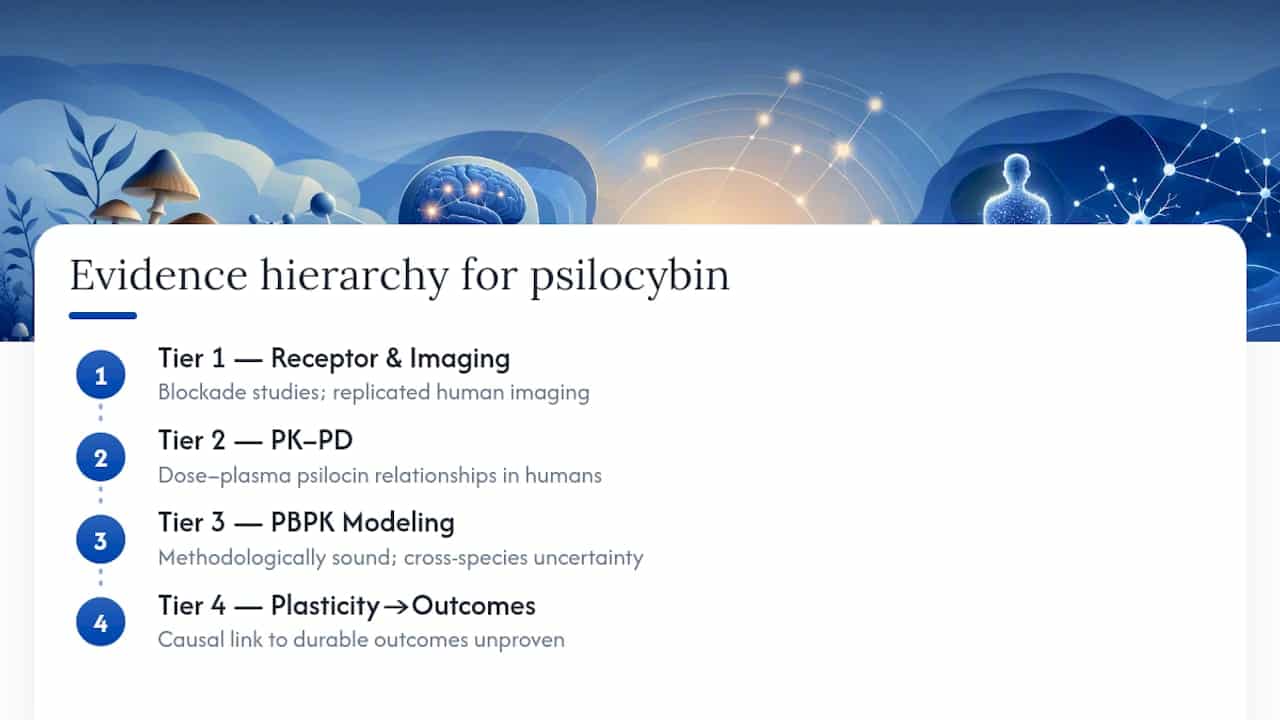
The strongest evidence sits at the receptor level. 5-HT2A agonism as the driver of acute effects is about as well established as pharmacology gets for a psychoactive compound, backed by blockade studies and decades of binding data. Human imaging showing DMN desegregation and increased network entropy is nearly as solid, replicated across multiple independent cohorts and imaging modalities.
The middle tier covers pharmacokinetics and PBPK modeling. PK-PD relationships linking dose to plasma psilocin and subjective intensity are well characterized in humans, and PBPK models predicting tissue-level exposure are methodologically sound but still carry the inherent uncertainty of cross-species extrapolation.
The weakest tier, and the most clinically important, is the causal chain connecting molecular plasticity markers to durable clinical outcomes in humans, and the question of whether hallucinogenic and therapeutic signaling can be cleanly separated. Priority research should focus on biased-signaling ligand development, longitudinal studies pairing PK sampling with repeated imaging in the same subjects, and standardized electrophysiological protocols that can be compared across labs rather than each using bespoke methods.
What the Evidence Actually Adds Up To
Three things stand out after working through this mechanism end to end. First, the chain from prodrug conversion to receptor binding to network disruption is genuinely well supported by human data, not just animal extrapolation dressed up as consensus. Second, the plasticity story, while biologically plausible and consistent with animal findings, is still the weakest empirical link when it comes to humans, and anyone treating BDNF-driven synaptogenesis as a settled explanation for lasting clinical benefit is overstating the evidence. Third, biased signaling research deserves more attention than it currently gets in public discussion, because it’s the one research direction that could eventually answer whether the trip and the treatment are actually the same thing.
If I were setting research priorities, paired PK-imaging designs and conservative medication screening protocols would sit at the top of the list, not because they’re novel, but because too much existing work still studies these pieces in isolation. Mechanistic claims about psilocybin move fast in public conversation; the underlying data should get equal scrutiny before those claims get translated into clinical promises.
— Alex
Key Studies and Reviews Worth Reading
For readers who want to verify the claims above directly, these sources carry the primary weight of the evidence discussed:
- Psilocybin desynchronizes the human brain: longitudinal MRI mapping of connectivity change and persistent hippocampus-DMN effects.
- Pharmacokinetics and Pharmacodynamics of Oral Psilocybin Administration in Healthy Participants: dose-proportional Cmax, Tmax, and half-life data.
- Pharmacokinetics of Psilocybin: A Systematic Review: metabolic enzyme pathways and interindividual variability.
- Development of a PBPK model of psilocybin/psilocin from Psilocybe cubensis in mice, rats, and humans: compartmental modeling and cross-species scaling.
- Biased signaling at 5-HT2A receptor: separating hallucinogenic and therapeutic pathways: emerging receptor-signaling research.
- Neural mechanisms underlying psilocybin’s therapeutic potential: review synthesizing receptor and plasticity mechanisms.
This article is general information, not a substitute for advice from a qualified doctor. Consult a qualified healthcare professional about your own circumstances before acting on anything here.
Sources
- Psilocybin desynchronizes the human brain
- Pharmacokinetics and Pharmacodynamics of Oral Psilocybin Administration in Healthy Participants
- Pharmacokinetics of Psilocybin: A Systematic Review
- Development of a PBPK model of psilocybin/psilocin from Psilocybe cubensis in mice, rats, and humans
- Biased signaling at 5-HT2A receptor: separating hallucinogenic and therapeutic pathways
Recommended
- Psilocybin Depression Treatment California: Your Complete Guide to Legal Mushroom Delivery Services and Therapeutic Options 2025
- Microdosing Psychedelics: Unveiling Remarkable Health Benefits and Therapeutic Potential 2026
- Can Psychedelic Mushrooms Help With Anxiety | Psychedelic Mushrooms For Sale 1 0z | Where to buy Mushrooms for sale online

24–48 Hour Buffer for Psilocybin and Alcohol: Clinical Risks
Mixing psilocybin and alcohol produces unpredictable, often unpleasant results, and no credible harm-reduction source recommends it. The safest rule is a 24 to 48 hour alcohol-free buffer before and after a psilocybin session. Clinical trials studying psilocybin therapeutically require full abstinence and direct supervision, not casual combination.
TL;DR:
- Mixing psilocybin and alcohol often intensifies nausea and dehydration, while impairing coordination and emotional regulation, especially at higher doses.
- Psilocybin activates serotonin receptors to increase perception, whereas alcohol depresses the nervous system, creating unpredictable effects when combined.
- Most recreational use involves drinking to manage nerves, which greatly increases risks like blackout, dehydration, and psychiatric distress due to impaired judgment.
- The safest approach requires abstaining from alcohol 24 to 48 hours before and after a psilocybin session, with microdosing also needing similar alcohol-free windows.
- Clinical research showing psilocybin reduces heavy drinking depends on strict abstinence and supervision, not casual mixing with alcohol at home.
Table of Contents
- What Typically Happens When You Mix Psilocybin and Alcohol
- How Psilocybin and Alcohol Act on the Brain Differently
- Why People Drink While Taking Psilocybin
- Does Alcohol Cancel Out Psilocybin’s Effects?
- Main Risks of Mixing Psilocybin and Alcohol
- How Long Should You Wait Between Alcohol and Psilocybin?
- What Clinical Research Actually Shows About Psilocybin and Alcohol Use Disorder
- When Mixing Signals a Bigger Problem
- A Straight Take on Harm Reduction
- Where to Find Lab-Tested Psilocybin and Dosing Guides
- Sources
What Typically Happens When You Mix Psilocybin and Alcohol
Combining the two rarely produces the experience either substance offers alone. Alcohol tends to blunt the depth and clarity of a psilocybin trip while amplifying nausea, and people report feeling emotionally unstable rather than open or reflective. Community harm-reduction reports back this up: drinking during a session commonly increases stomach upset and dulls the introspective quality people seek from psilocybin.
The physiological picture stacks risk on risk. You get dehydration from alcohol layered onto psilocybin’s own effects on body temperature and heart rate, plus impaired balance and a strained autonomic nervous system trying to process two opposing chemical signals at once.
- Nausea and gastrointestinal distress tend to intensify, not cancel out.
- Emotional swings become harder to predict or self-regulate.
- Coordination and balance suffer more than with either substance alone.
- The outcome depends heavily on dose, individual body chemistry, and setting.
None of this is fixed. A small amount of wine with a light psilocybin dose in a calm home setting behaves nothing like heavy drinking during a strong dose at a crowded event.
How Psilocybin and Alcohol Act on the Brain Differently
The two substances work in almost opposite directions, which is exactly why mixing them gets messy. Psilocybin converts to psilocin in the body and activates 5-HT2A serotonin receptors, driving cortical excitation, that is, increased signaling activity in brain regions tied to perception and self-referential thought.
Alcohol does the reverse. It potentiates GABA-A receptors and blocks NMDA receptors, producing broad central nervous system depression: slowed reaction time, sedation, reduced inhibition.
When you combine a receptor-activating compound with a receptor-suppressing one, the brain doesn’t average the two effects into something moderate. Instead, the excitatory push from psilocin can mask how sedated and impaired you actually are from alcohol. You might feel more alert or less drunk than your coordination and judgment suggest, which is where real danger creeps in.
Why People Drink While Taking Psilocybin
Most people who mix the two aren’t chasing a bigger high. They’re managing nerves.
- A drink beforehand to ease pre-trip anxiety or social awkwardness at a gathering.
- Alcohol offered casually in group settings where psilocybin is also present.
- Confusion about whether the same caution applies to microdosing as to a full psychedelic dose.
Motive matters here. Someone using alcohol to numb anticipatory anxiety before a macrodose faces a very different risk profile than someone who has a glass of wine on an otherwise ordinary evening and also happens to be microdosing. The dosing guidance that applies to one doesn’t automatically apply to the other.
Does Alcohol Cancel Out Psilocybin’s Effects?
Not in the way people hope. Cross-sectional survey data on recreational co-use suggests psilocybin can subjectively blunt the perceived effects of alcohol, meaning people often feel less drunk than they actually are.
That gap between feeling and reality is the whole problem. Blood alcohol concentration, motor impairment, and judgment deficits don’t disappear just because the psilocybin dulls your awareness of them. This mismatch is a well-documented pattern in small studies of recreational co-use, and it’s a common setup for overdrinking, blackouts, and accidents, because the internal warning signals people normally rely on to slow down simply stop working reliably.

Main Risks of Mixing Psilocybin and Alcohol
The dangers here are concrete and worth walking through one at a time.
- Vomiting and aspiration risk. Nausea is common with psilocybin alone; alcohol raises the odds and severity. Never let someone who has vomited from the combination sleep unsupervised or lie flat on their back.
- Dehydration and autonomic strain. Both substances tax fluid balance and heart rate. Water and electrolytes matter more than usual.
- Impaired judgment and accident risk. Disinhibition plus distorted perception is a bad combination near roads, water, heights, or stoves.
- Panic reactions and psychiatric vulnerability. Alcohol can intensify anxiety spikes during a difficult psilocybin moment, and having a calm, sober person present changes outcomes.
- Alcohol poisoning and blackout risk. Because psilocybin can mask perceived drunkenness, people drink more than they realize, raising the odds of dangerous blood alcohol levels.
Pro Tip: Keep a sober, trusted sitter present for any session where alcohol has been involved at all, even a single drink earlier in the day. Judgment failure, not pharmacological overdose, is the real acute danger in healthy adults, and a sober second opinion is the cheapest safeguard against it.
Public-health guidance is blunt on this point: combining psychoactive substances increases unpredictability and raises the risk of accidents and respiratory depression, and that risk calculus doesn’t improve just because psilocybin is a naturally occurring compound rather than a synthetic one. For anyone worried about a difficult experience unfolding, it also helps to review guidance on avoiding a bad trip before dosing, not during.
How Long Should You Wait Between Alcohol and Psilocybin?
The standard harm-reduction buffer is 24 to 48 hours alcohol-free on both sides of a macrodose session, a window recommended by clinical safety guides to protect judgment, hydration, and the integration period that follows a strong experience.

Microdosing calls for a lighter version of the same rule. Keep actual dosing days alcohol-free, and if you want to drink socially, do it on your rest days between doses rather than stacking substances on the same day. The details in microdosing guidance cover this rhythm in more depth.
Already hungover? Reschedule. A hangover means you’re already dehydrated and physiologically stressed, exactly the state you don’t want heading into a psilocybin session. Hydrate, rest, and try again another day.
What Clinical Research Actually Shows About Psilocybin and Alcohol Use Disorder
Here’s where context gets critical, because this is the research most likely to get misread as permission to self-medicate. Clinical trials studying psilocybin for Alcohol Use Disorder have shown reductions in heavy drinking days, with some participants maintaining improvements for months afterward.
A systematic review of classic psychedelics and alcohol use disorders found psilocybin has the most consistent evidence among psychedelics for reducing drinking, though the authors flagged methodological limitations across the studies and called for larger, better-controlled trials.
- Preclinical work shows psilocybin can restore mGluR2 receptor expression and reduce relapse-like drinking behavior in animal models, offering a plausible biological mechanism.
- Every trial pairs the drug with structured psychotherapy.
- Every trial enforces strict abstinence windows around dosing sessions.
Those conditions aren’t incidental. They’re the reason the results hold up. A guided, alcohol-free, therapist-supported protocol is not the same intervention as someone drinking wine while microdosing at home, and treating the research as a green light for casual mixing misreads what the studies actually tested.
When Mixing Signals a Bigger Problem
Occasional overlap is different from a pattern. Watch for repeatedly using alcohol to manage the emotional intensity of psilocybin, needing to combine them more often over time, or noticing that either substance is interfering with work, relationships, or responsibilities.
If that sounds familiar, talk to a clinician experienced in addiction or psychedelic-assisted therapy, and consider a supervised program that explicitly addresses treatment options rather than self-directed use. Seek emergency care immediately for unconsciousness, dangerously slow breathing, seizures, or severe confusion.
A Straight Take on Harm Reduction
Most guidance on this topic hedges. Mine won’t. If you’re choosing to use psilocybin recreationally or exploring it for your own wellbeing, treat alcohol as something to schedule around, not something to layer in. The clinical evidence for psilocybin and alcohol use disorder is genuinely promising, but it was built on abstinence and supervision, not on the idea that psilocybin makes drinking safer or drinking makes tripping smoother. It does neither. If you’re using psilocybin at all, use lab-tested product, respect the buffer windows, and if alcohol has become something you reach for around every session, that’s worth a real conversation with a clinician, not a workaround.
— Alex
Where to Find Lab-Tested Psilocybin and Dosing Guides
If you’ve decided psilocybin is right for you, sourcing matters as much as timing. Fungipsilocybinmushroom lab-tests its products before they ship, discreetly, worldwide, so you know your dose potency going in instead of guessing.
Beyond the products themselves, the site’s dosing guides walk through how to plan a session responsibly, including the alcohol-free windows covered above. Readers exploring lower-commitment options can start with the edible dosing details on the Seremoni chocolate bar line, which lists exact milligram amounts per piece. None of this replaces medical advice, especially for anyone managing alcohol use disorder or another mental health condition. But if you’ve already decided to move forward, start with a product page, check the lab results, and read the dosing notes before you order.
Sources
For deeper reading beyond this guide: the systematic review on psychedelics and alcohol use disorders covers the clinical evidence base, NIAAA’s overview of alcohol’s effects on the body explains alcohol-specific physiological risk, and the CDC’s polysubstance use guidance offers public-health context on combining substances generally.
This article is general information, not a substitute for advice from a qualified doctor. Consult a qualified healthcare professional about your own circumstances before acting on anything here.
- Barrett et al. (cross-sectional reports on recreational co-use)
- BU AOD Health summary of psilocybin trials for AUD
- Classic psychedelics and alcohol use disorders: systematic review (PMC9541961)
- CDC guidance on polysubstance use
Recommended
Get Cracker Dry to Keep Magic Mushrooms Potent 1–2 Years
The fastest way to preserve potency is to get your mushrooms “cracker-dry” (snapping clean at roughly 5% moisture) using a gentle dehydrator or a staged desiccant setup, then seal them airtight with a fresh desiccant pack and store them cool and dark. Dry first, always. Never freeze fresh mushrooms hoping to preserve them later. Heat, light, moisture, and oxygen are the four things working against you from the moment you harvest.
TL;DR:
- Using a dehydrator at 95°F to 115°F and achieving a snap or crack test is essential for long-term potency preservation.
- Leave small mushrooms whole and slice larger ones into quarter-inch pieces to ensure even drying and prevent mold.
- Storing dried mushrooms in airtight, dark containers with desiccant packs greatly extends shelf life compared to loose jars or plastic bags.
- Reaching cracker-dry with about 5% moisture content reduces mold risk and chemical degradation, making the drying process critical.
- Avoid water rinsing, excessive heat, and storing fresh or improperly dried mushrooms to prevent enzymatic degradation, mold, and potency loss.
Table of Contents
- How Do You Prepare Mushrooms Before Drying?
- What’s the Best Way to Dry Magic Mushrooms?
- What Are the Alternatives to a Dehydrator?
- Why Are My Mushrooms Overheating, Under-Drying, or Molding?
- How Should You Store Dried Mushrooms for Maximum Shelf Life?
- How Long Do Dried Mushrooms Actually Stay Potent?
- What Mistakes Ruin a Dried Mushroom Batch?
- What Actually Separates a Good Dry From a Great One?
- An Editor’s Take on Getting This Right
- Want Lab-Tested Dried Mushrooms Without the Guesswork?
- Sources
How Do You Prepare Mushrooms Before Drying?
Harvest at the right window and get mushrooms into a drying setup the same day. Enzymatic activity starts breaking down compounds the moment a mushroom is picked, and every hour of delay before drying begins works against you.
Skip the rinse. Water introduces moisture you’ll spend hours trying to remove later, and it invites mold before drying even starts. Instead, brush off substrate with a soft, dry brush or a clean paper towel, and trim away any dark, dirt packed root ends.
The whole-versus-sliced decision matters more than most guides admit. Research on tryptamine stability found that drying whole in the dark at room temperature produces biomass with comparable tryptamine levels to fresh material, while powdered or heavily damaged mushrooms degrade faster once in storage. That’s a strong argument for leaving smaller specimens intact.
That said, thick caps and dense stems dry slowly, and a slow dry is a moldy dry. The practical compromise:
- Leave small to medium mushrooms whole whenever possible to limit oxidation surface area.
- Slice larger caps and thick stems into pieces roughly a quarter inch thick so moisture escapes evenly.
- Handle everything gently. Bruising and crushing accelerate the enzymatic conversion that eats into your final potency.
- Lay pieces cap side up initially so gills aren’t crushed against a tray.
If you grew your own batch, the timing and handling steps in a grow kit FAQ cover harvest windows that line up directly with when drying should begin.
What’s the Best Way to Dry Magic Mushrooms?
A food dehydrator is the most reliable home method because it holds a steady low temperature and keeps air moving across every piece at once. Grower guides consistently point to a range of roughly 95°F to 115°F (35°C to 46°C) as the sweet spot. Below that, drying drags on and risks mold. Above it, you start cooking off the compounds you’re trying to preserve.
Setup and timing:
- Line dehydrator trays with mesh liners or parchment with holes punched through for airflow.
- Arrange mushrooms in a single layer with space between each piece. Crowding traps moisture and creates uneven drying.
- Set the dehydrator to 95°F (35°C) for the first few hours, then you can nudge toward 115°F (46°C) once the surface moisture is gone.
- Check trays every 2 to 3 hours for the first stretch, rotating them if your unit runs hotter on one side.
- Small caps and thin stems typically finish in 6 to 12 hours. Thicker specimens or whole large mushrooms can take 18 to 24 hours.
- Test a stem by bending it. If it flexes at all, it needs more time.
- Once it snaps clean instead of bending, pull a few pieces and let them sit at room temperature for 20 to 30 minutes before the final check.
- Snap-test again after cooling. Trapped internal moisture sometimes shows up only after the piece has cooled fully.
That snap, not a squeeze or a bend, is the benchmark growers rely on. It’s commonly called “cracker dry”, and it corresponds to a moisture content of around 5% or less. Below that threshold, mold has almost nothing to grow on and chemical degradation slows considerably.
Pro Tip: Keep a small bowl of uncooked rice or a food-safe silica packet next to your finished trays while you’re still checking other batches. It pulls ambient humidity away from mushrooms that are already dry, so they don’t reabsorb moisture while waiting on their slower neighbors.
What Are the Alternatives to a Dehydrator?
Not everyone owns a dehydrator, and several other methods work fine if you respect their limits.
- Fan and air drying: Spread mushrooms on a mesh screen or paper towel with a box fan running nearby, in a room with humidity below 50% if you can manage it. This is slow, often 2 to 4 days, and it only works reliably in dry climates. Damp environments turn this into a mold incubator.
- Desiccant chamber: Pre-dry mushrooms with a fan for 12 to 24 hours to knock out surface moisture, then transfer them into a sealed container lined with food-grade silica gel packets (never let mushrooms touch industrial or non-food silica directly). This finishes the job over another day or two with almost no heat exposure, which some growers consider the gentlest approach outside of a dehydrator.
- Oven drying: Treat this as a last resort. Set the oven to its lowest possible setting, prop the door open a few inches, and place a thermometer inside the door to confirm you’re staying under 115°F (46°C). Ovens run hot and uneven, and it’s easy to scorch a batch without noticing.
- Freeze-drying: This preserves texture and nutritional quality better than hot-air drying, but it requires equipment most home users don’t have and isn’t practical for a single harvest. Worth knowing about, not worth chasing unless you already have access to a freeze-dryer.
Combining a fan pre-dry with a desiccant finish is a smart middle path. It cuts total drying time while keeping mushrooms out of direct heat for most of the process.
Why Are My Mushrooms Overheating, Under-Drying, or Molding?
Heat and light are the two fastest ways to wreck a batch before storage even begins. Peer-reviewed stability research on Psilocybe cubensis found that thermal degradation becomes significant above 100°C, and separately, drying whole mushrooms in the dark at room temperature preserved tryptamine levels comparable to fresh biomass. The lesson is consistent across both findings: low, steady temperature beats speed every time.

Overheated mushrooms turn brittle, dark, and sometimes slightly scorched at the edges or stem base. Once that happens, the damage is done. There’s no fixing it. Drop your dehydrator temperature and watch the next batch more closely.
Under-dried mushrooms feel flexible instead of snapping, or show soft spots on thicker caps and stems. The fix is simple: put them back in for more time and recheck every hour rather than guessing.
Mold shows up as fuzzy patches, usually gray, white, or black, sometimes with a sour or musty smell. There’s no salvaging a moldy batch. Discard the contaminated pieces, disinfect trays and tools with a diluted bleach solution or high-proof alcohol, and let everything dry completely before the next run.
One stark data point underscores why drying matters so much: freezing fresh mushrooms at -80°F without drying first caused roughly 90% loss of tryptamines. Cold does not substitute for drying. Ever.
How Should You Store Dried Mushrooms for Maximum Shelf Life?
Let dried mushrooms cool to room temperature for at least 30 minutes before sealing anything. Packing warm mushrooms into a jar traps residual heat, which condenses into moisture on the container walls and undoes the entire drying process.
From there, you have three realistic packaging routes:
- Mason jars with silica packets are the simplest option. Drop in a food-grade desiccant packet, seal, and store somewhere dark. Good for shorter-term storage, but the jar still holds air, and oxygen is one of the four things driving degradation.
- Vacuum sealing removes most of that air and is the better choice for anything you want to keep more than a year. A basic vacuum sealer and food-safe bags handle this in under a minute per batch.
- Inert gas flushing (using argon or nitrogen in the headspace before sealing) pushes oxygen exposure even lower, but it requires gear most home users won’t bother buying for a personal supply.
Skip the fridge unless the bag is fully vacuum-sealed. Refrigerators cycle humidity constantly, and an improperly sealed jar in a fridge will pull in moisture over weeks. If you do freeze fully cracker-dry, vacuum-sealed mushrooms, let the sealed bag come to room temperature before opening it. Opening a cold bag straight from the freezer invites condensation onto the exact material you worked to dry.
Label every container with the strain, harvest date, and drying method. Portion into smaller vacuum bags by dose before sealing rather than breaking open your entire stash every time you need a gram.
Pro Tip: Keep your main supply sealed and untouched, and portion a small rotating amount into a separate jar for near-term use. Every time you open a container, you expose the whole batch to fresh air and ambient humidity.
How Long Do Dried Mushrooms Actually Stay Potent?
Storage method changes the timeline dramatically, and the numbers are more specific than most people expect.
| Storage method | Expected shelf life | Notes |
|---|---|---|
| Pantry jar with desiccant | 6 to 12 months | Good for near-term supply; monitor for moisture regularly |
| Vacuum sealed, room temperature | Up to 1 year | Oxygen removal is the main advantage over a loose jar |
| Vacuum sealed and frozen | 1 to 2 years | Best long-term option if sealing is done properly before freezing |
These ranges come from practical cracker-dry storage benchmarks that growers and preservation guides rely on. Degradation doesn’t stop at any point, it just slows to a crawl under cool, dark, dry conditions.
Powdered mushrooms lose potency noticeably faster than whole pieces because grinding exposes far more surface area to oxygen and light at once. If you plan to store for more than a few months, keep material whole and grind only right before use. Check jars every two to three months for any sign of moisture beading on the glass or a musty smell, both early warnings that something is going wrong inside.
What Mistakes Ruin a Dried Mushroom Batch?
Most ruined batches trace back to one of a handful of avoidable errors. Storing mushrooms before they’re truly cracker-dry is the single biggest one. Drying at excessive heat to save time is a close second. Washing mushrooms with water before drying and sealing containers while any residual moisture remains round out the list.
- Never store a batch that only feels dry. Snap-test every piece, not just the biggest one.
- Inspect stored mushrooms periodically: look for spotting or fuzz, feel for any softness that wasn’t there before, and smell for anything musty or sour.
- If anything about a batch seems off, discard it. A few dollars of lost mushrooms is a far better outcome than a contaminated one.
What Actually Separates a Good Dry From a Great One?
Home drying setups vary enormously, which is exactly why lab verification matters when you’re not doing it yourself. Fungipsilocybinmushroom runs its own products through lab testing before they’re listed, so buyers aren’t relying on a stem snap and a guess. That same rigor shapes the educational resources the site maintains around cultivation and safe handling.
If you’re drying your own harvest, the grow-at-home guidance walks through how growing conditions set up the drying stage that follows. One caveat worth stating plainly: psilocybin’s legal status varies enormously by country and even by region within a country. Check your local laws before you harvest, dry, or store anything.
An Editor’s Take on Getting This Right
Most drying guides treat “cracker dry” as a nice-to-have detail buried halfway down the page. It shouldn’t be. It’s the entire game. Everything else, tray layout, temperature range, whether you use a dehydrator or a box fan, is just a means of getting to that one snap test reliably and without scorching your batch.
Here’s what I think gets underweighted: people obsess over the drying method and treat storage as an afterthought, when the data suggests the opposite matters more over time. A mediocre dry followed by a genuinely airtight, dark, desiccant-backed seal will likely outlast a perfect dry stuffed into a loosely closed jar on a sunny windowsill. Oxygen and light do slow, patient damage that most people never notice until the batch is noticeably weaker than they remember.
If you take one habit from this guide, make it this: get to cracker-dry, then obsess over sealing out air and light. That single combination does more for long-term potency than any temperature tweak or gadget upgrade ever will.
— Alex
Want Lab-Tested Dried Mushrooms Without the Guesswork?
If drying your own harvest sounds like more equipment and trial-and-error than you want to take on, Fungipsilocybinmushroom offers an alternative: lab-tested products that arrive already at the potency and quality you’re after, with discreet worldwide shipping so you skip the dehydrator entirely.
Beyond raw dried mushrooms, the shop carries options for readers who’d rather not manage storage at all, including dosed edibles like the Seremoni psilocybin chocolate bar, which sidesteps the entire drying and sealing process since potency is locked in at production. Every product listed goes through lab verification before it’s offered for sale, so you’re not relying on a snap test and a hope.
If you’d rather explore a specific variety than build your own drying setup from scratch, take a look at the Amazonian psilocybin mushroom selection and place an order with confidence that the testing and handling were done right the first time.
This article is general information, not a substitute for advice from a qualified doctor. Consult a qualified healthcare professional about your own circumstances before acting on anything here.
Sources
- Stability of psilocybin and its four analogs in the biomass of the psychotropic mushroom Psilocybe cubensis
- Cracker Dry: How to Dry & Store Magic Mushrooms (2026)
- Storage & Degradation — iMicrodosing Research
- Novel Perspective of Medicinal Mushroom Cultivations: A Review Case for ‘Magic’ Mushrooms (MDPI review)
Recommended
- How to Grow Magic Mushrooms at Home: The Secret Method Experts Don’t Want You to Know 2day
- Magic Mushroom Grow Kit FAQ: All Questions & Solutions 2026
- How Long Do Magic Mushrooms Stay in Your System New York? Complete Guide 2025
- Top 7 magic mushroom strains and their effects | magic mushroom For Sale