
Blog
Psilocybin Legal Status: 4 Steps to Verify U.S. and Global Rules


Psilocybin remains a Schedule I controlled substance under federal law, meaning possession, cultivation, and distribution are federal crimes anywhere in the United States. Oregon and Colorado are the two exceptions that matter: both run state-licensed programs where adults can legally access supervised psilocybin experiences. More than 30 U.S. cities have deprioritized enforcement, but that’s a policing choice, not a change to state or federal law, and it offers no real protection if you’re caught with mushrooms.
TL;DR:
- Federal law classifies psilocybin as a Schedule I drug, making possession and distribution illegal nationwide, despite some state and city decriminalization efforts.
- Oregon and Colorado have established regulated frameworks for supervised psilocybin use, but both programs operate within strict on-site, supervised models that do not legalize take-home possession.
- The lack of FDA approval for psilocybin-based medicines means it remains in Schedule I until clinical trials in progress conclude, which could take several years.
- City deprioritization policies reduce enforcement but do not change the legal status of psilocybin, and crossing jurisdictions or borders still involves federal legal risks.
- International legal approaches vary, with some countries allowing personal use or selective legality of certain product forms, but most still treat psilocybin as a controlled substance without broad legal access.
Table of Contents
- Is Psilocybin Legal Under Federal Law?
- Where Are Oregon and Colorado Different From Everywhere Else?
- What Does City Deprioritization Actually Change?
- How Do Other Countries Handle Psilocybin?
- What’s Driving Legal Change Right Now?
- What Are the Real Legal Risks of Using or Carrying Psilocybin?
- How Do You Check the Actual Law Where You Live?
- Publisher Resources for Safety and Education
- What Should Readers Watch for Next?
- Explore Fungipsilocybinmushroom’s Safety and Product Resources
- Sources
Is Psilocybin Legal Under Federal Law?
No. Psilocybin sits in Schedule I of the Controlled Substances Act, the same tier as heroin, reserved for substances the DEA considers to have a high potential for abuse and no accepted medical use. That classification makes possession, growing, selling, or transporting psilocybin mushrooms a federal offense in all 50 states, regardless of what your city council or state legislature has done. The DEA’s drug scheduling framework hasn’t budged on psilocybin, and as of September 2026, there’s still no FDA-approved psilocybin medicine on the market.
That last point matters more than people realize. Schedule I status isn’t just a label. It’s tied to a specific legal finding that a drug has no accepted medical use, and the primary way to overturn that finding is for the FDA to approve a drug containing it. Two things have to happen, in sequence, before psilocybin could move to a lower schedule or off the schedule entirely:
- A drug maker completes Phase 3 clinical trials and files a New Drug Application with the FDA.
- The FDA approves that application, which then gives the DEA legal grounds to reschedule the compound (or the DEA moves on its own through administrative rescheduling, a rarer and slower path).
Neither has happened yet. Compass Pathways and Usona Institute both have Phase 3 programs in progress, and their outcomes are the single biggest lever on federal change. The FDA’s drug approval process explains why this takes years rather than months: trial data has to hold up, manufacturing standards have to be locked in, and safety signals get scrutinized across thousands of patient hours before anything reaches a pharmacy shelf.
Federal Schedule I status means no FDA-approved psilocybin drug exists nationwide as of September 2026, and every state-level program operates as a carve-out, not a challenge to that federal baseline.
The practical fallout from Schedule I status goes beyond criminal exposure. Federal employees and contractors can face termination or security clearance denial for psilocybin use, even where a state has legalized it. Immigration consequences can be severe. A drug conviction, or in some cases even an admission of drug use, can affect a green card application or naturalization case. Crossing state lines with mushrooms, even from a legal-access state to another, is a federal transport issue because it treats the substance as contraband the moment it crosses a border the federal government controls.
Where Are Oregon and Colorado Different From Everywhere Else?
Oregon and Colorado are the only two states that have built regulated frameworks for legal psilocybin access, and they took different routes to get there.
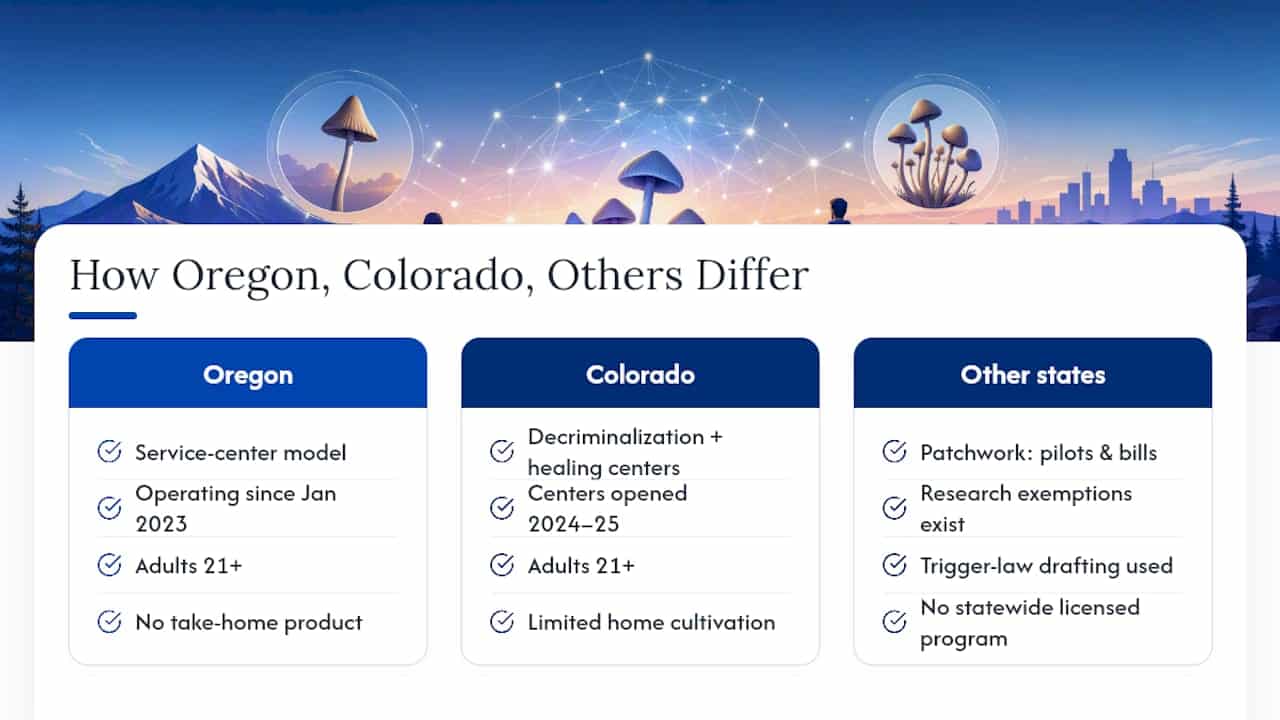
Oregon passed Measure 109 in 2020, and the resulting service center model has been operating since January 2023. Adults 21 and older can book a supervised psilocybin session at a state-licensed service center, but there’s no prescription involved and no take-home product. You consume it on-site, under supervision, and leave without any mushrooms in your possession. More than 100 licensed centers were operating by 2026, and a typical session runs $1,800 to $3,500, a price point that reflects facilitator time, facility costs, and the multi-hour commitment a full session requires. The Oregon Health Authority regulates the program, and in 2026 it merged its psychedelic mushroom oversight with its medical marijuana regulatory arm, partly to address budget shortfalls. That merger came with proposed licensing fee increases, a reminder that these programs are still finding their financial footing years after voters approved them.
Colorado took a broader approach with Proposition 122 in 2022. It decriminalized personal possession, use, and limited home cultivation and sharing for adults, on top of building a licensed healing-center framework similar in spirit to Oregon’s. Licensed centers began opening in 2024 and 2025, regulated through the state’s Division of Professions and Occupations. The distinction that trips people up: decriminalization under Prop 122 applies broadly to personal use, while the licensed healing-center piece is the supervised, paid-session model, closer to what Oregon offers. Both tracks exist side by side under state law.
Outside these two states, the picture is a patchwork of pilot programs, research exemptions, and bills that haven’t crossed the finish line. Several states have introduced legislation modeled on Oregon or Colorado, and a growing number have adopted what’s called trigger law language, meaning a statute that only activates certain psilocybin allowances if and when the FDA approves a psilocybin drug or the DEA reschedules it. That drafting choice matters because it determines how fast a state could move if federal rules change. A state with a trigger law already on the books could have a functioning program within months of federal rescheduling. A state starting from zero would need years to write and pass new legislation.
Pro Tip: Before assuming any state “allows” psilocybin, check whether the law is a full decriminalization statute, a licensed-access program, or just a pending bill that hasn’t passed yet. All three get reported in the news using similar language, and conflating them is one of the most common mistakes readers make.
State law and federal law don’t cancel each other out. Oregon and Colorado residents using licensed programs are still technically violating federal law, even though federal prosecutors have shown little interest in pursuing individual users in states with regulated access. That gap between what’s tolerated and what’s technically illegal is the defining feature of psilocybin law in 2026.
What Does City Deprioritization Actually Change?
Not much, legally speaking. City deprioritization is a local government or district attorney’s decision to make psilocybin enforcement the lowest law enforcement priority, or to direct police and prosecutors not to pursue simple possession cases. It’s an administrative directive, not a change to the underlying statute. The mushrooms are still illegal under state and federal law in every deprioritized city. What changes is the likelihood that local police will make an arrest or that a local prosecutor will file charges.
More than 30 U.S. cities have passed some version of this policy, including well-known examples like Denver (which deprioritized psilocybin before Colorado’s statewide measure passed), Oakland, Santa Cruz, Ann Arbor, and Seattle. Each city’s policy language differs slightly. Some cover only personal possession; others extend to cultivation for personal use or gifting between adults.
Two limitations deserve attention:
- Deprioritization can be reversed by a new city council, a new district attorney, or a new police chief without any ballot measure or legislative vote.
- It provides zero protection outside city limits. A deprioritized city sitting inside a state where psilocybin is still fully criminalized doesn’t change your legal exposure the moment you cross into county jurisdiction, drive to a neighboring town, or get stopped by state or federal authorities rather than local police.
Reporters and advocates often blur the line between local deprioritization and actual decriminalization, and that confusion creates false expectations for people who assume “my city deprioritized it” means “it’s legal here.” It doesn’t. It means enforcement is a lower priority, which is a meaningfully different thing than the possession laws actually changing.
How Do Other Countries Handle Psilocybin?
International approaches to psilocybin fall into four rough categories: fully scheduled and criminalized, decriminalized for personal use, regulated medical access, and a gray zone where a specific product form (like fresh truffles) is tolerated while dried mushrooms remain illegal.
The Netherlands is the clearest example of that last category. Dried psilocybin mushrooms have been banned since 2008, but psilocybin-containing truffles remain legal for sale in licensed smartshops because they weren’t included in the original ban’s plant classification. Visitors to Amsterdam regularly buy truffles legally while assuming, incorrectly, that mushrooms carry the same status.
A few other notable examples:
- Jamaica has never scheduled psilocybin mushrooms, which has made it a hub for commercial retreat centers operating in a genuinely unscheduled legal environment rather than a gray area.
- Brazil doesn’t explicitly schedule psilocybin mushrooms, and that regulatory ambiguity has allowed retreat operators to run legally ambiguous but practically tolerated businesses.
- Canada doesn’t have broad legal access, but its Special Access Program allows physicians to request psilocybin for patients with serious or life-threatening conditions who haven’t responded to standard treatments, a narrow medical exception rather than general legalization.
- Many other countries, including most of the EU beyond the Netherlands’ truffle carve-out, still treat psilocybin as a fully scheduled controlled substance with no legal personal-use pathway.
If you’re planning to attend a retreat abroad, verifying legal status is only half the job. Retreat legitimacy and medical staffing vary enormously even within countries where the practice is tolerated. A center operating in a legal gray zone in Brazil or Jamaica may or may not have a physician on-site, may or may not screen for contraindicated medications or heart conditions, and may or may not carry any liability insurance. Country-level legality tells you whether you’ll get arrested. It tells you nothing about whether the facilitators know what they’re doing.
Access even within legal state programs isn’t as open as headlines suggest. Cost and geography limit uptake in both Oregon and Colorado, since licensed sessions aren’t covered by mainstream insurance and centers remain concentrated in a handful of metro areas rather than spread statewide.
What’s Driving Legal Change Right Now?
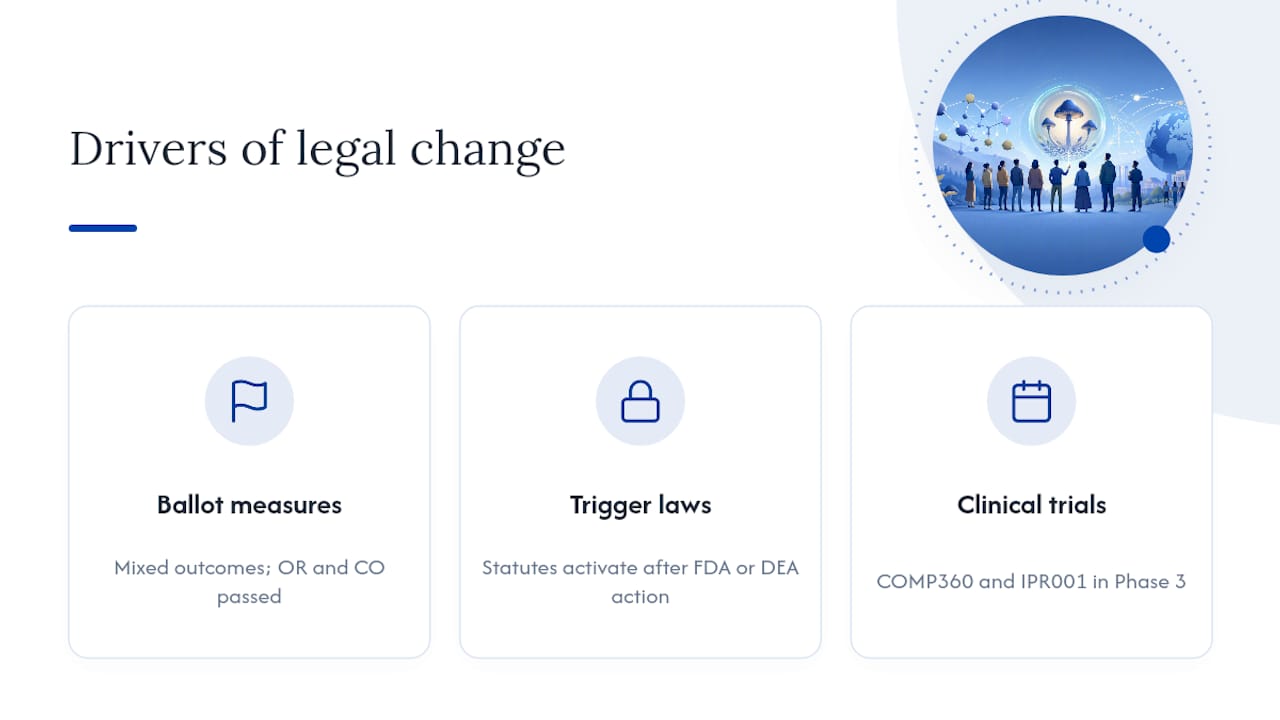
Three forces are shaping where psilocybin law goes next: ballot initiatives, trigger laws, and the clinical trials that could unlock federal rescheduling.
Ballot measures have had a mixed record. Oregon’s Measure 109 and Colorado’s Prop 122 both passed, but similar measures in other states have stalled at the signature-gathering stage or failed outright at the ballot box. That inconsistency reflects genuine public split on the issue rather than a clear national trend in one direction. Some states are instead moving through the legislature, introducing bills that mirror the Oregon service-center model or Colorado’s decriminalization-plus-licensing structure, with mixed success getting them out of committee.
Trigger laws are the quieter but arguably more important development. These are statutes drafted so that certain psilocybin allowances only activate once the FDA approves a psilocybin-based drug or the DEA reschedules the compound. States adopting this language are essentially pre-positioning themselves for a federal change they can’t control the timing of, so they can move quickly instead of starting the legislative process from scratch. Watching policy trackers is the most reliable way to see which states have this language on the books and which bills are actively moving.
The clinical trial pipeline is the piece that could reshape everything else. Compass Pathways’ COMP360 and Usona Institute’s IPR001 are both in Phase 3, the last stage before an FDA New Drug Application. Neither has produced an approved drug as of mid-2026, but a successful outcome for either program would be the strongest catalyst for federal rescheduling that currently exists. It would also likely accelerate every trigger law sitting on a state’s books, turning conditional statutes into active law almost overnight.
None of this means change is imminent. Phase 3 trials, FDA review, and any subsequent DEA rescheduling process typically take years even in a best-case scenario. Readers tracking this space should expect incremental movement, not a single announcement that flips the legal picture nationwide.
What Are the Real Legal Risks of Using or Carrying Psilocybin?
Federal prosecution of individual users for simple possession is uncommon in practice, but “uncommon” isn’t “impossible,” and the variables that push a case toward prosecution include quantity, intent to distribute, prior record, and whether the case intersects with another federal matter (a border stop, an immigration proceeding, a firearms investigation). Federal resources tend to focus on distribution and trafficking rather than personal use, but that pattern isn’t a guarantee, and it can shift with political priorities.
Collateral consequences often matter more than the criminal charge itself:
- Federal employees, contractors, and security-clearance holders can lose their jobs or clearance over psilocybin use, even in a legal-access state.
- Immigration consequences can include denial of a green card, naturalization, or reentry, since federal immigration law treats controlled substance violations harshly regardless of state legality.
- Federal benefits and firearms eligibility can both be affected by a drug conviction, since federal law prohibits firearm possession by unlawful drug users.
- Child custody proceedings sometimes treat psilocybin use as evidence of impaired judgment, even where the underlying use was legal under a state program.
Transporting psilocybin across any border, state or international, carries outsized risk compared to using it in a fixed location. Crossing state lines turns simple possession into a potential federal trafficking or transport issue, and crossing an international border adds customs law and the receiving country’s own statutes on top of that. Airports and ports of entry are federal jurisdiction by definition, which erases any state-level protection the moment you’re in that space.
Different product forms also get treated inconsistently. Spores are legal to possess in most U.S. states because they don’t contain psilocybin themselves, even though germinating them into mushrooms is illegal almost everywhere spores are sold. Edibles and concentrates sometimes fall into legal gray areas that dried mushroom possession doesn’t, simply because older statutes were written before those product forms existed.
Pro Tip: If you’re relying on a state’s licensed program, keep documentation of your session (receipts, facility licensing info) rather than any product. Oregon and Colorado programs are built around consumption on-site, and carrying product away from a licensed facility puts you outside the protection the program was designed to offer.
How Do You Check the Actual Law Where You Live?
Verifying psilocybin’s legal status where you live, or where you’re traveling, takes a few concrete steps rather than a single Google search.
- Start with the DEA’s scheduling page to confirm the federal baseline hasn’t changed.
- Check your state legislature’s official website for the actual statute text, not a news summary, and note its effective date.
- If your state has a licensed program (currently Oregon or Colorado), review the regulating agency’s site (Oregon Health Authority or Colorado’s Division of Professions and Occupations) for current licensing rules and any recent fee or policy updates.
- Cross-reference with a dedicated tracker, since these compile bill numbers, ballot text, and municipal measures in one place.
A few resources are worth bookmarking rather than searching for each time:
- The Psychedelic Alpha law and policy tracker for near-real-time updates on state bills and municipal measures.
- The Berkeley Center for the Science of Psychedelics law and policy map for a state-by-state legal overview.
- Your state’s official legislative website for primary statute text, which always outranks a news article’s summary of that text.
Practical risk reduction comes down to a short list: never transport psilocybin across state or international borders, consult an attorney before assuming any high-stakes use case (employment, custody, immigration) is safe, and if you’re using a licensed state program, keep records showing you followed its rules.
Publisher Resources for Safety and Education
A reputable supplier maintains lab-testing standards across its product catalog and publishes harm-reduction material because legal access and safe use are two separate problems that both deserve real answers. Readers researching dosing guidance will find practical, experience-level breakdowns rather than vague advice, and the site’s broader psilocybin education hub covers everything from strain differences to how psilocybin compares with other psychedelics.
None of this is legal advice. Nothing in this article should be read as a recommendation to violate any law in your jurisdiction. Laws vary by state and country, change over time, and carry consequences that a general information page can’t account for. If you’re facing a specific legal question, a licensed attorney in your jurisdiction is the only reliable source for advice you can act on.
What Should Readers Watch for Next?
Phase 3 results from Compass Pathways and Usona Institute are the single biggest variable to track over the next few years. A positive outcome would likely accelerate trigger laws already sitting in multiple state legislatures, turning conditional statutes into active programs faster than a normal legislative process would allow. Short of that, expect the current pattern to continue: more cities deprioritizing enforcement, a handful of states experimenting with pilot programs, and Oregon and Colorado working out the operational kinks in their licensing systems.
My advice is unglamorous but durable: verify the actual statute before you act, not a headline or a friend’s summary of one. Use trackers like Psychedelic Alpha for anything time-sensitive, and treat state-level access as narrower and more conditional than most coverage implies.
— Alex
Explore Fungipsilocybinmushroom’s Safety and Product Resources
Understanding where psilocybin stands legally is only useful once you’re also thinking about quality and safety; reputable vendors typically ensure their products ship with lab-testing so users know what they’re taking. That matters more in a legal landscape this fragmented, where the substance itself often isn’t the risky part of the equation, but an untested, unverified source can be.
For readers exploring options, the Copelandia Cyanescens listing shows what a rigorously tested, high-potency strain looks like on the market, and the therapeutic strains guide breaks down options by experience level rather than marketing hype. Fungipsilocybinmushroom ships discreetly worldwide and backs every order with the same testing standards discussed throughout this guide. Browse the current catalog and see which strain fits your experience level before you place an order.
This article is general information, not a substitute for advice from a qualified lawyer. Consult a qualified legal professional about your own circumstances before acting on anything here.