
Blog
How Long Does MDMA Stay in Your System

How Long Does MDMA Stay in Your System
If you’ve recently taken MDMA and you’re wondering how long it stays in your system — whether for an upcoming drug test, health reasons, or just curiosity — you’re in the right place. This guide is written for anyone who wants straight, honest answers without the medical jargon.
Here’s what we’ll cover: how your body actually breaks down MDMA, how long it shows up across different drug tests (urine, blood, saliva, and hair), and what personal factors — like your age, metabolism, and how much you took — can change the timeline for you specifically.
Understanding What MDMA Does in the Body
MDMA (3,4-methylenedioxymethamphetamine), commonly known as Ecstasy or Molly, is an illegal synthetic drug combining stimulant and hallucinogenic properties. Users experience euphoria, well-being, and altered perception, with effects typically:
-
Beginning: 30–45 minutes after ingestion
-
Peaking: 15–30 minutes after onset
-
Lasting: 4–6 hours, sometimes extending days or weeks
> ⚠️ Street Ecstasy and Molly frequently contain contaminants — methamphetamine, ketamine, or caffeine — and sometimes no MDMA at all.
How the Liver Breaks Down MDMA
MDMA has a half-life of approximately 8 hours, meaning the body reduces its bloodstream concentration by 50% every 8 hours. Using the standard five half-life rule:
| Half-Lives Completed | Time Elapsed | MDMA Remaining |
|---|---|---|
| 1 | ~8 hours | ~50% |
| 3 | ~24 hours | ~12.5% |
| 5 | ~40 hours | ~5% |
Roughly 95% of MDMA is cleared within 40 hours.
Key Factors That Affect Metabolism Speed
How long does MDMA stay in your system? It varies based on:
-
Dose and frequency of use
-
Age, weight, and gender
-
Overall physical health
-
Fluid intake and exercise levels
-
Dietary factors
-
Genetic variations in metabolizing enzymes
How Long MDMA Stays in Each Type of Drug Test
Urine Tests and Detection Windows
Urine testing is the most common method used to detect MDMA. How long does MDMA stay in your system via urine? It can be detected for up to 120 hours (5 days), though some sources suggest a shorter window of 2 to 4 days.
Blood Tests and How Quickly MDMA Clears
Blood tests offer a shorter detection window compared to urine. MDMA typically clears from the bloodstream within approximately 71 hours (3 days) after last use, making blood tests more useful for identifying very recent consumption.
Saliva Tests and Short Detection Periods
Similar to blood testing, saliva tests detect MDMA for up to 71 hours (roughly 3 days). These tests are often used for roadside or on-site screening due to their convenience.
Hair Follicle Tests and Long-Term Detection
Hair follicle testing provides the longest detection window. MDMA can be identified in hair samples for months after last use, with the exact duration depending on:
-
Hair length
-
Sample location on the head
| Test Type | Detection Window |
|---|---|
| Urine | Up to 5 days |
| Blood | Up to ~3 days |
| Saliva | Up to ~3 days |
| Hair Follicle | Several months |
Key Factors That Influence How Long MDMA Stays in Your System
A. Dosage and Frequency of Use
Higher doses and repeated use mean more MDMA accumulates in the body, extending the detection window significantly.
B. Body Weight and Fat Percentage
MDMA and its metabolites can bind to fatty tissue. Individuals with higher body fat percentages may retain traces longer, directly affecting how long MDMA stays in your system.
C. Age and Overall Metabolic Rate
Metabolic rate slows with age. Older individuals typically process and eliminate MDMA more slowly than younger people with faster metabolism.
D. Kidney and Liver Health
The liver and kidneys are central to breaking down and flushing out MDMA. Compromised organ function reduces clearance efficiency, prolonging detection times.
E. Hydration Levels and Lifestyle Habits
Several lifestyle factors influence elimination speed:
| Factor | Effect on MDMA Clearance |
|---|---|
| High hydration | Supports faster renal excretion |
| Regular exercise | May boost metabolic processing |
| Poor diet | Can slow overall metabolism |
| Low fluid intake | Slows elimination via urine |
With this in mind, genetic variations in the enzymes responsible for metabolizing MDMA also play a notable role — individuals with less active enzyme variants may clear the substance more slowly, regardless of other lifestyle factors.
Common Symptoms While MDMA Leaves Your System

Physical Side Effects During Clearance
As your body works to eliminate MDMA, you may experience a range of physical symptoms, including:
-
Nausea and appetite loss
-
Hot flashes, chills, and sweating
-
Dehydration and elevated heart rate
-
Increased muscle tension, tremors, and teeth clenching
-
In severe cases: fainting, seizures, kidney failure, or loss of consciousness
These physical effects reflect the significant strain MDMA places on your body’s systems during clearance.
Emotional and Psychological Effects After Use
Beyond physical symptoms, MDMA affects your mental state both during and after use. Common psychological effects include:
-
During use: Euphoria, confusion, and paranoia
-
After use: Anxiety, panic attacks, and strong cravings for more MDMA
These emotional swings occur as brain chemistry attempts to rebalance after MDMA-induced depletion of key neurotransmitters.
How Long Comedown Symptoms Typically Last
Now that we’ve covered the immediate effects, it’s important to understand that some symptoms persist well beyond how long MDMA stays in your system. Extended comedown effects can last days to weeks and include:
| Symptom Category | Examples |
|---|---|
| Mood | Depression, irritability, aggression |
| Cognitive | Poor attention, memory issues |
| Behavioral | Poor impulse control, decreased appetite |
| Sleep | Disturbances and insomnia |
How to Support Your Body in Clearing MDMA Faster

Staying Hydrated to Aid Kidney Function
Proper hydration supports kidney filtration, helping your body process and eliminate MDMA metabolites more efficiently. Aim for consistent water intake throughout the day rather than excessive amounts at once.
Eating Nutritious Foods to Support Liver Health
Since the liver is the primary organ responsible for metabolizing MDMA, nourishing it matters. Focus on:
-
Antioxidant-rich foods – fruits and vegetables that reduce oxidative stress
-
Lean proteins – support enzyme production needed for metabolism
-
Whole grains – provide steady energy during recovery
Avoiding heavily processed or fatty foods reduces the liver’s workload during this period.
Getting Adequate Sleep to Speed Up Recovery
Sleep is when your body performs critical repair and detoxification processes. Prioritizing consistent, quality sleep allows your metabolism to function optimally, which directly influences how long MDMA stays in your system.
-
Maintain a regular sleep schedule
-
Limit screen exposure before bed
-
Create a calm, dark sleeping environment
Avoiding Other Substances That Slow Metabolism
Combining MDMA with alcohol or other drugs can burden the liver and slow metabolic clearance. With this in mind, eliminating additional substances during recovery gives your body the best opportunity to process MDMA without added interference.
Important Health and Safety Considerations
A. Risks of Frequent or High-Dose MDMA Use
Frequent or high-dose MDMA use significantly elevates health risks, including:
-
Dangerous spikes in blood pressure and heart rate
-
Hyperthermia (dangerously high body temperature)
-
Seizures, delirium, and loss of consciousness
-
Severe dehydration and kidney failure
-
Brain swelling and, in rare cases, death
-
Long-term risks include heart arrhythmias, heart damage, and heart disease
B. When to Seek Medical Help After MDMA Use
Seek immediate medical attention if someone experiences:
-
Unconsciousness or suspected overdose
-
Seizures or severe delirium
-
Life-threatening changes in vital signs
-
Physical injury following use
Professional addiction treatment and detox programs are available to manage acute intoxication, withdrawal symptoms, and long-term abuse patterns.
C. Understanding Legal Consequences of Positive Drug Tests
Now that we’ve covered health risks, it’s equally important to understand the legal weight of a positive result. MDMA is classified as a Schedule I substance, indicating a high potential for abuse and no accepted medical use.
Positive drug tests carry serious consequences across multiple settings:
| Setting | Potential Consequence |
|---|---|
| Workplace | Termination or suspension |
| Schools | Disciplinary action |
| Sports organizations | Disqualification or ban |
| Courts | Legal penalties or probation violations |
7 FAQ
How long does MDMA stay in your system?
MDMA typically clears from blood within 1–2 days, urine within 3–5 days, saliva within 1–2 days, and hair up to 90 days.
Can you speed up how fast MDMA leaves your body?
Not dramatically. Staying hydrated, sleeping well, and eating nutritious food supports your liver and kidneys, but there’s no shortcut that significantly cuts detection time.
Does drinking water flush MDMA out faster?
Water helps your kidneys process waste, but drinking excessive amounts won’t meaningfully shorten detection windows and can actually be dangerous.
Why did MDMA show up in my urine test after 5 days?
Heavy or repeated use, slow metabolism, kidney issues, or high body fat can all extend how long MDMA stays in your system beyond the typical range.
Can a urine test tell the difference between MDMA and other substances?
Standard immunoassay tests can produce false positives. A confirmatory GC-MS test is needed to specifically identify MDMA.
Does a single dose clear faster than repeated use?
Yes. A one-time dose clears much quicker than multiple doses taken over a weekend, which can extend detection windows noticeably.
Is MDMA detectable in hair after 90 days?
Generally no. Hair tests typically cover a 90-day window, though this depends on hair length and growth rate.
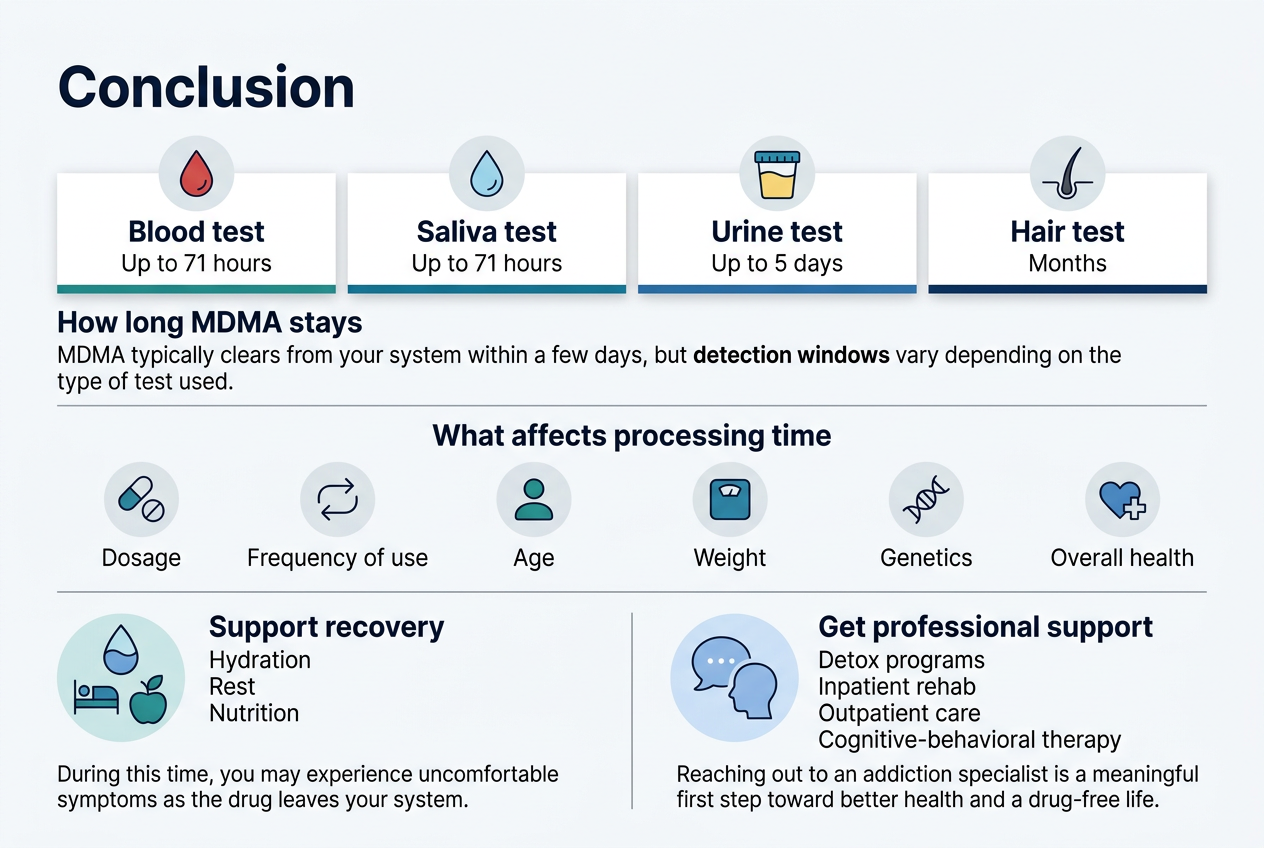
MDMA typically clears from your system within a few days, but detection windows vary depending on the type of test used. Blood and saliva tests can detect it for up to 71 hours, urine tests for up to 5 days, and hair tests for months. How quickly your body processes MDMA depends on factors like dosage, frequency of use, age, weight, genetics, and overall health. During this time, you may experience uncomfortable symptoms as the drug leaves your system, making proper hydration, rest, and nutrition important for supporting your recovery.
If concerns about MDMA use go beyond passing a drug test, it may be time to seek professional support. Treatment options such as detox programs, inpatient rehab, and outpatient care can help address dependency and any co-occurring substance use. Cognitive-behavioral therapy has shown to be especially effective in treating ecstasy addiction. Reaching out to an addiction specialist is a meaningful first step toward better health and a drug-free life.
How Long Does MDMA Stay in Your System | How Long Does MDMA Stay in Your System | How Long Does MDMA Stay in Your System | How Long Does MDMA Stay in Your System | How Long Does MDMA Stay in Your System | How Long Does MDMA Stay in Your System | How Long Does MDMA Stay in Your System