
Blog
60% vs 1.3%: Psilocybin Risks and When Clinical Safety Applies


The biggest danger with psilocybin isn’t a toxic overdose, it’s a bad psychological episode in the wrong setting. Physical toxicity at typical doses is low, but the psychological risks (acute distress, paranoia, and in rare cases a psychotic break) are real, especially for people with a personal or family history of psychosis, severe bipolar disorder, uncontrolled cardiovascular disease, or pregnancy. Supervised clinical use with proper screening cuts serious-event rates far below what recreational, unsupervised use produces.
TL;DR:
- The primary danger from psilocybin is a poorly managed psychological episode, especially for individuals with personal or family histories of psychosis, bipolar disorder, or unmanaged health issues.
- Physical risks at therapeutic doses are minimal, with rare serious events mainly linked to high doses, polysubstance use, or preexisting conditions, and most side effects resolve within two days.
- Misidentified wild mushrooms pose a much greater poison risk than psilocybin itself, and using lab-tested products reduces this danger significantly.
- Most adverse psychological effects, like anxiety or paranoia, are managed in clinical settings, but unsupervised use increases the chance of persistent perceptual disorders like HPPD.
- Pre-screening and harm reduction measures, including thorough health assessment and having a sober support person, considerably lower the risk; skipping these increases the chance of dangerous outcomes.
Table of Contents
- Physical and Physiological Risks of Psilocybin
- Psychological Risks: Distress, Paranoia, Psychosis, and HPPD
- Contraindications and Who Should Not Use Psilocybin
- Drug Interactions and Medical Screening for Psilocybin
- Acute vs. Long-Term Psilocybin Risks: What the Research Actually Shows
- Clinical Supervised Use vs. Recreational, Unsupervised Use
- How to Reduce Psilocybin Risks Before and During Use
- Psilocybin Overdose Symptoms and Emergency Response
- A Straight Answer on Whether Psilocybin Is Worth the Risk
- Sources
- FAQ
Physical and Physiological Risks of Psilocybin
Psilocybin has one of the most forgiving safety profiles among controlled substances when it comes to raw toxicity. Clinical reviews describe a wide therapeutic index, meaning the dose that causes real harm sits far above the dose that produces the psychedelic effect people are actually seeking, based on dosing guidance from clinical protocols. Death from psilocybin toxicity alone is essentially not documented in the therapeutic dosing literature.
That doesn’t mean the body has an easy time of it. A systematic review and meta-analysis of six randomized controlled trials covering 528 participants found psilocybin produced significantly more of the following than placebo or comparator drugs:
- Headache
- Nausea
- Anxiety
- Dizziness
- Elevated blood pressure
Statistic Callout: Nausea occurred at nearly nine times the rate seen in comparison groups (relative risk 8.85), and dizziness came in at nearly six times the comparator rate (relative risk 5.81), according to the JAMA Network Open meta-analysis. Most of these effects resolved within 24 to 48 hours.
Rare case reports describe more serious events, including seizures, rhabdomyolysis, and stress-induced cardiomyopathy, but these show up almost exclusively in uncontrolled settings involving high doses, polysubstance use, or preexisting conditions. They’re outliers, not the expected outcome.
The physical risk that deserves more attention than it usually gets is poisoning from misidentified mushrooms. Foraged fungi that resemble psilocybin species can be lethal, and no amount of drying, cooking, or home processing neutralizes those toxins, according to the California Poison Control System. That’s a completely different hazard from psilocybin itself, but it gets lumped into the same conversation constantly.
Psychological Risks: Distress, Paranoia, Psychosis, and HPPD
Acute psychological distress is the psilocybin risk that shows up most often in both clinical trials and real-world reports. Anxiety during the session, transient paranoia, and periods of intense fear or confusion (sometimes called a “challenging experience”) happen even in monitored settings, where they’re managed with reassurance and a calm environment rather than medication.
The JAMA Network Open meta-analysis found no significant increase in paranoia or transient thought disorder across pooled trial data, which tells you something important: clinical screening removes most of the people who’d be vulnerable to those outcomes before they ever take a dose. People with a personal or family history of psychosis are routinely excluded from trials, so the low reported rates of psychotic reactions in that research don’t tell you much about what happens to someone with that vulnerability who uses psilocybin outside a screened setting.
Hallucinogen persisting perception disorder, or HPPD, is where a lot of confusion sets in. The condition involves ongoing visual disturbances, like halos, trails, or static in the visual field, that persist well after the drug has left the body.
Statistic Callout: Transient visual symptoms after psychedelic use are common, reported by roughly 40% to 60% of users in some surveys. A formally diagnosed case of HPPD, the kind that causes clinical distress or impairment, showed up in only about 1.3% of respondents in a 2023 study.
Risk factors that raise the odds of a rough psychological outcome include:
- High doses without a controlled setting
- Preexisting anxiety disorders or unaddressed trauma
- Using alone or with unfamiliar/untrusted people
- Combining psilocybin with other substances, especially stimulants or alcohol
Contraindications and Who Should Not Use Psilocybin
Some people carry enough risk that psilocybin use, clinical or otherwise, is not appropriate without a serious conversation with a clinician first. The contraindications below are drawn from clinical guidance and institutional screening protocols, not guesswork.
- Personal or family history of schizophrenia or schizoaffective disorder. Psilocybin can precipitate or worsen psychotic symptoms in people with this vulnerability, according to guidance from Memorial Sloan Kettering Cancer Center.
- Active psychosis or a history of psychotic episodes. This is a hard exclusion in essentially every clinical protocol.
- Severe bipolar disorder. Manic or mixed episodes can be triggered or intensified.
- Borderline personality disorder. Emotional dysregulation during the session carries elevated risk.
- Uncontrolled cardiovascular disease or significant arrhythmia. Psilocybin raises blood pressure and heart rate, a real problem for anyone whose cardiac status is not stable.
- Pregnancy and breastfeeding. There’s no safety data supporting use in either case, so it’s excluded categorically.
Anyone with a complex psychiatric or medical history who is still considering psilocybin, clinically or otherwise, should talk to a clinician first rather than assume their situation is “probably fine.”
Drug Interactions and Medical Screening for Psilocybin
Psilocybin’s biggest interaction risk involves serotonin. Combining it with SSRIs, SNRIs, or MAOIs raises a theoretical risk of serotonin syndrome, and some clinical protocols require a supervised taper or washout period before a session, following guidance summarized by Memorial Sloan Kettering.
Lithium is a separate concern. Several treatment protocols exclude patients who’ve taken lithium recently, since case reports link the combination to seizures, based on clinical dosing guidance. Antipsychotic medications raise similar red flags and are typically screened for individually.
There’s also a metabolic angle that rarely gets discussed. Psilocin, the active compound psilocybin converts into, is processed partly through UGT enzymes. Drugs like diclofenac and probenecid can inhibit those enzymes, potentially altering how strongly and how long psilocin’s effects last. This area is still thinly studied, so treat it as a caution rather than a settled rule.
- Full medication list review before any session, clinical or otherwise
- Cardiac history screening
- Suicidality and mental health screening
Pro Tip: If you take any prescription medication, write down the exact name, dose, and last time taken before talking to a clinician about psilocybin. Vague answers like “I’m on an antidepressant” don’t give a screener enough to work with.
Acute vs. Long-Term Psilocybin Risks: What the Research Actually Shows
Short-term trial data is fairly strong. Long-term data is thinner and comes with real caveats worth naming upfront.
| Risk category | Evidence source | Key finding |
|---|---|---|
| Acute adverse effects | Meta-analysis, 6 RCTs, N=528 | Higher headache, nausea, anxiety, dizziness, elevated blood pressure vs. comparators; most resolve in 24 to 48 hours |
| Psychotic-like symptoms | Same meta-analysis | No significant increase in paranoia or transient thought disorder |
| Transient visual symptoms | Survey data | Roughly 40% to 60% of users report some effect |
| Diagnosed HPPD | 2023 study | About 1.3% of respondents |
The JAMA Network Open meta-analysis is strong evidence, but it’s built on trial participants who were screened, prepared, and monitored by trained staff. That’s a very different population than someone taking dried mushrooms at a festival with no clinical support.
Statistic Callout: The gap between transient visual symptoms (up to 60%) and diagnosed HPPD (1.3%) is the single most misunderstood number in psilocybin safety discussions. Most people who notice lingering visual quirks never develop anything close to a clinical disorder.
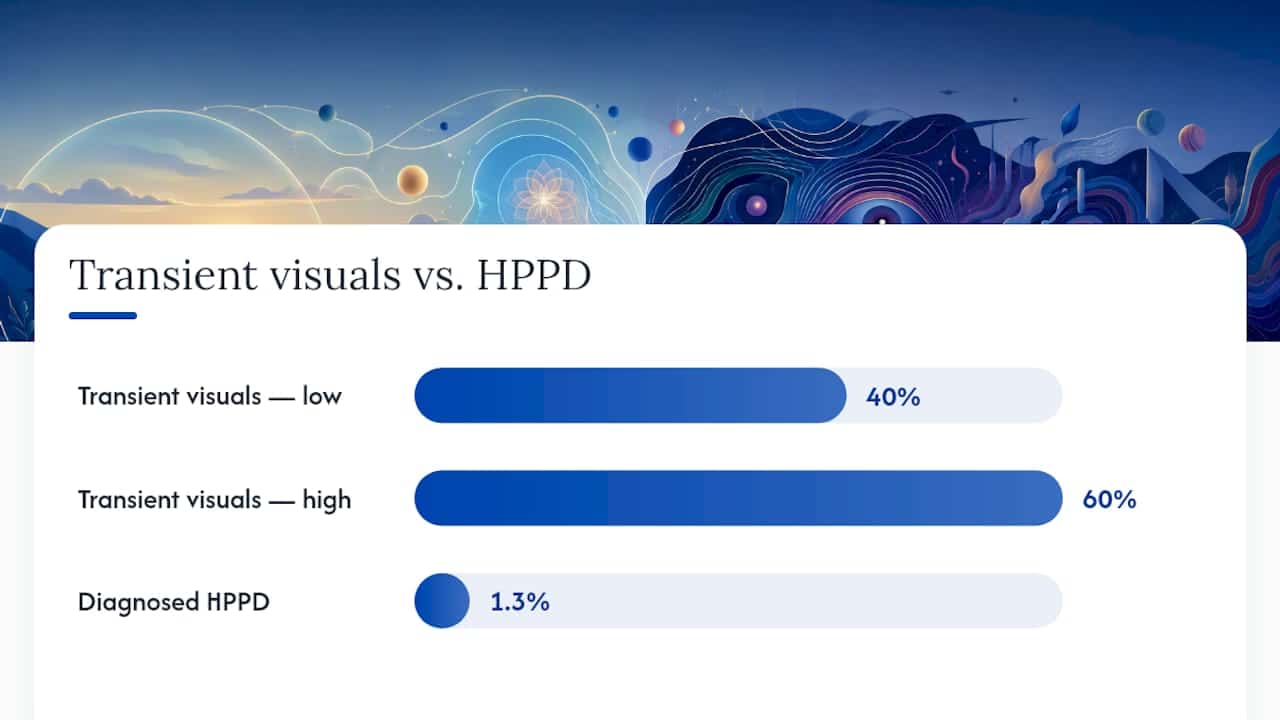
Longer-term harms documented in case series tend to trace back to a small set of contributors: excessive dose, poor set and setting, and preexisting vulnerability that wasn’t screened for. That pattern shows up again and again in the clinical literature.
Clinical Supervised Use vs. Recreational, Unsupervised Use
The difference in outcomes between clinical and recreational psilocybin use isn’t about the drug changing chemically depending on where you take it. It’s about everything surrounding the experience.
Clinical protocols build in preparation sessions before dosing, a trained facilitator present throughout the experience, a controlled and known dose, and structured integration sessions afterward to process what happened. That combination is repeatedly identified as the reason challenging experiences in trials resolve without lasting harm, according to practical clinical guidance on dosing.
Recreational use typically strips out every one of those protections:
- Dose and purity are frequently unknown
- No trained support person is present
- Mixing with alcohol or other substances is common
- There’s no plan for what happens after a difficult experience
Some protective habits from clinical research translate reasonably well to a non-clinical setting, like having a sober, trusted person present, choosing a quiet and familiar environment, and avoiding other substances entirely. But the safety numbers from trials don’t automatically transfer to someone using alone in an unfamiliar setting, and treating them as if they do is one of the more common mistakes people make when researching this. For a broader comparison of how psilocybin’s risk profile stacks up against other psychedelics like LSD and MDMA, it’s worth reading before deciding what “acceptable risk” looks like for you.
How to Reduce Psilocybin Risks Before and During Use
If you’re going to use psilocybin outside a clinical setting, or you’re preparing to ask a clinician the right questions, a handful of steps meaningfully cut your risk.
- Review your health history honestly. Screen yourself against the contraindications above before anything else.
- Check every medication you take, including supplements, for serotonergic or lithium-related interactions.
- Source lab-tested products rather than foraged mushrooms. Misidentification remains one of the most preventable causes of severe poisoning, according to the California Poison Control System.
- Start with a low dose. A dosing guide can help you calibrate a first experience rather than guessing.
- Wait out the full effect before considering more. Redosing too early is a common cause of overwhelming experiences.
- Have a sober, trusted person nearby, not necessarily guiding you, but present and calm.
- Plan for integration. Even a short conversation with someone you trust the next day helps process a difficult session.
Pro Tip: If any contraindication on this list applies to you, a supervised clinical program is a meaningfully safer route than self-administered use. Screening exists precisely to catch the risk factors you might not think to flag yourself.
Psilocybin Overdose Symptoms and Emergency Response
Most psilocybin sessions, even difficult ones, don’t require emergency intervention. But some signs mean it’s time to call for help immediately:
- Chest pain, irregular heartbeat, or signs of a cardiac event
- Seizure activity
- Loss of consciousness or unresponsiveness
- Severe, unrelenting panic that isn’t responding to reassurance
- Any symptom that could indicate poisoning from a misidentified mushroom (vomiting, severe abdominal pain, jaundice appearing hours after ingestion)
Keep the person safe from physical harm, speak calmly, and avoid leaving them alone. When you call emergency services or poison control, have this ready: what was taken, roughly how much, when it was ingested, and any medications or medical conditions involved. Emergency staff typically respond with cardiac monitoring, calming medication if agitation is severe, and testing to rule out actual poisoning rather than a psychological reaction.
A Straight Answer on Whether Psilocybin Is Worth the Risk
People want a clean yes-or-no answer on psilocybin safety, and the honest response is that the question is incomplete without asking “safe for whom, and in what setting.” The data genuinely supports a favorable physiological safety profile at researched doses. What it doesn’t support is the leap so many recreational users make: assuming that because clinical trials look safe, their unscreened, unsupervised experience will look the same.
The number that should actually change how people think about this is the gap between 60% and 1.3%, transient visual effects versus diagnosed HPPD. Most of the fear around lasting psychological damage traces back to a small number of cases, usually involving people who had risk factors nobody checked for beforehand. That’s not a reason to dismiss the risk. It’s a reason to take screening seriously instead of treating it as a formality.
If there’s one place conventional wisdom gets it backward, it’s the assumption that “natural” means low-risk. A compound can have a wide margin of physiological safety and still be genuinely dangerous for the wrong person in the wrong setting. Both things are true at once, and pretending otherwise does readers no favors.
— Alex
Sources
The clinical claims here rely on a small set of higher-quality sources rather than general internet consensus. The JAMA Network Open meta-analysis supplied acute adverse event rates across six randomized trials. The PMC clinical dosing guidance and Memorial Sloan Kettering’s psilocybin overview informed contraindications and screening protocols. The 2023 HPPD prevalence study grounded the perceptual-disorder figures, and the California Poison Control System informed the poisoning and misidentification guidance.
Fungipsilocybinmushroom’s own dosing guide and product pages, including its selection of therapy-oriented mushroom strains, reflect the same harm-reduction principles covered above, with lab-tested products intended to remove the misidentification risk entirely.
This article is general information, not a substitute for advice from a qualified doctor. Consult a qualified healthcare professional about your own circumstances before acting on anything here.
- Acute Adverse Effects of Therapeutic Doses of Psilocybin: A Systematic Review and Meta-Analysis | JAMA Network Open
- Therapeutic use of psilocybin: Practical considerations for dosing and administration – PMC
- Psilocybin | Memorial Sloan Kettering Cancer Center
- Prevalence and correlates of hallucinogen-persisting perception disorder following classic psychedelic use (2023)
- Magic Mushrooms (Psilocybin) Safety | California Poison Control System
FAQ
How Risky Is Psilocybin, Really?
Physiologically, the risk is low at researched doses, with no documented lethal toxicity in clinical trials. The real risk sits in the psychological domain: acute distress, and for vulnerable individuals, the chance of triggering a psychotic episode.
Who Shouldn’t Use Psilocybin?
People with a personal or family history of schizophrenia, active psychosis, severe bipolar disorder, or borderline personality disorder should avoid it, along with anyone with uncontrolled cardiovascular disease or who is pregnant or breastfeeding, per guidance from Memorial Sloan Kettering.
Is Psilocybin Hard on the Liver?
Psilocybin isn’t flagged in clinical literature as a significant liver toxin at studied doses, and reviews of therapeutic dosing note a wide safety margin rather than organ toxicity concerns. The bigger physical risks documented in trials are cardiovascular (elevated blood pressure) and gastrointestinal (nausea), not hepatic.
Is Psilocybin Less Harmful Than Alcohol?
Direct head-to-head risk comparisons weren’t part of the clinical trial data reviewed here, but psilocybin’s favorable therapeutic index and lack of documented lethal overdose stand in contrast to alcohol’s well-established toxicity and dependence risks. That said, psilocybin carries its own distinct psychological risks that alcohol does not, so “less harmful” depends heavily on which harm category you’re weighing.
What Is HPPD and How Common Is It?
HPPD is a condition involving persistent visual disturbances after psychedelic use. Formal diagnosis is uncommon, affecting about 1.3% of respondents in a 2023 study, even though transient visual symptoms are reported by a much larger share of users.
Recommended
- How to Dose Magic Mushrooms
- Understanding MACRO Macrodose Psilocybin Capsules: A Comprehensive Guide to Effects, Safety, and Legal Considerations
- Microdosing Psychedelics: Unveiling Remarkable Health Benefits and Therapeutic Potential
- Psilocybin Depression Treatment California: Your Complete Guide to Legal Mushroom Delivery Services and Therapeutic Options