
Blog
24–48 Hour Psilocybin Toxicity: Clinical Triage and Lab Tested Safety

Psilocybin has one of the widest safety margins of any psychoactive compound, and lethal poisoning from the drug itself is essentially unheard of in clinical literature. The real hazards are psychological, meaning severe anxiety, disorientation, and behavior that leads to injury, plus the danger of eating a misidentified toxic mushroom instead of a genuine psilocybin species. Effects begin within an hour and usually resolve within a day, and most cases need nothing more than a calm setting and reassurance rather than aggressive medical intervention.
TL;DR:
- Most adverse effects like nausea, headache, and anxiety typically resolve within 24 to 48 hours without medical intervention.
- The primary danger stems from psychological reactions causing disorientation or panic, which may lead to injury if alone or in unsafe environments.
- Psilocybin’s toxicity at the molecular level is very low, with no established lethal dose and animal studies showing no neuronal damage.
- Serious complications are mostly linked to unsafe behavior or misidentification of toxic mushrooms, not the pharmacology of psilocybin itself.
- Using lab-tested products, starting with low doses, and having a sober, familiar sitter significantly reduce the risks associated with recreational use.
Table of Contents
- What Does Psilocybin Toxicity Actually Look Like?
- How Toxic Is Psilocybin at the Molecular Level?
- How Long Do the Effects Last?
- What Should You Do If Someone Is Having a Bad Reaction?
- Who Should Avoid Psilocybin Entirely?
- What Are the Rare but Serious Complications?
- How Can You Reduce the Risk Before You Ever Take a Dose?
- What Resources Help You Assess Product Safety?
- Why Clinical Data and Real-World Use Tell Different Stories
- Choosing Tested Product Over Guesswork
- Where to Learn More
- Sources
- FAQ
What Does Psilocybin Toxicity Actually Look Like?
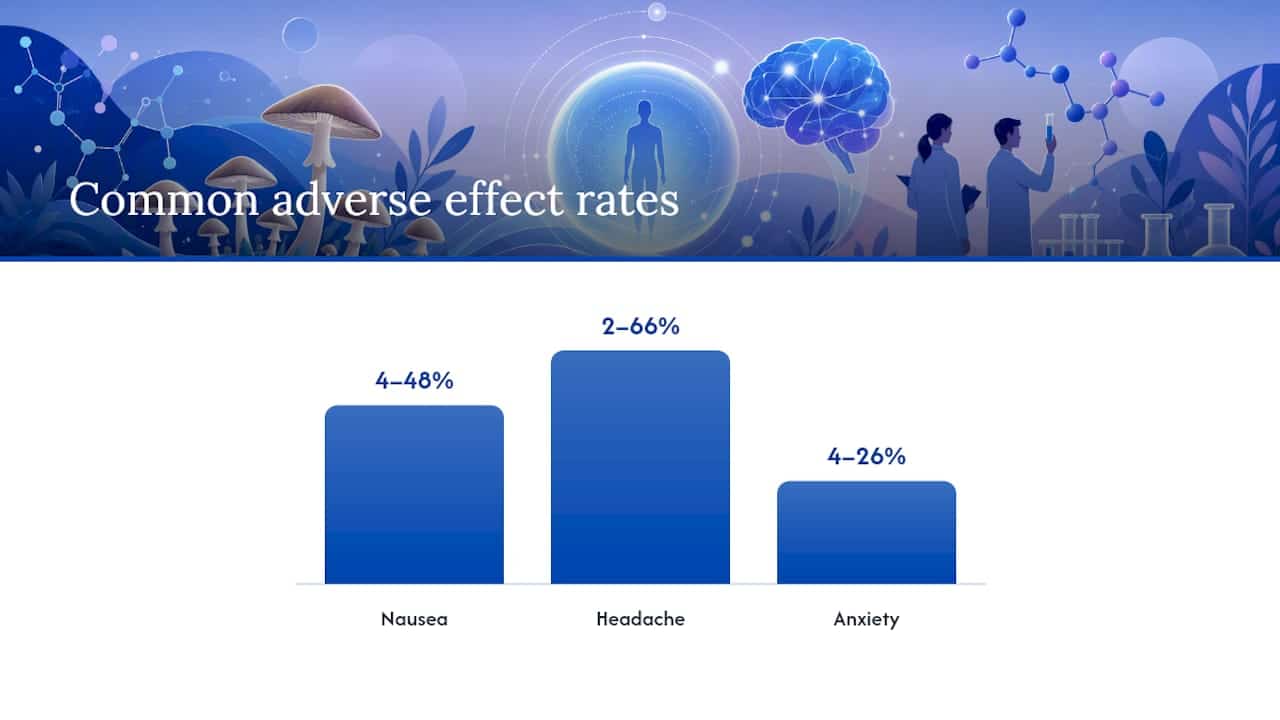
Most people who take psilocybin experience a predictable cluster of physical effects that would alarm a first-time user but rarely require treatment. Nausea shows up in 4% to 48% of cases depending on dose and setting, headache in 2% to 66%, and anxiety in 4% to 26%, according to a review of emergency visits linked to magic mushroom use. Heart rate and blood pressure tend to climb temporarily, mirroring the body’s general stress response rather than signaling organ damage.
Statistic Callout: Nausea (4–48%), headache (2–66%), and anxiety (4–26%) are the most commonly reported adverse effects, and nearly all resolve within 24 to 48 hours without medical treatment.
The psychological presentation is where things get more variable and, for some users, more frightening. Common findings include:
- Visual and auditory hallucinations, ranging from mild pattern distortion to full perceptual shifts
- Acute anxiety or panic, sometimes escalating into paranoia
- Ego dissolution, a loss of the usual sense of a separate self, which can feel profound or deeply destabilizing depending on preparation and setting
- Confusion or disorientation that impairs judgment about physical safety
- In rare cases, severe agitation bordering on a transient psychotic state
The injury risk rarely comes from the drug’s chemistry. It comes from a disoriented person climbing something, wandering into traffic, or panicking near water. Emergency clinicians see this pattern often enough that trauma, not toxicology, is the more common reason for a psilocybin-related ER visit.
Children and older adults deserve separate attention. A child who accidentally ingests mushrooms can show more pronounced gastrointestinal upset and unpredictable behavioral change relative to body weight, and any pediatric exposure warrants a call to poison control regardless of apparent severity. Older adults, particularly those with existing cardiovascular disease, are more vulnerable to the transient blood pressure and heart rate increases that younger, healthier users tolerate without issue. Red flags that justify emergency evaluation in any age group include chest pain, seizure activity, loss of consciousness, or agitation severe enough to risk harm to the person or others.
How Toxic Is Psilocybin at the Molecular Level?
Psilocybin itself is a prodrug. Once ingested, the body converts it into psilocin, the active compound that binds to serotonin 5-HT2A receptors in the brain and produces the perceptual and mood effects associated with a psychedelic experience. That receptor activity also disrupts the default mode network, the brain circuit tied to self-referential thought, which is part of why users report altered senses of identity and time.
What psilocybin does not do, at typical doses, is threaten vital organs. Reviews of clinical-trial data describe a favorable safety profile with a notably large therapeutic index, indicating a wide margin between effective and harmful doses, though exact ratios vary with factors like purity and individual health.
Neurotoxicity is a separate question from acute overdose, and here the animal data are reassuring rather than alarming. A study mapping brain tissue in rats found no HSP70 expression, a marker of neuronal injury, after psilocybin exposure. In contrast, ketamine and other NMDA receptor antagonists did trigger that marker in the same model. This suggests psilocybin may not cause the neuronal damage seen with some dissociative drugs, though animal findings may not fully predict human safety.
A few structural points explain why psilocybin’s toxicity profile differs so much from what people expect:
- No known lethal dose has been established in human clinical settings, unlike alcohol or opioids
- The compound does not appear to accumulate in tissue or cause cumulative organ stress with typical use patterns
- Clinical trials that screen participants and monitor them closely report low rates of serious adverse events
- The dominant real-world danger is not psilocybin at all: it is misidentifying a toxic wild mushroom as a psilocybin species, which can cause liver failure or death from unrelated toxins
That last point deserves emphasis because it gets lost in casual conversations about “mushroom overdose.” Amatoxin-containing species like Amanita phalloides look nothing like psilocybin mushrooms to a trained mycologist, but to an untrained forager they can be mistaken for one, and cooking or drying does not neutralize the toxins. Deaths attributed to “magic mushrooms” in emergency literature are frequently traced back to this kind of misidentification rather than psilocybin itself.
How Long Do the Effects Last?
Timing follows a fairly consistent arc across users, which is part of why harm-reduction planning works as well as it does. According to guidance from California Poison Control, symptom onset usually occurs within an hour after ingestion, with effects lasting several hours depending on dose and individual metabolism.
The progression generally breaks down like this:
- 0 to 60 minutes: Early autonomic symptoms appear first, including nausea, mild sweating, and a faster heartbeat, sometimes accompanied by a rising sense of anticipation or unease.
- 1 to 3 hours: Peak perceptual effects set in, with visual distortions, altered thought patterns, and emotional intensity reaching their height.
- 3 to 6 hours: The experience gradually levels off, though residual perceptual changes and fatigue can persist.
- 6 to 12 hours: Most acute effects resolve, leaving many users with a lingering sense of mental clarity or, alternatively, exhaustion.
- 24 to 48 hours: Nearly all physical symptoms, including headache and lingering nausea, fully resolve by this point for the large majority of users.
Delayed reactions are uncommon but worth knowing about. A small subset of users report Hallucinogen Persisting Perception Disorder, or HPPD, where visual disturbances like trailing lights or geometric patterns recur weeks or months after the original experience. This appears rare relative to total use, and current evidence does not point to a reliable predictor for who develops it, though prior anxiety disorders and heavy hallucinogen use are frequently discussed as possible risk factors.
What Should You Do If Someone Is Having a Bad Reaction?
The overwhelming majority of adverse psilocybin reactions resolve with environmental management alone, not medication. That single fact changes how a rescuer, sitter, or clinician should approach the situation.
Pro Tip: Before assuming a “bad trip” needs medical intervention, try moving the person to a quiet, dimly lit room with one calm, familiar person present. A change in surroundings resolves the majority of acute panic reactions without any drug intervention at all.
- Create a low-stimulation environment. Dim lighting, reduced noise, and a small number of familiar, calm people work better than a crowded or chaotic space. Remove sharp objects, open flames, or anything the person could trip over or fall from.
- Stay present and speak calmly. Simple, reassuring statements, reminding the person the effects are temporary and drug-induced, help ground someone experiencing anxiety or paranoia. Avoid arguing with hallucinations or dismissing what they’re describing; validate the feeling while gently redirecting attention.
- Monitor vital signs informally. Watch for breathing difficulty, chest pain, or a level of confusion that seems out of proportion to a typical trip. This is where a companion who stayed sober earns their keep.
- Escalate to emergency services when specific red flags appear. These include seizures, loss of consciousness, chest pain, severe agitation that risks injury to the person or others, signs of self-harm, or any airway or breathing compromise. Do not wait to see if it passes.
- In a clinical setting, benzodiazepines are the first-line pharmacologic option for agitation that does not respond to a calm environment. Emergency toxicology references to describe diazepam dosing in the range of 5 to 10 mg IV for adults as a typical starting point, titrated to effect. Midazolam is another option cited in the same guidance.
- Antipsychotics are used cautiously, if at all. Some clinicians reach for sedating antipsychotics in refractory cases, but these carry a risk of lowering seizure threshold and are generally considered second-line behind benzodiazepines.
- Document everything and involve a poison control consult when uncertainty exists, particularly if the substance ingested is not confirmed to be psilocybin, if a child or older adult is involved, or if symptoms seem disproportionate to what psilocybin alone typically causes.
There is no antidote to psilocybin. Every management approach described here is supportive, meaning the goal is to keep the person safe and comfortable while the drug clears the system on its own. If you’re planning ahead of an experience rather than reacting to one already underway, the guide to avoiding a bad mushroom trip covers preparation steps that reduce the odds you’ll ever need this section.
Who Should Avoid Psilocybin Entirely?
Certain histories change the risk calculation enough that psilocybin should be avoided outright or only considered under close clinical supervision. Clinical trial protocols consistently exclude people with schizophrenia, bipolar disorder, and serious cardiovascular disease, and that exclusion criteria reflects real risk, not overcaution.
Statistic Callout: Reviewers behind clinical dosing protocols note that a personal or family history of psychosis, uncontrolled bipolar disorder, or unmanaged serious heart disease are among the most consistently cited exclusion criteria in trial screening.
Key contraindications and interaction concerns include:
- Personal or family history of psychosis or schizophrenia. Psilocybin can trigger or worsen psychotic symptoms in vulnerable individuals, and this risk appears to persist even years after a psychotic episode has resolved.
- Uncontrolled bipolar disorder. The mood-altering effects of psilocybin can potentially destabilize mood cycling in people whose bipolar disorder is not well managed.
- Pregnancy and breastfeeding. There’s no established safety data for fetal or infant exposure, so avoidance is the standard recommendation.
- SSRIs, SNRIs, and other serotonergic medications. Combining these with psilocybin raises a theoretical risk of serotonin syndrome, though published case reports remain scarce. Clinical guidance still recommends careful medication screening and, in supervised settings, a supervised taper before dosing.
- MAOIs and tricyclic antidepressants. These carry a similar theoretical serotonergic risk and are generally treated as a reason for extra caution or avoidance.
- UGT enzyme inhibitors. Psilocin is metabolized in part through UGT1A9 and UGT1A10 pathways. Drugs or substances that inhibit these enzymes could theoretically prolong or intensify psilocin’s effects, an area where research is still developing.
None of this is a one-size-fits-all checklist. A person on a low-dose SSRI with no psychiatric history is in a very different risk category than someone with a first-degree relative who has schizophrenia, and any decision involving current medications should include an honest conversation with a prescribing clinician rather than a guess based on a forum post.
What Are the Rare but Serious Complications?
Severe outcomes from psilocybin exist in the medical literature, but they cluster around indirect causes far more than direct pharmacological toxicity. Case reports and emergency department reviews describe trauma, acute kidney injury, seizures, and cardiac arrhythmia tied to psilocybin use, but these events are consistently linked to unsafe behavior during intoxication, coingested substances, or preexisting undiagnosed conditions rather than psilocybin acting as a direct organ toxin.
The most-discussed long-term concerns break down into two categories:
- HPPD (Hallucinogen Persisting Perception Disorder): Recurring visual disturbances after the drug has fully cleared the body. Current estimates suggest this is rare relative to total psilocybin use, though exact incidence figures are difficult to pin down given inconsistent diagnostic criteria across studies.
- Persistent psychosis risk: Documented mainly in individuals with preexisting vulnerability to psychotic disorders rather than emerging spontaneously in psychiatrically healthy users.
- Reported deaths involving psilocybin are overwhelmingly linked to trauma, coingested substances, or misidentified toxic mushroom species rather than psilocybin toxicity in isolation.
Set against these rare case reports, controlled clinical-trial data tell a more reassuring story. Trials that screen out high-risk participants and monitor dosing sessions closely report few serious adverse events, a gap that highlights how much screening and supervision reduce risk compared to unsupervised recreational use. The takeaway isn’t that psilocybin is risk-free. It’s that the risk profile changes dramatically based on who is taking it, in what setting, and under what supervision.
How Can You Reduce the Risk Before You Ever Take a Dose?
Harm reduction for psilocybin starts long before ingestion, and most serious incidents trace back to a step that got skipped here rather than anything unpredictable about the drug itself.
- Know your source. Lab-tested product removes the biggest variable in psilocybin safety: not knowing what you’re actually taking. Foraging wild mushrooms without expert-level identification skills is where the most severe poisonings originate, not from psilocybin itself.
- Start low and go slow. Conservative dosing, especially for first-time users, reduces the odds of an overwhelming psychological reaction. A structured dosing approach beats guessing based on someone else’s experience.
- Control set and setting. A comfortable, familiar environment and a stable emotional state going in matter as much as the dose itself. A sober sitter who knows the plan and stays present the entire time is one of the single highest-value harm-reduction steps available.
- Skip the alcohol and other substances. Mixing psilocybin with alcohol, stimulants, or other psychoactive drugs increases unpredictability and complicates any emergency response if one becomes necessary.
- Store products securely. Keep mushrooms and edibles clearly labeled and out of reach of children and pets. An unlabeled edible in a shared fridge is a common and entirely preventable source of accidental pediatric exposure.
- Know when to call poison control. If an accidental ingestion happens, especially involving a child, call poison control immediately and be ready to describe what was taken, roughly how much, when it happened, and any symptoms observed so far.
Pro Tip: Photograph any product before consuming it, including packaging and any lab-testing information available. If an adverse reaction happens, that photo gives poison control or an emergency clinician something concrete to work from instead of a vague description.
What Resources Help You Assess Product Safety?
Reducing psilocybin’s risk profile comes down largely to controlling the one variable users can actually manage: knowing exactly what they’re taking. Fungipsilocybinmushroom built its process around that idea, using lab testing to verify potency and screen for contamination before any product reaches a customer.
That approach shows up across a few practical resources:
- Strain-specific information that helps users understand potency differences between varieties, rather than treating “mushrooms” as one uniform product
- Dosing guidance aimed at conservative titration for people new to psilocybin
- Safety pages addressing interactions and precautions beyond the psychotropic medication list covered earlier in this guide
- Background material on how psilocybin compares to other psychedelics people frequently ask about, including DMT and LSD
None of this replaces a conversation with a physician or pharmacist, particularly for anyone managing psychiatric medication or a complex medical history. What it does is close the information gap that leads most people into risky situations in the first place, whether that’s an unverified street product or a dose calculated by guesswork instead of a plan.
Why Clinical Data and Real-World Use Tell Different Stories
The gap between what clinical trials show and what happens in unsupervised settings is the single most misunderstood part of the psilocybin safety conversation. Trials succeed partly because of the drug and partly because of everything wrapped around it: screening out people with psychotic disorders, controlling dose precisely, and having trained staff present for hours. Strip away those safeguards, and the risk profile shifts, not because the pharmacology changed, but because the guardrails did.
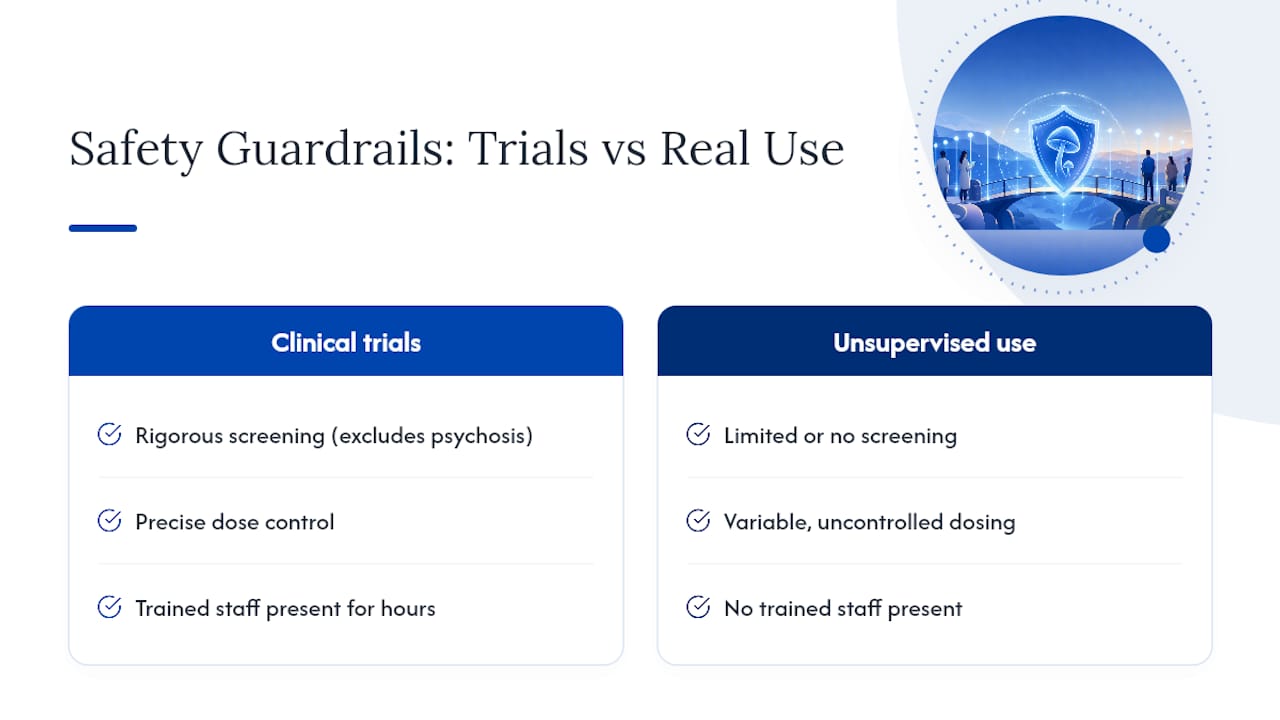
That’s not an argument against psilocybin. It’s an argument for treating “set, setting, and screening” as seriously as dose. Anyone with a complicated psychiatric history, a heart condition, or a long medication list owes it to themselves to talk to a clinician before assuming they fall into the low-risk category most safety data describes. The people getting hurt aren’t usually the ones asking these questions ahead of time. They’re the ones who skipped that step entirely.
There’s also an honest gap in the research that deserves more attention than it gets: long-term data on repeated recreational use, outside the structure of a clinical trial, remains thin. Until that gap closes, cautious, informed use, backed by verified product and realistic expectations, is the most defensible position anyone can take.
— Alex
Choosing Tested Product Over Guesswork
Foraging carries the poisoning risk, and unverified street product carries the potency guesswork. An alternative to both is to use lab-tested products for potency and contamination before shipping, discreetly, wherever ordered. That removes the single biggest variable this entire article has been about, not knowing what’s actually in front of you.
For anyone planning a first experience, the smartest place to start isn’t a strain page, it’s the dosing guide, which walks through conservative titration so you’re not calculating a first dose from a stranger’s forum post. From there, browsing tested options like the Amazonian psilocybin mushroom line gives you a verified starting point instead of an unknown one. This is educational and product information, not medical advice. Anyone with a psychiatric history, cardiovascular condition, or current medication concerns should talk to a clinician before deciding anything.
Where to Learn More
A few sources back the clinical claims throughout this guide and are worth bookmarking directly:
- California Poison Control’s psilocybin safety page covers acute management, dosing timelines, and misidentification warnings.
- The PMC review on emergency treatment after magic mushroom use breaks down adverse effect incidence rates in detail.
- PMC’s dosing and administration review outlines clinical screening protocols and contraindications.
- UVA Toxicology’s clinical reference details emergency department management and medication dosing.
This article is general information, not a substitute for advice from a qualified doctor. Consult a qualified healthcare professional about your own circumstances before acting on anything here.
Sources
- Adverse experiences resulting in emergency medical treatment after use of magic mushrooms (PMC)
- Magic Mushrooms (Psilocybin) Safety — California Poison Control
- Therapeutic use of psilocybin: Practical considerations for dosing and administration (PMC)
- Psilocybin — UVA Toxicology (PDF)
FAQ
Is Psilocybin Toxic to the Body?
Psilocybin has low direct physical toxicity and a wide margin between an effective and a dangerous dose, with clinical trials reporting few serious organ-related adverse events in screened, supervised settings. The greater risk comes from psychological effects and unsafe behavior during intoxication, not organ damage from the drug itself.
How Long Does Mushroom Toxicity Take to Resolve?
Effects typically begin within 15 to 60 minutes, peak within a few hours, and resolve within 24 to 48 hours for the large majority of users. Symptoms lasting significantly longer, or involving confusion out of proportion to a typical trip, warrant medical evaluation.
What Is Ego Death With Psilocybin?
Ego dissolution describes a temporary loss of the usual sense of a separate self, a common feature of moderate to high psilocybin doses that some users describe as profound and others find deeply distressing. Research suggests it often correlates with positive therapeutic outcomes in supervised clinical settings, but it can trigger severe panic in unsupervised or poorly prepared circumstances.
Is Psilocybin Bad for the Brain?
Preclinical research mapping neuronal injury markers found no evidence of the neurotoxic signal seen with some other drugs like ketamine, suggesting psilocybin doesn’t cause that type of structural brain damage at studied doses. Long-term human data on repeated use outside clinical settings is still limited, so caution and conservative use remain reasonable.
Can You Overdose on Psilocybin?
A fatal overdose from psilocybin alone is exceptionally rare in medical literature, largely because of its wide therapeutic index. Most severe outcomes tied to “mushroom overdose” trace back to misidentified toxic species, coingested substances, or injury during intoxication rather than psilocybin’s own pharmacology.
Recommended
- How to Dose Magic Mushrooms
- How to Avoid a Bad Mushroom Trip: Complete Guide to Safe Psychedelic Experiences 2026
- How Long Does a Magic Mushroom Trip Last? Guide | Where to buy Magic Mushroom | 3.5g Magic Mushroom For Sale
- Understanding MACRO Macrodose Psilocybin Capsules: A Comprehensive Guide to Effects, Safety, and Legal Considerations 2026