
Blog
4 Quick Field Tests Growers Use to Tell Mycelium From Mold

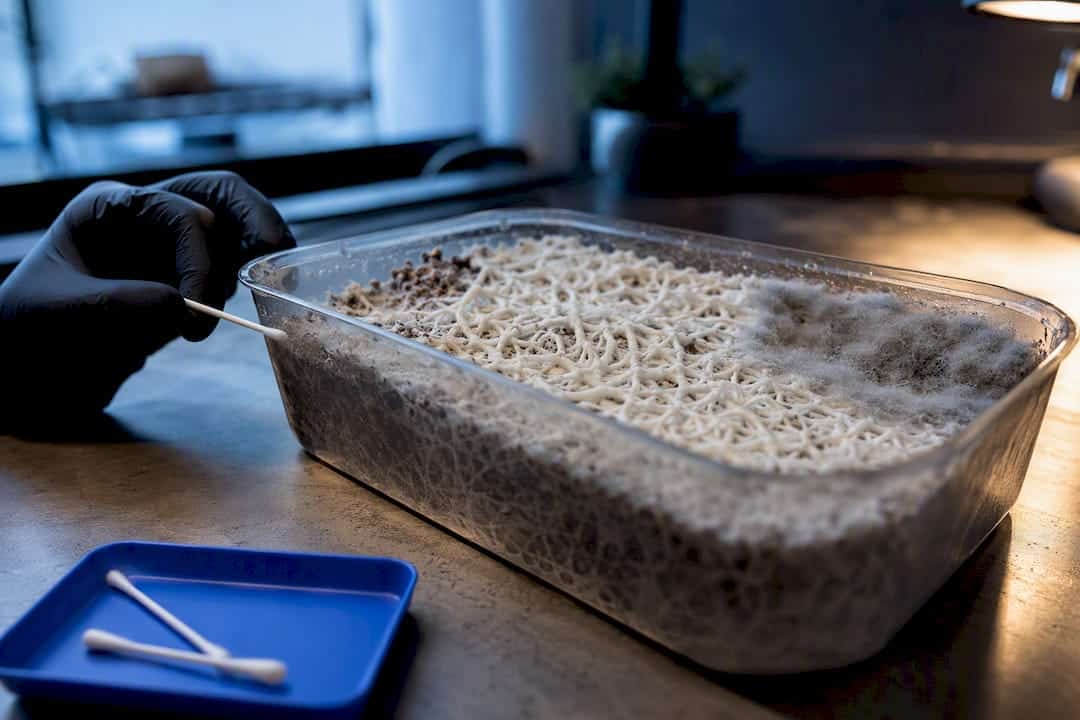
If what you’re looking at is bright white, dense, and hugging the substrate, it’s almost certainly healthy mycelium. If it’s dull gray, wispy, and climbing up into the air above your growing medium, treat it as cobweb mold until proven otherwise. The fastest way to settle it: watch for a 24 to 48 hour growth burst, or grab a bottle of 3% hydrogen peroxide and spray a test spot.
TL;DR:
- Healthy mycelium grows at 1 to 2 centimeters per day, remains low in the substrate, and has a dense, chalky white appearance.
- Cobweb mold can cover a tub within 24 to 48 hours, lifts above the substrate, and shows a wispy, grayish or dingy white texture.
- Applying hydrogen peroxide or performing a Q-tip test quickly reveals mold by dissolving it or transferring pigment, distinguishing it from healthy mycelium.
- High humidity combined with stagnant air creates ideal conditions for cobweb mold, so proper fresh-air exchange and sanitation are critical for prevention.
- Early detection of contamination, within the first 48 hours, using visual cues or simple tests, greatly improves the chances of salvage or containment.
Table of Contents
- Mycelium vs Mold: The Visual Differences That Matter Most
- How Do You Run a Peroxide or Q-Tip Test?
- Should You Isolate, Salvage, or Discard the Grow?
- What Should Your Grow Room Environment Look Like?
- Where Can You Find Reliable Grow Guidance?
- What Molds and Mycelium Species Actually Show Up in Cultivation?
- How Does Contamination Progress Visually Over Time?
- Does Mold Contamination Actually Hurt Your Yield?
- Can Magnification Help You Confirm What You’re Looking At?
- A Grower’s Take on Staying Calm Through Contamination Scares
- Ready to Start With Cleaner Spawn and Better Odds?
- Sources
- FAQ
Mycelium vs Mold: The Visual Differences That Matter Most
Growers panic first and check facts second, which is backward. The good news is that mycelium and mold rarely look alike once you know what to check, and the differences show up in four places: color, texture, speed, and direction of growth.
Healthy mycelium is bright, opaque white, almost chalky in its density, and it spreads at a fairly modest 1 to 2 centimeters per day. It stays low, colonizing outward through the substrate rather than up into the air. Cobweb mold, by contrast, is grayish or dingy white, thin as spun cotton, and it doesn’t stay put. It lifts 0.5 to 1 inch above the substrate surface and can blanket an entire tub in 24 to 48 hours, a pace healthy mycelium never matches.
Smell is a secondary clue worth trusting. Mycelium usually carries a mild, earthy, almost mushroomy scent. A sour, musty, or chemical odor is a signal something else has moved in, even if the color still looks close to white.
| Feature | Healthy Mycelium | Cobweb / Mold Contaminant |
|---|---|---|
| Color | Bright, opaque white | Gray tinted, dingy, or dull white |
| Texture/density | Dense, ropy, tomentose | Wispy, thread-like, airy |
| Growth speed | About 1 to 2 cm/day | Can cover a tub in 24 to 48 hours |
| Growth direction | Hugs the substrate | Lifts into headspace |
| Smell | Mild, earthy | Sour, musty, or chemical |
| Response to disturbance | Holds shape | Collapses easily |
A few field notes that separate the two at a glance:
- Mycelium appears integrated into the substrate surface, firmly attached.
- Cobweb mold tends to lie loosely on the surface, delicate and easily disturbed.
- Some green molds like Trichoderma can initially appear white before changing color later, so a white patch does not guarantee safety.
- Gently blowing near the patch may cause cobweb mold to wave or collapse, which mycelium does not.
How Do You Run a Peroxide or Q-Tip Test?
You don’t need a lab to get a real answer here. Four checks, done in order of speed and cost, will tell you almost everything you need to know.
- Hydrogen peroxide spray. Mix or use straight 3% hydrogen peroxide from the pharmacy and mist a small amount directly onto the suspicious patch. Cobweb mold visibly melts or dissolves within seconds. Healthy mycelium shows little to no reaction, maybe a slight sheen, nothing more.
- Fan or breath test. A light puff of air or a few seconds under a small fan tells you a lot. Cobweb collapses or waves like a spider web in a breeze. Mycelium holds its structure because it’s actually rooted into the substrate.
- Photo-marking and time-lapse. Circle the suspicious spot with a marker on the outside of the container, snap a photo, and check again in 24 hours. Growth that’s crept well past your mark in a day is growing far faster than mycelium’s normal pace.
Pro Tip: Run the peroxide test on a small corner first, not the whole patch. If it’s mycelium, you’ll want to keep the rest of that colonization intact, not soak it.
Should You Isolate, Salvage, or Discard the Grow?
Containment comes before diagnosis. Move any suspect tub away from your other grows immediately and avoid opening lids or disturbing the surface, since agitation can send spores airborne and cross-contaminate an entire grow room.
Some situations call for an immediate discard, no debate needed:
- Green, black, pink, or powdery patches, especially with visible sporulation
- A strong sour, chemical, or rotten smell coming off the substrate
- Growth that’s doubled or tripled overnight, far outpacing normal colonization
- Contamination that’s spread past 50% of the substrate surface
Early-stage cobweb, caught before it sporulates, sometimes responds to a peroxide spray followed by re-covering and close observation for another day. This works best when the contamination is small and isolated, not when it’s already spread across a wide area. When in doubt, discard the batch and start clean rather than risk your health on a borderline call.
What Should Your Grow Room Environment Look Like?
Cobweb mold thrives in one specific combination: very high humidity paired with stagnant, poorly exchanged air. Fix that combination and most cobweb problems disappear before they start.
Keep relative humidity in the moderate range typical for fruiting, generally high but avoid condensation pooling on surfaces or allowing the substrate to become waterlogged. Standing moisture is basically an invitation. Pair that humidity with real fresh-air exchange, several times a day if you can manage it, so the headspace doesn’t turn into a stagnant, humid box where mold spores settle and germinate uninterrupted.
Sanitation matters just as much as climate. Wipe down tools and work surfaces with isopropyl alcohol before handling substrate, and avoid touching your grow with unwashed hands. Cobweb spores are everywhere in ambient air, waiting for the right conditions.
- Keep humidity high enough to fruit, but never let substrate sit wet or waterlogged.
- Run fresh-air exchange multiple times daily to avoid a stagnant, humid headspace.
- Sanitize tools, hands, and work surfaces before every substrate handling session.
- Take a daily photo of your grow and mark anything suspicious for a 24 hour recheck.
Pro Tip: A small personal fan on low, aimed near but not directly at your grow, does more for fresh-air exchange than most growers expect, and it costs less than a bag of substrate.
Where Can You Find Reliable Grow Guidance?
Good identification skills only get you so far if your setup or spawn was compromised from the start. That’s where sourcing and instructions matter as much as the peroxide bottle in your kit.
- A step-by-step grow kit guide walks through colonization timelines so you know what “normal” looks like before day 10 ever arrives.
- The full cultivation guide covers environmental setup in detail, which is where most contamination problems actually start.
- A troubleshooting FAQ is worth checking before you write off a whole grow as a loss.
Lab-tested spawn matters here too. Contamination that shows up in week one is sometimes traceable back to spawn quality rather than anything the grower did. Starting with tested material removes one entire category of guesswork from the identification process.
What Molds and Mycelium Species Actually Show Up in Cultivation?
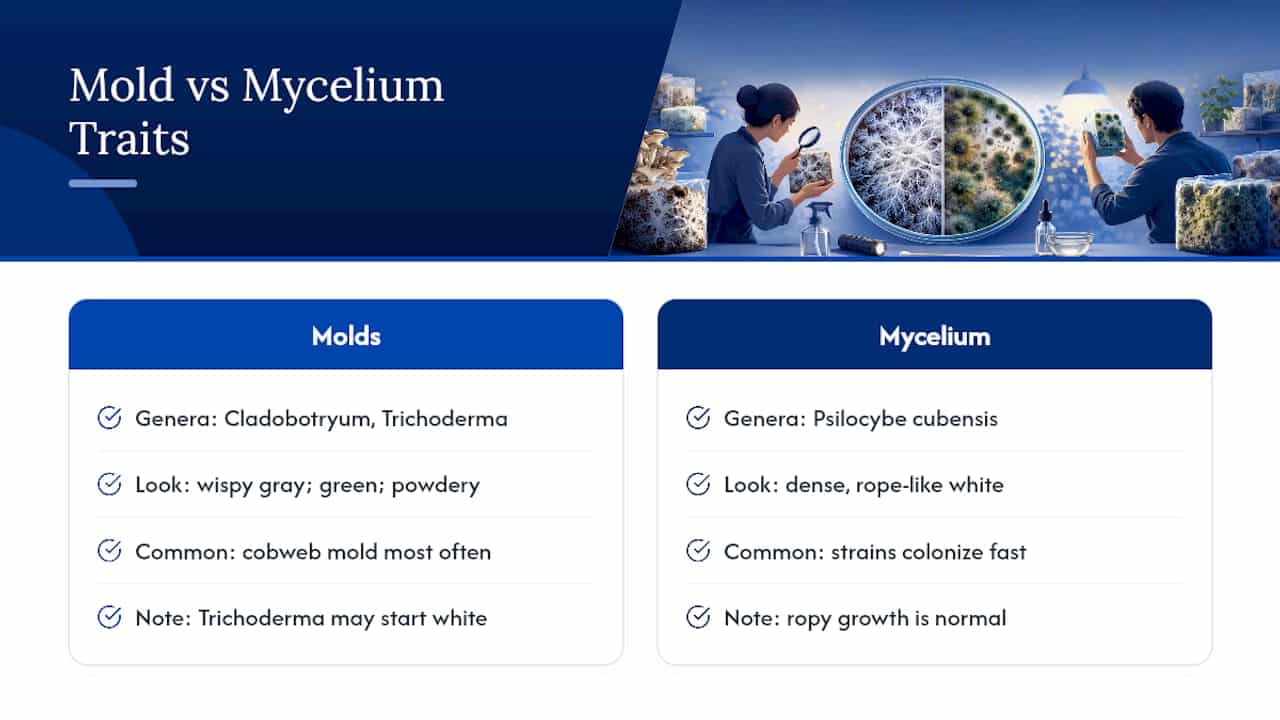
Not every contaminant looks or behaves the same, and knowing the usual suspects speeds up your diagnosis. Cobweb mold, caused by species in the Cladobotryum genus, is the one growers run into most often, recognizable by that wispy, gray, cotton-candy texture drifting above the substrate.
Trichoderma species show up as aggressive green mold, though as noted earlier, they can start deceptively white before the color shift kicks in. Penicillium brings the classic blue-green, powdery look, often with a distinct musty smell. Black mold, usually Aspergillus or similar species, is less common on grain or straw but shows up occasionally on overly wet substrate.
On the mycelium side, cultivated species differ visually too. Psilocybe cubensis strains, including popular varieties like Golden Teacher, tend to produce dense, rope-like white mycelium that colonizes fast once established. Some strains run noticeably ropier or more rhizomorphic than others, which is normal strain variation, not a warning sign.
Taxonomically, molds and mushroom-forming fungi often sit in entirely different branches of the fungal kingdom, a distinction the NCBI Taxonomy database catalogs in detail. That’s a useful reminder that “mold vs fungus” isn’t really the right framing. Mold is a fungus. So is mycelium. The real question is always which specific organism you’re looking at.
How Does Contamination Progress Visually Over Time?
Contamination rarely announces itself on day one. It builds in a fairly predictable sequence, and knowing the stages helps you catch problems before they’re unsalvageable.
In the first 24 hours, a contaminant patch usually looks like nothing more than a slightly fuzzy or off-white dot, easy to mistake for normal mycelium pinning. By hour 48, if it’s cobweb, that dot has usually tripled in size and started lifting visibly off the surface. Pigmented molds like Trichoderma or Penicillium tend to hold a whitish appearance through this stage too, which is exactly why the Q-tip and color-tracking checks matter more than a single glance.
By day 3 to 4, color typically resolves. Green, black, or blue-green pigment becomes obvious, and any lingering doubt usually disappears. Cobweb mold, if left alone, can blanket an entire substrate surface in that same window, which is faster than almost any healthy colonization stage.
The takeaway: the earlier you catch a contaminant, visually or through testing, the more options you have. A patch identified at hour 12 is a spot treatment. The same patch ignored until day 4 is usually a total loss.
Does Mold Contamination Actually Hurt Your Yield?
Yes, and often more than growers expect from a small-looking patch. Contamination competes directly with your intended fungus for nutrients and substrate real estate, and it releases metabolites that can slow or stall pinning even in areas that look untouched.
A contaminated tub that isn’t fully discarded often produces a noticeably smaller flush, smaller fruit sizes, and sometimes fruit with off coloring or texture near the contamination site. Mold pressure also raises the risk of secondary contamination during later flushes, since spores from an early cobweb outbreak can linger in your grow space and reappear on subsequent batches if sanitation isn’t tightened up.
The financial and time cost adds up quickly too. Substrate, spawn, and weeks of colonization time all get lost if a tub has to be scrapped, which is exactly why early identification through the peroxide and Q-tip tests pays off. Catching contamination at the pinhead stage, rather than after it’s spread across half the tub, is often the difference between a partial loss and a total one.
Can Magnification Help You Confirm What You’re Looking At?
A basic 30x to 60x jeweler’s loupe or a cheap USB microscope adds a level of confidence the naked eye can’t match, especially for growers who deal with contamination often enough that it’s worth the small investment.
Under magnification, healthy mycelium shows clear, uniform hyphal strands, often described as looking like fine white threads woven tightly together. Cobweb mold, under the same magnification, looks noticeably thinner and more erratic, with hyphae that branch out in a looser, spider-web pattern rather than a dense weave.
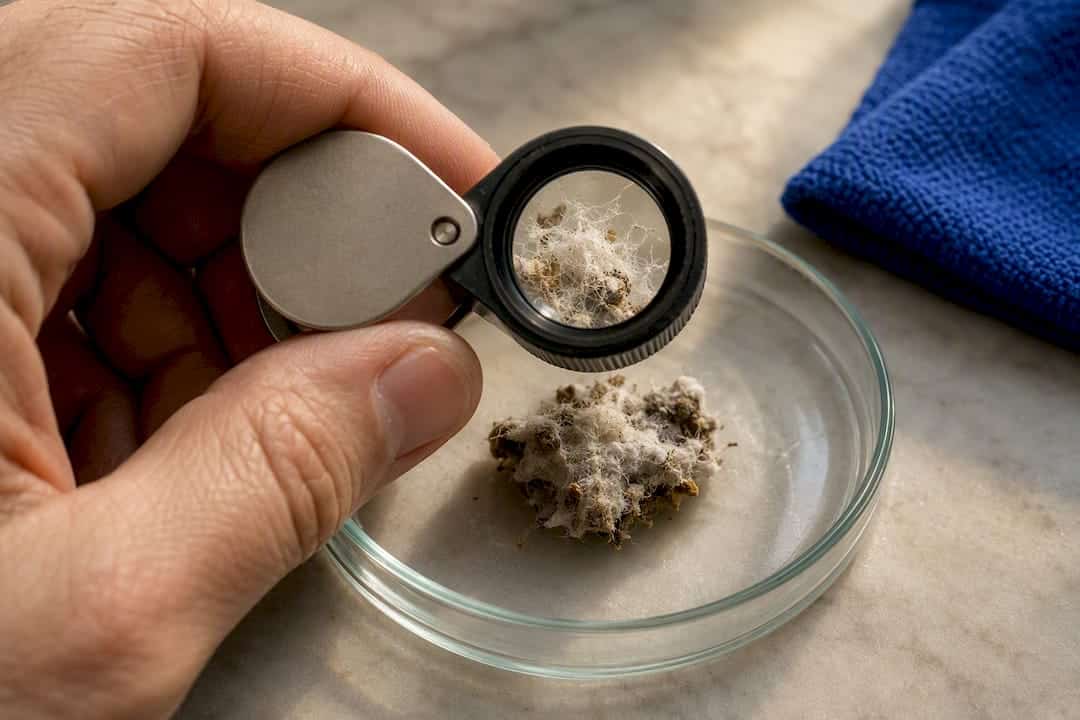
Magnification won’t replace the peroxide or Q-tip tests, and it’s not necessary for every grower. But if you’re running multiple grows at once, or if you’ve had recurring contamination issues you can’t quite pin down, a $15 to $20 loupe pays for itself the first time it saves you from tossing a perfectly healthy tub of mycelium.
A Grower’s Take on Staying Calm Through Contamination Scares
Most fuzzy white patches growers panic over turn out to be normal aerial mycelium, not mold. Slow down, check the growth pattern and the fan test, and photograph before deciding anything. A rushed discard costs you a whole grow; a careful 24-hour check rarely costs you anything.
— Alex
Ready to Start With Cleaner Spawn and Better Odds?
Every test in this guide gets easier when you start with lab-tested spawn instead of gambling on unknown sourcing. Some grow kits available on the market go through lab testing before shipping, which can reduce the incidence of mystery patches and allow more colonization time spent growing rather than troubleshooting.

If you’re building your first setup or replacing a contaminated batch, the grow kit and cultivation guide walks through timelines, humidity targets, and troubleshooting steps in order, so you’re not guessing at what “normal” looks like on day 5. Ready to start fresh? Browse the current mushroom and grow kit selection and pick a strain suited to your setup, then follow the guide step by step from spawn to first flush.
Sources
- Cobweb Mold vs. Mycelium – Fungi Academy
- Mushroom Growing Tips — Contamination ID
- Cobweb Mold vs Mycelium: Tell the Difference Fast – MycoMansion
FAQ
Is Mycelium Harmful to Humans?
Healthy, properly identified mycelium from a food-grade or cultivated mushroom species is not harmful to touch or be around. Problems come from actual mold contaminants like Trichoderma or Penicillium, not from mycelium itself.
Is Eating Mycelium Good for You?
Mycelium from edible mushroom species is commonly consumed and forms the basis of several mycelium-based food products, but you should never eat mycelium from a tub that showed any signs of contamination, discoloration, or off odors.
Is Mycelium Mold Toxic?
Mycelium itself isn’t mold and isn’t toxic, but true mold contaminants like Trichoderma or Aspergillus can produce compounds that cause allergic reactions or illness, which is why identification tests matter before you consume anything from a questionable grow.
Is This White Mold or Mycelium?
Run the peroxide test first: a spot that visibly collapses within seconds under 3% hydrogen peroxide is mold, while unaffected white growth that’s dense and hugging the substrate is almost certainly healthy mycelium.
Recommended
- Next Level 100% Mycelium B+ Magic Mushroom Grow Kit Guide
- Grow B+ Mushrooms with 100% Mycelium: Fast Colonization, Massive Flushes, and Rock-Solid Results
- Magic Mushroom Grow Kit FAQ: All Questions & Solutions 2026
- How to Grow Magic Mushrooms at Home: The Secret Method Experts Don’t Want You to Know 2day