
Blog
Shrooms Drug Test: Federal Panels Skip Psilocin, DoD Added It in 2026

Standard workplace drug tests don’t screen for psilocybin or psilocin, so a routine 5-panel or 10-panel test almost never flags mushroom use. Specialized mass-spectrometry tests can detect psilocin, but the window is short, often around 24 hours in urine. The real exceptions are military programs, court-ordered testing, and forensic toxicology, where labs sometimes order psilocin specifically.
TL;DR:
- Routine workplace drug tests rarely detect psilocybin or psilocin because standard panels do not include these substances and specialized tests are costly.
- Psilocin has a detection window of about 24 hours in urine and less than a day in blood, making detection difficult after this period without targeted testing.
- Specialized mass spectrometry methods like LC-MS/MS or GC-MS are necessary for definitive detection, and most agencies only order these when legally or medically justified.
- The Department of Defense began testing for psilocin in 2025, making military testing an exception to typical civilian screening policies.
- False positives for shrooms on standard panels are rare, and confirmatory testing is essential to verify any initial positive result.
Table of Contents
- Does a Shrooms Drug Test Show Up on Standard Panels?
- How Long Does Psilocybin Stay in Your System?
- When Do Labs Order a Specialized Psilocybin Test?
- What Actually Changes Your Detection Risk?
- Can a Drug Test Give a False Positive for Shrooms?
- What Do the Federal Guidelines and Research Say?
- What Should You Actually Do If You’re Worried About a Test?
- Sources
- FAQ
Does a Shrooms Drug Test Show Up on Standard Panels?
The immunoassay panels used by most employers, from pre-employment screens to random workplace checks, are built to catch a fixed list of substances: THC, cocaine, opiates, amphetamines, and PCP. Psilocybin and its active metabolite psilocin aren’t on that list, and they never automatically enter it just because a lab is running a “drug test.” Building a test that also flags psilocin costs more and requires a different chemistry setup, so unless someone specifically orders it, it won’t appear.
That’s the core reason so many people search “do shrooms show up on a drug test” and get conflicting answers. The honest answer depends entirely on what kind of test is being run and who ordered it.
Standard immunoassay panels (5-panel, 10-panel): built for common street and prescription drugs, not psilocin. These are the tests used for most employment screening, and psilocybin detection isn’t part of the design.
Here’s how detection windows break down by sample type when a lab does order psilocin-specific testing:
| Sample type | Typical detection window | Notes |
|---|---|---|
| Urine | Around 24 hours | Some anecdotal reports suggest longer windows, but pharmacokinetic evidence supports a detection window generally around one day |
| Blood | Less than a day | Psilocin clears quickly from plasma |
| Saliva | Only several hours | The shortest practical detection window among sample types |
| Hair | Up to 90 days | Rarely used and less reliable for psilocin specifically |
| Nails | Potentially months | Longest theoretical window, but almost never tested in practice |
The hair and nail numbers deserve a caveat. Laboratory studies have detected psilocin in hair samples using LC-MS/MS methods, but the concentrations involved are low and the validation data behind hair testing for mushrooms is thinner than it is for drugs like cocaine or opioids. Most labs won’t build a case on a hair result alone.
How Long Does Psilocybin Stay in Your System?
Psilocybin itself barely exists in the body for long. Once swallowed, it converts almost immediately into psilocin, the compound actually responsible for the psychedelic effects and the one any lab test would need to target.
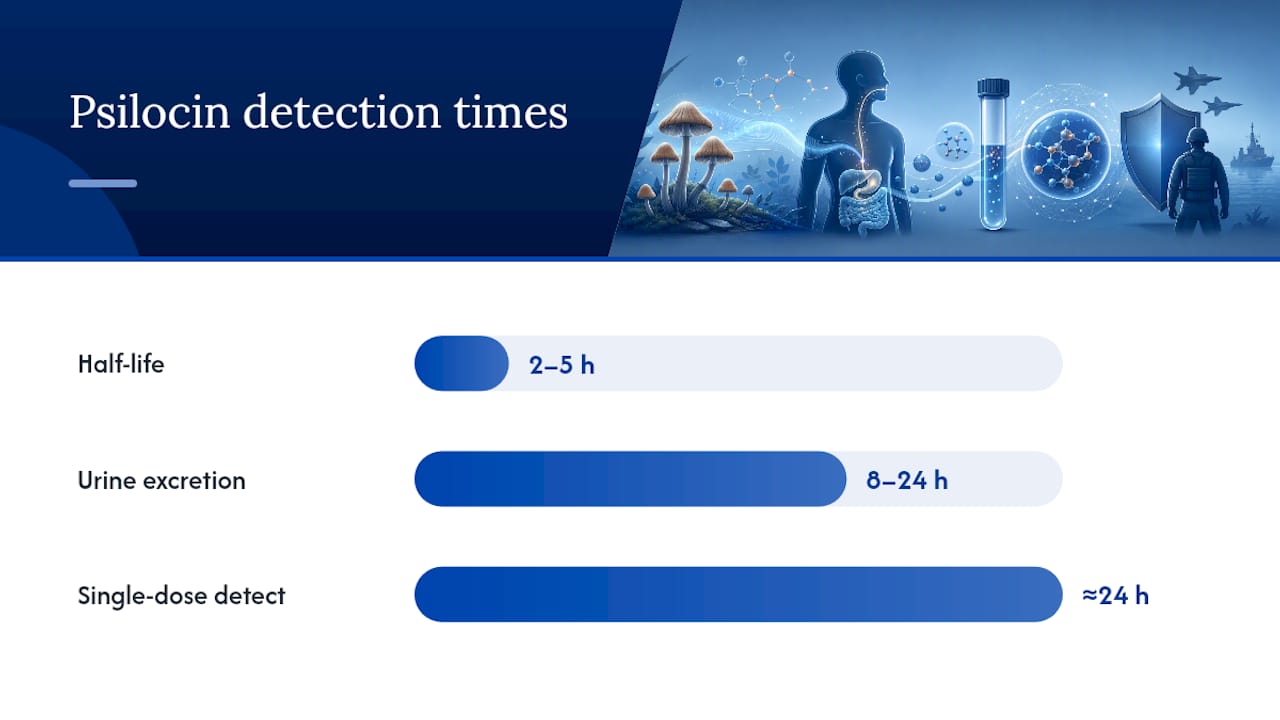
Psilocin’s elimination half-life runs roughly 2 to 5 hours, and the bulk of what gets excreted in urine shows up within the first 8 to 24 hours after ingestion. That’s a narrow biological window by any standard, far shorter than THC’s, which can linger for weeks in frequent users.
A few things shape how that timeline plays out in practice:
- Single, moderate doses clear fastest, often falling below detectable levels within a day.
- Repeated or heavy use over several days can extend residual traces, though solid data on this pattern is still limited.
- Body composition and liver function affect how quickly any individual metabolizes and excretes psilocin.
- Occasional use doesn’t build up the way chronic use of some other drugs does, since psilocin doesn’t store in fat tissue.
The takeaway is straightforward. Because breakdown happens fast and excretion front-loads into the first day, the practical detection window is genuinely narrow. Someone who takes mushrooms on a Friday night has a very different risk profile than someone testing 12 hours later versus five days later.
When Do Labs Order a Specialized Psilocybin Test?
Nobody accidentally gets tested for shrooms. Psilocin testing requires a deliberate decision by whoever ordered the panel, and that decision tends to show up in a handful of specific contexts.
- Court and probation orders, where a judge or supervising officer has specified psilocin as a monitored substance.
- Forensic investigations, including autopsies or incident-related toxicology where psychedelic use is suspected.
- Clinical toxicology after an emergency room visit, when a patient’s symptoms suggest hallucinogen use and doctors need to confirm it.
- Certain military programs, most notably the Department of Defense, which added psilocin to its drug testing program starting October 1, 2025.
When labs do go looking for psilocin, they rely on LC-MS/MS or GC-MS, mass spectrometry methods that can identify the compound with high specificity. These tests cost significantly more per sample than a standard immunoassay strip, which is exactly why routine employer screening skips them.
Federal policy backs this up directly. The Mandatory Guidelines for Federal Workplace Drug Testing Programs don’t include psilocin among the authorized analytes for routine federal panels. Individual agencies can request biomarker authorization for a specific substance, which is essentially what the DoD did, but that’s an opt-in exception, not the federal default.
What Actually Changes Your Detection Risk?
Two people who took the same dose at the same time can produce completely different results depending on a handful of variables.
- Dose and frequency matter most. A larger dose or repeated use over several days pushes more psilocin through the system and can extend the window slightly.
- Metabolism and physiology, including age, liver function, and body composition, change how fast any individual clears the compound.
- Timing relative to ingestion is the single biggest factor. Testing 6 hours after use versus 36 hours after use produces wildly different odds of a positive result.
- Lab cutoffs and method decide whether anything shows up at all. A screening immunoassay that doesn’t even target psilocin will report negative no matter what’s in the sample, while a confirmatory mass-spec test ordered specifically for psilocin is far more sensitive.
Home “detox” drinks and flushing tricks don’t meaningfully change any of this. Psilocin’s clearance is driven by liver metabolism and kidney excretion on its own biological timeline, not by how much water someone drinks beforehand.
Pro Tip: If you know a specific test date and are worried, timing matters more than any detox product on the market. Understanding how dosing amounts affect how much psilocin enters your system is more useful than any last-minute trick.
Can a Drug Test Give a False Positive for Shrooms?
Cross-reactivity with psilocin on standard panels is uncommon, mostly because those panels aren’t built to look for it in the first place. A false positive specifically attributed to mushrooms is rare in practice, largely because the screening step usually isn’t even chemically capable of flagging it.
The real accuracy question comes down to which stage of testing produced the result.
- Screening immunoassays are fast and cheap but not built to target psilocin on standard panels.
- Confirmatory testing with LC-MS/MS or GC-MS is what labs use when a result needs to hold up legally or clinically, and it identifies psilocin with high specificity.
- A Medical Review Officer (MRO) typically reviews any non-negative result before it becomes official, giving the tested person a chance to explain or contest it.
If you’re ever notified of a positive result tied to psilocybin, ask two direct questions: which analyte triggered the flag, and whether confirmatory mass-spec testing was run. A presumptive screen alone shouldn’t be treated as a final answer.
What Do the Federal Guidelines and Research Say?
The policy and science line up cleanly on this topic, which is part of why the answer to “will I fail a shrooms drug test” is more consistent than people expect.
- Federal workplace testing guidelines set the baseline most private employers follow, and psilocin isn’t part of that authorized panel for routine screening.
- Pharmacokinetic research confirms psilocin’s short half-life and rapid urinary excretion, which is the biological reason detection windows stay narrow.
- The DoD’s 2025 policy expansion shows that individual agencies can and do diverge from the federal default when they have a specific reason to test for it.
Those three facts together explain almost every real-world scenario a reader might face, from a routine pre-employment screen to a military drug panel.
What Should You Actually Do If You’re Worried About a Test?
Three things matter more than anything else here: routine tests won’t catch mushroom use, targeted tests can but only within a short window, and the panel type determines everything. If a test is coming up, find out who ordered it and which analytes it covers. Request confirmatory testing if a result seems wrong, and loop in medical or legal counsel for anything court-related. Testing policy keeps shifting, so what’s true in 2026 may not hold in a few years.
— Alex
Sources
- Federal Register, Volume 91 Issue 49 (Friday, March 13, 2026)
- Pharmacokinetics review (doi:10.1007/s40262-017-0540-6)
- Journal of Analytical Toxicology – screening and confirmation methods (doi:10.1093/jat/bkv067)
If you’re researching psilocybin for reasons beyond drug testing, whether that’s therapeutic interest or simple curiosity about strains and dosing, Fungipsilocybinmushroom carries lab-tested products including dried mushrooms, capsules, and edibles with discreet worldwide shipping. Readers exploring how different consumption methods affect experience and timing might also find the dosing guide useful before making any decisions.
This article is general information, not a substitute for advice from a qualified doctor. Consult a qualified healthcare professional about your own circumstances before acting on anything here.
FAQ
Do Shrooms Show Up on a Standard Workplace Drug Test?
No. Standard 5-panel and 10-panel immunoassay tests don’t screen for psilocybin or psilocin unless an employer specifically orders a specialized panel.
How Long Do Shrooms Stay in Your Urine?
Psilocin is typically detectable in urine for around 24 hours, with some anecdotal reports suggesting longer windows, but pharmacokinetic evidence supports detection generally around one day.
What Test Method Can Actually Detect Psilocybin?
LC-MS/MS and GC-MS are the confirmatory laboratory methods capable of reliably detecting psilocin, but they’re expensive and rarely included in routine employer screening.
Does the Military Test for Psilocybin?
Yes. The Department of Defense added psilocin to its drug testing program starting October 1, 2025, making military testing a notable exception to civilian routine practice.
Can You Get a False Positive for Shrooms on a Drug Test?
It’s uncommon, since most standard panels don’t chemically target psilocin at all. A confirmed positive typically requires a specialized test ordered specifically for that analyte.